 A Space for Thoughtful

QTI 101: A Beginner’s Guide to the Question and Test Interoperability Standard
Summarize with:
The Question and Test Interoperability (QTI) Standard has been a game-changer in the world of digital assessments. Introduced back in 1999 by the IMS Global Learning Consortium, it aimed to enable organizations to exchange assessment questions and content, particularly in digital assessments. The shift to online learning in recent years has only increased the need for such interoperability and accessibility.
At its core, QTI is the most widely used standard for marking up assessments, quizzes, and exams. Technically, it is a ZIP file that contains quiz data in XML form along with all of its associated multimedia content. This specification enables the communication and exchange of assessment content across various platforms and systems. It effectively prevents a situation where all your valuable data is locked in with specific vendors or trapped in incompatible formats.
In this comprehensive guide, we cover everything you need to know about the QTI standard. We’ll explore how it is revolutionizing the creation, distribution, and management of assessments for educators and institutions.
Table of Contents:
- What is Question and Test Interoperability?
- Key Components of QTI
- The Purpose and Importance of QTI Standards
- The Many Benefits of QTI Standards
- Key Applications: Where to Use QTI
- Ensuring Accessibility and Equity with QTI
- A Step-by-Step Guide to QTI Assessment Integration
- Best Practices for Creating QTI-Compliant Assessments
- Why Is There a need for QTI Compliance?
- Summing Up
What is Question and Test Interoperability?
Question and Test Interoperability (QTI) is an XML-based standard developed by the IMS Global Learning Consortium for the easy exchange, or interoperability, of assessment content. It allows for the convenient and faster sharing of tests, questions, and results data between different learning management systems (LMS) and assessment tools.
Integrating QTI assessments into educational platforms helps ensure that your test or assessment content is interoperable, scalable, and reusable. This is especially relevant for educational institutions and organizations that wish to streamline their assessment processes and enhance the flexibility of their digital learning environments.
There are three major versions available: QTI 1.x, 2.x, and the recently released QTI 3. Most modern LMS platforms today support both QTI 1.2 and 2.1, with some older systems only supporting QTI 1.2. The standard identifies everything from formats and protocols to points of interoperability that save users and suppliers time and money in the development, delivery, and outcomes of assessments.
Key Components of QTI
There are three key components of the QTI standards that enable this powerful interoperability. These include the following:
1. Data Model
The data model defines the framework or the structure of the assessment, including the questions, their respective answers, the scoring rules, and the overall metadata. In other words, it works as a blueprint for the creation of tests, dictating the structure of questions, tests, and results using XML data binding.
2. Packaging Format
The packaging format refers to how assessments are packaged and shared across different systems and platforms. This is the component that ensures a test created in one system can be understood and rendered correctly in another, regardless of the underlying technology.
3. Delivery and Scoring
The delivery and scoring protocols control how tests are delivered to the learner and the criteria based on which they are scored or calculated. This ensures consistency in how assessments are presented and graded, which is crucial for valid and reliable results.
The Purpose and Importance of QTI Standards
QTI standards are designed primarily to facilitate easy interoperability between various systems and bring sophistication to the entire assessment ecosystem. In simple terms, the purpose of QTI is to:
- Offer a structured content format for educators and publishers to store and exchange items independent of the authoring tool used to create them.
- Provide a standard format for storing and exchanging complete tests independent of the test construction tool.
- Support the seamless deployment of item banks across multiple learning and assessment delivery systems.
- Enable systems to report test results consistently and interpretably.
- Allow for the easy deployment of items, item banks, and tests from diverse sources into a single delivery system.
- Capture and exchange individual student results for specific items or entire assessments across multiple contexts.
This standardization is vital in a learning environment where institutions often use a combination of different systems, LMSs, and assessment tools.
The Many Benefits of QTI Standards
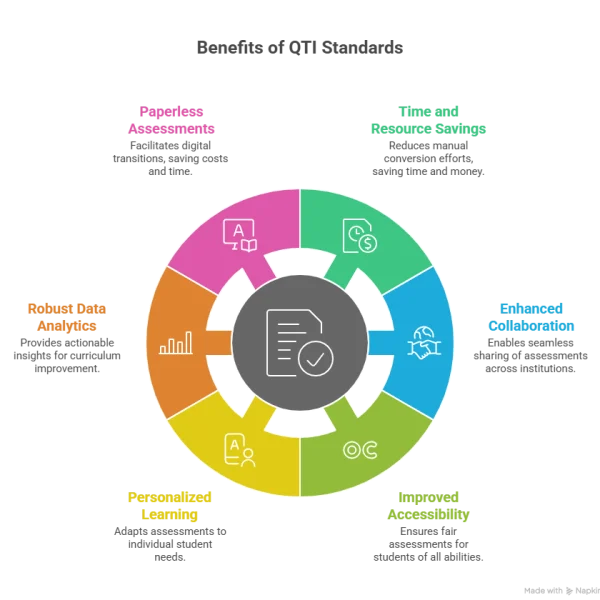
Adopting QTI standards can be highly beneficial for teachers, curriculum designers, and educational institutions. By allowing assessments to be created once and deployed in a range of situations, QTI delivers significant advantages.
1. Helps Save Time, Money, and Resources
The first benefit is that QTI standards help teachers and publishers save a great deal of time, preventing them from having to manually convert questions for different formats. As questions can be created once and deployed across various platforms, it saves significant time and money that can be invested in more constructive aspects of education, like content development and student support.
2. Boosts Collaboration and Efficiency
QTI standards enable the sharing of tests and questions with colleagues and stakeholders across other institutions. This allows you to bypass the restrictions often set by using different Learning Management Systems (LMS) and assessment tools. As a result, teachers across institutions can collaborate seamlessly, ensuring the same high standards of assessments across the board and improving overall efficiency.
3. Enhances Accessibility and Equity
One of the most important features of QTI standards is the incorporation of key accessibility features. This helps ensure that students of all abilities can access assessments, improving educational equity. By adhering to defined accessibility guidelines, publishers and institutions can create fair assessments that more effectively evaluate student knowledge.
4. Enables Personalized and Adaptive Learning
QTI also helps teachers create adaptive assessments based on individual student performance. Assessments can be personalized based on a student’s strengths and weaknesses, allowing them to improve their subject knowledge and retention over time. This adaptability supports diverse and engaging assessments that cater to varied learning styles.
5. Facilitates Robust Data Analytics
QTI facilitates the recording of actionable insights and data that enable teachers to offer students personalized learning based on their performance. While it can capture data from individual items, it can also aggregate data across classes, schools, districts, and even states. This data helps stakeholders contribute meaningfully to curriculum changes that benefit both students and teachers.
6. Supports Paperless, Virtual Assessments
Another key benefit is that QTI compliance enables educational institutions to move away from paper-based assessments and swiftly transition to digital assessments. This offers significant savings in costs, time, and implementation. It also facilitates the cross-institution collaboration mentioned earlier, making digital assessment ecosystems more powerful and interconnected.
Key Applications: Where to Use QTI
The primary focus of the QTI standard is on the creation, delivery, and results of assessments. Here are some of the most common applications:
1. Assessments Import/Export in Learning Management Systems
Most educational institutions use various learning management platforms. QTI standards can simplify the process of moving assessments between these platforms, eliminating the need for manual adjustments and minimizing the risk of data corruption. This ensures consistency and continuity in the assessment process.
2. Assessment Testing Platforms
Another common application is in online assessment or exam testing platforms. QTI makes the transfer of assessments easier and faster, enabling seamless integration between an LMS and third-party assessment tools.
3. Authoring Tools for Assessments
You can integrate the QTI file format into several assessment authoring tools, such as Dictera. This provides an excellent way for educators to create test questions or assessments in a standardized format from the very beginning, ensuring they are portable and reusable.
4. Creating and Authoring Assessments
QTI standards allow educators to author assessments in a simple, standardized format. By adhering to the QTI specifications during creation, users ensure compatibility and consistency, making their content future-proof and widely shareable.
Ensuring Accessibility and Equity with QTI
QTI standards play a crucial role in making online learning more accessible and equitable. The standards support compliance with federal requirements like Section 508 of the Rehabilitation Act of 1973, which requires WCAG 2.0 AA compliance. The latest versions also support accommodations commonly used in K-12 assessments.
This is addressed in several ways:
- Overcoming Format Barriers: A lack of standardized formats can create barriers to specific accessibility features. QTI addresses this by providing a consistent structure that assistive technologies can more easily interpret.
- Enhancing Equity and Adaptability: With different institutions using various tools, there is a need for equity and adaptability. QTI ensures that assessment content remains adaptable across these diverse environments, providing a level playing field for all learners.
- Supporting Diverse Question Types: QTI supports a wide range of question types, including multiple-choice, short answer, true/false, and more. This allows educators to create assessments that cater to varied learning styles and subject matter, promoting greater equity.
A Step-by-Step Guide to QTI Assessment Integration
If you are looking to integrate QTI assessments into your curriculum, here is a structured procedure to follow:
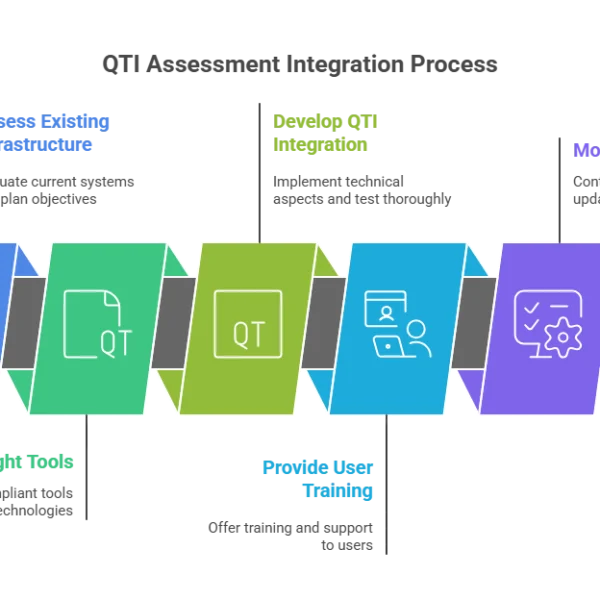
Step 1: Assess Existing Infrastructure and Plan Accordingly
First, you need to understand and evaluate your existing systems, such as the current LMS and other assessment tools in use. Clearly outline your objectives, identify the specific goals of the QTI integration, and allocate the necessary resources, including budget and technical expertise.
Step 2: Select the Right Tools and Technologies
Ensure that the LMS and assessment tools you plan to use support the required QTI standards. It’s also wise to use modern technologies or JavaScript frameworks like TypeScript and React for efficient development and integration.
Step 3: Develop the QTI Integration
This phase involves the technical implementation. You will need to develop QTI-compliant content (tests, quizzes) that adheres to the standards. Implement the XML-based data exchange mechanisms between your systems. Finally, test the integration thoroughly to ensure it works as desired and meets the goals set in the planning phase.
Step 4: Provide Proper User Training
For successful adoption, it is important to offer adequate training and support to users. Give ongoing training sessions to both educators and administrators to help them understand and use the new system effectively. Offer proper technical support to address any issues that arise during and after the integration process.
Step 5: Monitor Regularly and Keep Improving
The final step is continuous monitoring and improvement. Conduct regular reviews to assess the performance of the QTI integration. Gather feedback from users to identify areas for improvement, and make necessary updates to keep the system efficient and current.
Best Practices for Creating QTI-Compliant Assessments
Here are some best practices to follow when creating your QTI-compliant assessment questions:
1. Offer Equal Opportunities to All Learners
Your primary consideration should be giving all students a fair opportunity to demonstrate their learning.
- Validity: Test questions should purposefully relate to your course content and learning goals.
- Bias-Free: Use language that is free from bias and easily understood by all students. Avoid assuming learners understand specific slang or cultural references.
- Time and Consistency: Design questions so that all students have enough time to complete the exam. The exam should be consistent, meaning students would achieve similar results if they had to retake it.
2. Adopt Progressive Question Structures
Maintain a progressive structure in your exams. Questions should flow from easier to more challenging. This allows learners to build confidence as they tackle a variety of question types and progress through the assessment.
3. Select Appropriate Test Formats
Determine the best format to check the cognitive abilities of your students. For example, open-ended questions are ideal if you want students to compare and contrast a topic, while multiple-choice questions can efficiently test factual recall. QTI supports many formats, so choose the one that best fits your pedagogical goals.
Why Is There a need for QTI Compliance?
The primary focus of the QTI standard is the creation, delivery, and reporting of assessments. The objective is to maintain a testing ecosystem where results inform LMSs, content authoring tools, item banks, and test delivery platforms. As a result, it allows daily instruction to seamlessly synchronize with the testing process, which is why QTI is considered the gold standard in testing and interoperability.
The latest version, QTI 3.0, has introduced various features that improve upon previous iterations. It includes enhanced support for web accessibility to ensure students’ disabilities or circumstances do not hinder their access to high-quality testing. This version is also equipped with tools that play a crucial role in connecting assessments to learning.
While several vendors may claim to offer QTI compliance, the target for all should be to secure IMS-certified QTI compliance. This certification ensures they are more reliable and adhere to the stringent guidelines set by the IMS Global Learning Consortium.
Summing Up
QTI offers a sophisticated system for creating assessments in a manner that allows for them to be shared across platforms, institutions, and systems. By ensuring interoperability, promoting accessibility, and enabling robust data analytics, QTI is an essential standard for modern digital education. The latest version, QTI 3.0, continues to build on this foundation with a host of features that further improve its abilities.
If you are an educational publisher or institution looking for assessment creation tools that adhere to the highest QTI standards, check out Dictera. This AI and ML-powered QTI authoring tool, presented by Hurix Digital, seamlessly allows educators to create high-quality assessments, collaborate in real-time, and derive data-driven insights on student performance.
Connect with us today to learn more about how Hurix Digital and Dictera can transform your assessment strategy.
Summarize with:

Senior Vice President
A Business Development professional with >20 years of experience with strong capability to sell new solutions and develop new markets from scratch. New Market Entry Specialist with experience working in the largest emerging markets. Exceptional experience in conceptualizing, ideating and selling new learning technologies like VR AR, etc. across multiple industry verticals.