 A Space for Thoughtful
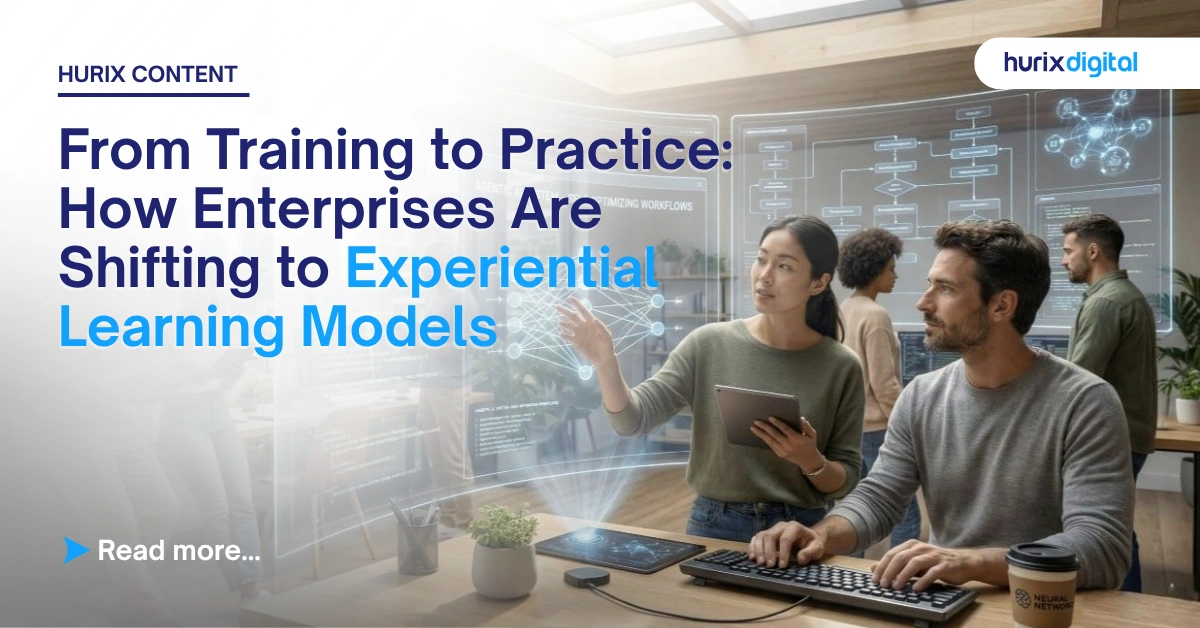
From Training to Practice: How Enterprises Are Shifting to Experiential Learning Models
Summarize with:
Your learning & development (L&D) director just led over a hundred employees through three hours of compliance training. A few weeks later, an employee in the field screws up a procedure that could have been prevented by simply doing the job. The lesson your L&D director learns (what most in learning have already discovered) is that sitting through somebody talking about how to do something is entirely different than doing the job itself.
Enterprises are trying to transform the way they develop their employees to achieve top performance. Training is not going anywhere, but for companies committed to workforce development, it is no longer enough.
Table of Contents:
- The Reality of Standard Training Approaches
- What Experiential Learning Actually Means (And Why It Matters)
- Why Enterprises Are Adopting Experiential Learning
- The Numbers Back Experiential Imperative
- The Shift From Time-Based to Competency-Based Development
- What L&D Leadership Looks Like Today?
- Getting Started: What Actually Works
- A Final Word
- Frequently Asked Questions
The Reality of Standard Training Approaches
Let’s be blunt. On average, when an employee sits through “typical corporate training”, here’s what happens. They sit in a workshop or complete an e-learning course. They learn some ideas. Perhaps watch a couple of scenarios played out. They take a test. They receive their certificate of completion. Two weeks later… POOF. Most of that knowledge is gone!
The retention rates are embarrassing. Lecture-style learning yields single-digit retention rates. While e-learning improves it to 25 to 60%. Furthermore, it costs a fortune in design, delivery, and employee time. Then the company wonders why performance hasn’t increased. That’s not a training issue. That’s an architecture issue.
What Experiential Learning Actually Means (And Why It Matters)
Experiential learning may be fashionable, but it’s really about doing learning in an optimized manner. An example of that mindset is when the employees work with scenarios, cases, or simulations modeled on actual workplace activities. They experiment. They make mistakes that don’t matter. This way, they are creating muscle memory.
This is borne out by the figures. Experiential learning methods retain 75% of what they learn. This is not just a little better. It means changing entirely how new information is encoded from short-term to long-term memory in our brains.
Studies show that when you practice something in a setting that resembles reality, your brain considers it a real experience. This is not memorizing data. Action plus reflection is how you create understanding. Your self-confidence grows as you do the work, even though it’s in a safe environment.
Basically, an employee who does 20 practice runs of the customer service scenarios in the simulator before making a real call performs consistently and measurably better than someone who attended a trainer’s lecture about customer calls.
Why Enterprises Are Adopting Experiential Learning
Experiential learning is slowly moving away from just being a nice-to-have to a strategic necessity.
First, competency expectations flipped. Executives and accreditors stopped asking “Did the employee complete the training?” and started asking “Can the employee actually do the work?” Time spent in training doesn’t matter anymore. Performance matters. That forced a recalibration of enterprise content management.
Second, technology has allowed experiential learning theory to be scaled up. With virtual reality (VR), augmented reality (AR), and sophisticated simulations becoming AI-powered, adaptable learning methods, on-the-job training for remote workers is no longer a logistical nightmare. A field engineer in Mumbai now has the same simulated environment to practice in as does a district manager in Dubai.
Finally, today’s employees expect more. They don’t want to sit through a lecture where you “talk at” instead of interacting with them. They want to be taught and can learn skills to help do their jobs better. Given the choice between a day-long classroom session that yields no practical skills and an interactive simulation that lets them practice tackling the problems they will face at work, however many times it takes to perfect their technique, workers prefer the simulation. They feel it’s likely more useful, and in every case that they have experience of, they’re right.
The Numbers Back Experiential Imperative
Virtual reality training is a particularly compelling case. PWC’s research found VR learners trained four times faster than their classroom peers. Even accounting for setup time, VR still beat traditional training by a factor of 3. A skill that took two hours to teach in a classroom took 29 minutes in VR.
If you have a dispersed workforce, as many organizations do these days, immersive experiential learning reduces travel and venue expenses, too. And it guarantees consistency. With immersive experiential learning, everyone is trained the same way. There’s no variance because Joe Trainer was teaching that day.
The Shift From Time-Based to Competency-Based Development
Traditional employee training program measures time. You went to 40 hours of training. Competency-based training measures ability. Can you do the job to expectations?
That’s important because it changes how training is developed and delivered. Rather than creating courses that cast a wide net, companies are developing tailored experiences that focus specifically on needs. Let’s say a customer service rep needs to deal with angry customers. Instead of sitting through a training course on “conflict resolution,” the company crafts a simulation with examples you’d find in the workplace. Angry customer. Product malfunction. Overcharged on the bill. The employee runs through the simulations until they show competency. Only then can they move forward.
Soft skills like leadership can be trained this way, too. Companies are developing simulations that allow managers to practice tough conversations. To give feedback. To work through conflict. They learn. They receive immediate feedback. They see what happens when they take different approaches. And when it’s time to do it for real, they’ve already practiced.
What L&D Leadership Looks Like Today?
The role of L&D is evolving faster than many organizations realize. It’s not platform administration anymore.
In organizations, getting this right, L&D leaders function as architects of learning solutions. They’re connecting experiential programs with job performance data. They’re using AI to personalize learning paths based on individual capability gaps and organizational needs. They’re embedding themselves in business initiatives to ensure development actually drives performance.
This shift also means smaller, more strategic teams. Rather than staff managing course completions, you have fewer people orchestrating systems. AI handles administrative work. Data partners track what’s actually working. Performance consultants design for real capability development.
Getting Started: What Actually Works
If you work for an organization looking to dive into experiential learning, take it one bite at a time.
Find a major problem with high risk and high frequency. Something where mistakes cost money. Something where execution discipline is important. Create a targeted experiential program around that. Test it thoroughly.
That data point will buy you some currency internally. It will also generate hard data on what “good” looks like for your organization. Grow capability over time. Your first simulation may not be up to the mark. Your first coaching program will be tiny. Don’t sweat it. You’re developing the framework for experiential growth as you learn.
Work with partners like Hurix Digital who understand your business and design thinking models. The magic happens when you pair a subject matter expert (SME) with someone who knows how to turn that expertise into experience.
A Final Word
Organizations that master experiential learning gain something difficult to replicate: faster, better-developed people.
When your team learns faster, performs better, and stays longer, that compounds. You reduce turnover costs. You spend less on remediation. You make better decisions because people have been trained to think, not just remember. You innovate faster because people have practiced problem-solving in safe environments.
Competitors copying your course might look similar. But experiential learning is built on a deep understanding of your specific challenges, your culture, and your real problems. That’s harder to copy. That becomes a capability advantage.
Ready to build enterprise learning that actually works?
Hurix Digital designs custom experiential learning programs that turn employees into capable practitioners. We work with large organizations to build simulations, immersive scenarios, and learning ecosystems that develop real capability.
Want to see how experiential learning could work for your specific challenges? Schedule a conversation with our learning architects. We’ll walk through your biggest skill gaps, discuss what experiential approaches could address them, and talk through what realistic outcomes look like for your organization.
Frequently Asked Questions(FAQs)
Q1:What is the main goal of experiential learning in a corporate setting?
The primary goal of experiential learning is to bridge the gap between theory and practice. Moving away from passive lectures, it allows employees to build muscle memory through hands-on practice. This approach ensures that learners don’t just memorize information but actually develop the competency and confidence required to perform their jobs effectively.
Q2:How does experiential education improve employee retention rates?
Experiential education leverages the “learning by doing” principle, which shifts information from short-term to long-term memory. Unlike traditional methods with low retention, practicing in realistic scenarios helps the brain encode actions as real experiences. This results in retention rates of up to 75%, significantly reducing the need for ongoing retraining.
Q3:What are some common experiential learning examples for remote teams?
Modern experiential learning examples for remote workforces include AI-powered simulations, Virtual Reality (VR) technical drills, and branching scenario-based modules. These tools allow dispersed employees to practice high-stakes tasks—like managing an angry customer or repairing complex machinery—in a safe, virtual environment that provides immediate feedback and ensures global training consistency.
Q4:Why is experiential training more effective than traditional classroom methods?
Experiential training is superior because it focuses on performance rather than just attendance. It allows for “safe failure,” where employees can make mistakes without real-world consequences. By reflecting on these actions, learners gain deeper insights, enabling them to train 4 times faster and be better prepared for the complexities of modern software and workflows.
Q5:How do organizations transition from time-based to competency-based development?
To transition, enterprises must replace broad, time-heavy courses with targeted experiential learning modules. Instead of measuring hours spent in a classroom, L&D leaders track specific performance metrics and “readiness scores.” This shift ensures that an employee only progresses once they have demonstrated the actual ability to execute a task within a simulated environment.
Summarize with:

Senior Vice President
A Business Development professional with >20 years of experience with strong capability to sell new solutions and develop new markets from scratch. New Market Entry Specialist with experience working in the largest emerging markets. Exceptional experience in conceptualizing, ideating and selling new learning technologies like VR AR, etc. across multiple industry verticals.