 A Space for Thoughtful
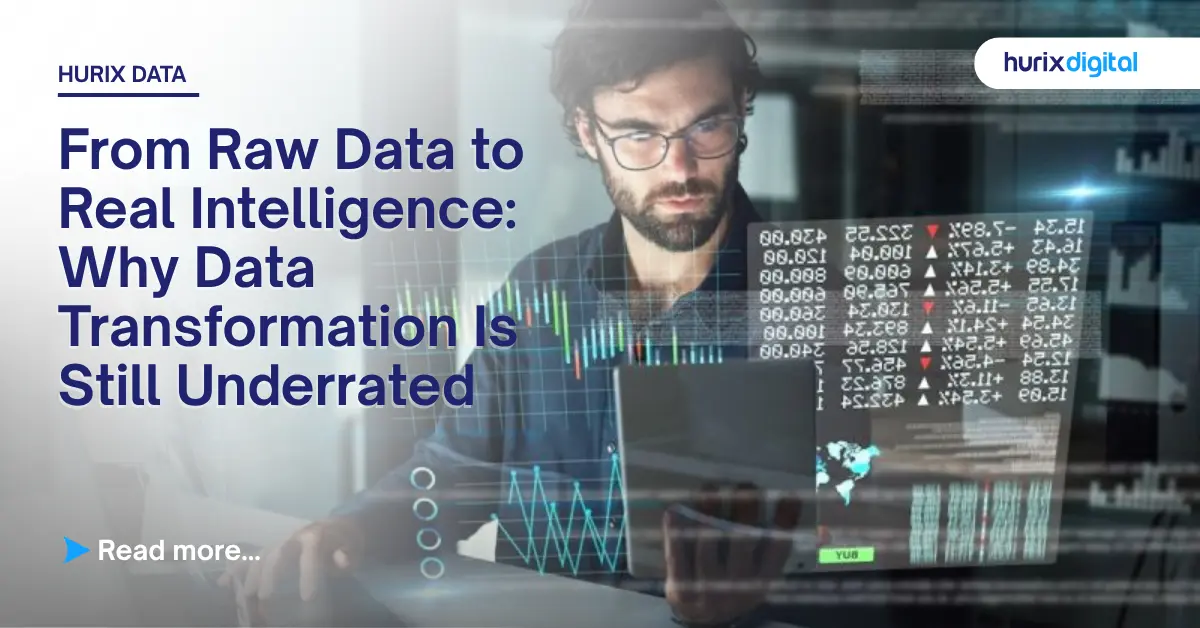
From Raw Data to Real Intelligence: Why Data Transformation Is Still Underrated
Summarize with:
Okay, let’s be real here. Walk into any boardroom today and quietly say “Generative AI,” and people will start paying attention. Maybe some may even grab a notebook to take notes. Generative AI is the shiny toy in town. The future of MAXIMUM efficiency.
But go walk into that boardroom and try to budget for data transformation. Crickets. People will look at you like you have two heads. The CFO will excuse themselves to take an “important call.”
On the one hand, we are pouring money into data-hungry AI models. But we aren’t treating the process of feeding them data (washing, chopping, seasoning) like a valuable process. And that becomes a reason for failure for many organizations aspiring to completely digitally transform themselves.
Table of Contents:
- When “Bad Data” Becomes a Multi-Million Dollar Liability
- Why Data Transformation is the Most Undervalued Asset in Your Stack?
- Rethinking the AI Data Pipeline: Moving Beyond Basic ETL
- Partnering for Scale: When to Call in the Data Annotation Experts
- A Final Word
- Frequently Asked Questions
When “Bad Data” Becomes a Multi-Million Dollar Liability
Garbage in, garbage out. This is becoming a cliché in tech circles now. It used to mean your monthly report had a rounding error. Who cares, right? But the stakes have changed. In the era of Agentic AI, “garbage” is a liability. It is a security leak.
Think about it. You might hire a data enrichment company or rely on internal teams to feed your Retrieval-Augmented Generation (RAG) system. You push a PDF file from 2017 into the data lake. That document contradicts a policy you updated last week. A standard search engine might miss the conflict. But your AI? It will confidently tell your biggest client that a discontinued service is still active!
This is why raw data is stupid. It has no context. It is a pile of clickstreams, scanned receipts, messy CRM notes, and audio logs. Transforming this into intelligence means structuring it so a machine can understand intent, not just keywords.
Why Data Transformation is the Most Undervalued Asset in Your Stack?
Why is the most critical part of the stack the most ignored?
First, it is invisible. When digital conversion works, nobody claps. You only notice it when it breaks. When the dashboard goes blank or the translation fails.
Second, there is this “magic box” fallacy. Non-technical leadership often believes AI can “figure it out.” They tend to assume in their heads, “Just throw the documents in the folder, the bot knows what to do.” Spoiler: It doesn’t. It will drown in the noise.
Third, the math is hard. It is easy to see the cost of a training data service. It is much harder to calculate the return on investment (ROI) of “cleaner context” until you see the efficiency gains two years later.
But look at the winners in 2026. They aren’t treating data cleanup as a cost center. They treat it as a product. They build architectures in which data is refined like oil before it ever reaches the engine.
Rethinking the AI Data Pipeline: Moving Beyond Basic ETL
So, what does a smart architecture look like these days? It is no longer just Extract, Transform, Load (ETL). That is ancient history. We are moving toward dynamic, real-time pipelines that handle text, video, audio, and code simultaneously.
The Human Safety Net
There is a growing interest in automated labeling. Automation is great. It is necessary. But the “set it and forget it” mindset is a trap.
The most robust systems we see today tend to go hybrid. They use AI for the heavy lifting. Say, for example, the initial digital conversion of a million files. But they also keep a human in the loop for the final mile. Why? Because AI is confident even when it is dead wrong.
Privacy and Compliance
We cannot talk about this without mentioning privacy. The regulations are tightening every quarter. Data transformation is your primary shield. Proper transformation means that anonymization and compliance tagging occur before the data reaches the model.
Partnering for Scale: When to Call in the Data Annotation Experts
For the CTOs here: Should you build your own transformation pipeline? It is tempting. You have smart engineers. You can make some servers run. But ask yourself: Is parsing unstructured text your core business?
If you are a bank, your business is risk. If you are a retailer, it is logistics. Building an internal tool for data transformation often starts well. Then formats change. New edge cases pop up. Maintenance becomes a jarring task.
The trend is toward partnership. Companies are realizing that training data services are a niche expertise. It involves linguistic nuance and cultural context that generalist teams lack. Partnering allows you to scale. If you need 50,000 hours of audio annotated by next month, you cannot hire internally to do it. You need a partner like Hurix.ai for that.
A Final Word
We are hitting a phase where adding more data doesn’t help as much as adding better data. The era of “big data” is over. The era of “smart data” is here.
You can download the whole internet. But if you want your AI to help your sales team close deals, it needs to understand your methodology. Your product specs. Your customer objections. That knowledge exists in your raw data, but it is buried deep.
This brings us to the bottom line. At Hurix Digital, we don’t see content, data, and platforms as separate buckets. They are the same stream.
We have spent years in the trenches of content digitization and digital transformation services. We watched the world go from simple e-book conversions to complex, AI-driven pipelines. We know that for a decision-maker, the goal isn’t “better data.” It is a better outcome.
Explore data solutions or talk to a data transformation expert today. Let’s turn that noise into the signal you have been waiting for.
Frequently Asked Questions(FAQs)
Q1: What is the difference between ETL and modern data transformation for AI?
Traditional ETL (Extract, Transform, Load) was designed for structured data destined for spreadsheets. Modern data transformation for AI must handle unstructured data like video, audio, and PDFs, converting them into machine-readable formats that maintain context and intent for LLMs and RAG systems.
Q2:How does data transformation improve the accuracy of GenAI?
AI models are only as good as the context they are given. Data transformation cleans “noisy” data, removes outdated information, and resolves contradictions. This ensures that when an AI agent retrieves information, it pulls the most accurate and relevant “signal” rather than “garbage.”
Q3:Can data transformation help with data privacy and GDPR compliance?
Absolutely. It is the most critical step for security. During the transformation process, sensitive PII (Personally Identifiable Information) can be automatically detected and redacted or anonymized before the data is used to train or prompt an AI model.
Q4: Why is data transformation considered the “bottleneck” of digital transformation?
Most organizations have plenty of data, but it’s “raw” and “stupid”—stored in messy, incompatible formats. The transformation process is often undervalued and underfunded, leading to delays when AI projects realize they cannot function without structured, high-quality inputs.
Q5:Is it better to automate data transformation or use a human-in-the-loop?
The most successful strategies are hybrid. While AI can handle the bulk of digital conversion and initial labeling, human subject-matter experts are essential for “the final mile.” They provide the cultural nuance and logical verification that prevent AI from being “confidently wrong.”
Summarize with:

Vice President – Content Transformation at HurixDigital, based in Chennai. With nearly 20 years in digital content, he leads large-scale transformation and accessibility initiatives. A frequent presenter (e.g., London Book Fair 2025), Gokulnath drives AI-powered publishing solutions and inclusive content strategies for global clients