 A Space for Thoughtful
Gamification 3.0: Integrating Generative Narrative and Dynamic Rewards
Summarize with:
Remember the first time you “played” a corporate training module? It likely involved a flat cartoon character named “Bob” who needed your help to click through slides on cybersecurity. At the end, you got a digital badge. Maybe a few points. It was “gamification,” technically. But let’s be honest: it was boring. We often called it “broccoli covered in chocolate.” The industry tried, but the engagement rarely outlasted the novelty of the leaderboard.
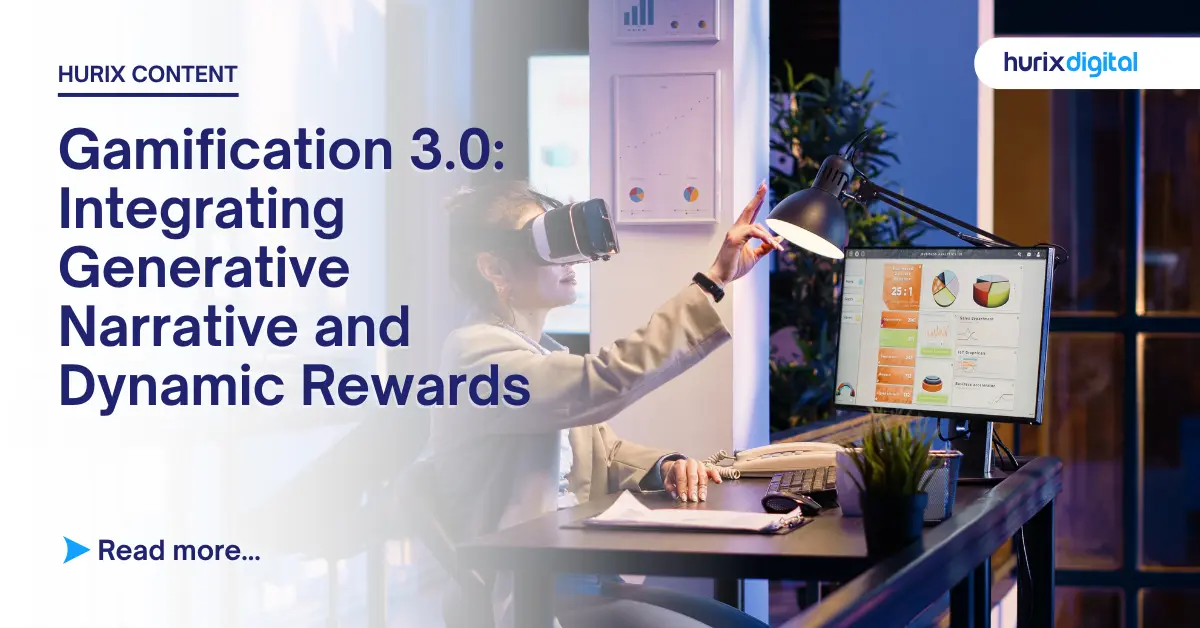
Today, that model is obsolete. We’re finally stepping into the era of Gamification 3.0, and frankly, it’s about time we moved past the tired fluff of superficial badges and points. By leaning into generative tech, we’re finally able to bake real narrative depth and reactive rewards into the very core of these systems. It has stopped being about just “playing a game” and has become about crafting a living, breathing experience that actually matters to the person sitting at the screen.
Make no mistake: this isn’t just a quick facelift for content gamification. We are talking about a total structural overhaul. We are turning passive content consumers into active, unique protagonists in their own professional development.
Table of Contents:
- What is Gamification 3.0 and What Makes it Different?
- Why is Traditional Gamification for Employee Engagement Failing?
- How Does AI Create Branching Narratives in Corporate Simulations?
- 5 Ways Dynamic Rewards Improve Workplace Gamification
- When Should You Use Gamification in Corporate Training?
- In Conclusion
- Frequently Asked Questions
What is Gamification 3.0 and What Makes it Different?
Gamification 2.0 was mostly about the external mechanics. It focused on motivators like leaderboards and digital stickers. It was a “one-size-fits-all” overlay applied to static content. Every employee experienced the exact same scenario, answered the same questions, and arrived at the same pre-determined outcome. It was predictable, and predictability is the death of play.
Gamification 3.0 flips the script by focusing on the experience, the intrinsic motivation of autonomy, and mastery. The primary difference is the engine. Instead of static content, your strategy is now powered by AI gamification that builds dynamic, branching storylines.
These aren’t simple “Choose Your Own Adventure” setups with three fixed endings. The system creates the narrative as you play. Every choice you make actively reshapes the simulation, making every “playthrough” of a course completely unique to that learner. This shift from “points for participation” to “consequences for choices” is what defines the new era.
Why is Traditional Gamification for Employee Engagement Failing?
If you are building a strategy in 2026, you cannot rely on a system that publicizes performance gaps via a static leaderboard. If an employee sees they are in 95th place on day two, they don’t work harder. Usually, they just tune out.
The badges themselves became devalued. A digital sticker for finishing a mandatory course doesn’t feel like an achievement. It feels like a compliance marker. Modern workers crave authenticity. They want to know that their time investment in learning will directly impact their skill set. They want recognition that feels personalized. This is exactly why gamification for employee engagement has to change. We need rewards that actually mean something, recognition that reflects specific behaviors and high-level competencies, rather than just rewarding someone for “clicking next” until they reach the end.
How Does AI Create Branching Narratives in Corporate Simulations?
This is where the real architecture happens. It starts with a foundational dataset: your company’s subject matter expertise, product guides, or leadership scenarios. When an employee starts a simulation, say, a complex client negotiation, the AI gamification engine generates the initial scenario.
When the employee chooses to “push for a higher price” rather than “focus on long-term partnership,” the system doesn’t just pull up the next pre-written slide. The system weighs that specific choice against your intended learning goals and, in a split second, crafts a unique, emotionally nuanced response from the virtual client. The story then branches based on that one interaction. That kind of personalization is what finally makes custom course development scalable; it lets you offer bespoke experiences that used to be way too expensive to build by hand.
5 Ways Dynamic Rewards Improve Workplace Gamification
Dynamic rewards go way deeper than a point tally. They’re about giving people recognition that feels both responsive and genuinely meaningful. If you’re looking to shake up your workplace gamification reward system, here are five ways to do it differently:
1. Competency-Based Micro-Credentials
Forget “Course Completion” badges. Reward specific behaviors. If a learner navigates five tough simulations without escalating, grant them a specialized specialist credential.
2. Unlocking Content, Not Just Points
Think of it this way: the best prize for a curious learner is more access. Nailing a foundational module should open the door to advanced simulations. In this model, the true reward for learning is the opportunity to learn more.
3. Move to Adaptive Leaderboards
Let’s stop demoralizing people by showing a “Top 10” for a 5,000-person company. It is much more effective to build dynamic clusters that pair learners with peers at the same stage or on the same skill path. This approach makes the competition feel both fair and relevant, rather than throwing everyone into one giant, demoralizing pool.
4. Make the Narrative the Reward
Sometimes, the narrative itself becomes the ultimate “win.” Pulling off a perfect outcome in a high-stakes simulation shouldn’t just end with some generic “Success” screen. Instead, why not grant the learner a “Director’s Cut” look at the underlying decision tree? There is something incredibly satisfying about pulling back the curtain to see exactly how your specific choices steered the ship—that’s a level of validation that a simple point tally just can’t touch.
5. Real-World Application
Tie digital success to tangible benefits, like a shout-out in the company newsletter or a credit toward a professional certification.
When Should You Use Gamification in Corporate Training?
Is every course a candidate for high-level simulation? Probably not. You don’t need a branching narrative to teach someone how to fill out an expense report. However, gamification in corporate training is essential for high-stakes, soft-skill environments.
Negotiation, leadership, crisis management, and complex sales cycles are the “sweet spots.” These are areas where there is rarely one “right” answer, but rather a series of “better” or “worse” choices. By using AI gamification in these areas, you allow employees to fail safely in a virtual environment so they can succeed in the real one.
In Conclusion
The fear of complexity often stops organizations in their tracks. They see “AI” and “Dynamic Narratives” and think it is too big or too unpredictable. The key is integration.
Start by looking at your current learning technology stack. You need an architecture that allows for modularity. To scale this, you must automate the heavy lifting of creating simulation backgrounds and initial scripts. AI handles the volume, so your instructional designers can focus on the strategic overarching narrative. This is how you modernize your content development without needing an army of writers.
At Hurix Digital, we specialize in this transition. Whether you are looking for immersive managed learning services or need to rethink your entire digital strategy, we have the tech to help you move beyond badges to true narrative immersion. We believe AI gamification is the bridge between training and true capability. It’s about moving the needle from simple knowledge retention to actual, visible behavioral change.
Ready to transform your training? Schedule a discovery call with Hurix Digital today to build immersive, AI-powered learning experiences for your team.
Frequently Asked Questions(FAQs)
Q1: How do you keep the AI narrative from going off-track?
We use “Guarded AI” frameworks. The system is trained only on your approved company data and strict instructional design parameters. This ensures the AI gamification operates within safe boundaries, delivering relevant content without risking a “wild west” scenario.
Q2:Is this too complex for smaller teams?
Actually, it’s a massive time-saver. Once the initial engine is set up, it requires far less manual “versioning” than traditional branching paths. One AI-powered simulation can replace dozens of static, manual courses.
Q3:What happens if a learner makes a “wrong” choice that ends the story early?
In Gamification 3.0, there is no “Game Over.” If a learner makes a critical error, the AI generates a “recovery” path or a “post-mortem” feedback loop. The goal is to keep them in the loop, learning from the consequences of that choice in real-time.
Q4:How does this impact your data and analytics?
Instead of a simple “80/100” score, you get a decision log. You can see how an employee arrived at an answer, where they hesitated, and which alternative paths they explored. This granular data is invaluable for identifying broader skills gaps.
Q5: Can we integrate this into our existing LMS?
Yes. Most modern systems can connect to an AI narrative engine via API. You don’t necessarily need to scrap your current platform; you just need to “plug in” the intelligence layer.
Summarize with:

Vice President – Delivery at Hurix Digital,
With over 20 years of experience in the digital learning and interactive systems industry. She specializes in operational excellence and end-to-end project delivery, overseeing complex learning solutions from conception to execution. With a strong background in practice leadership and delivery strategy, Reena focuses on driving efficiency and high-quality outcomes for global clients in the corporate and digital education space.