 A Space for Thoughtful
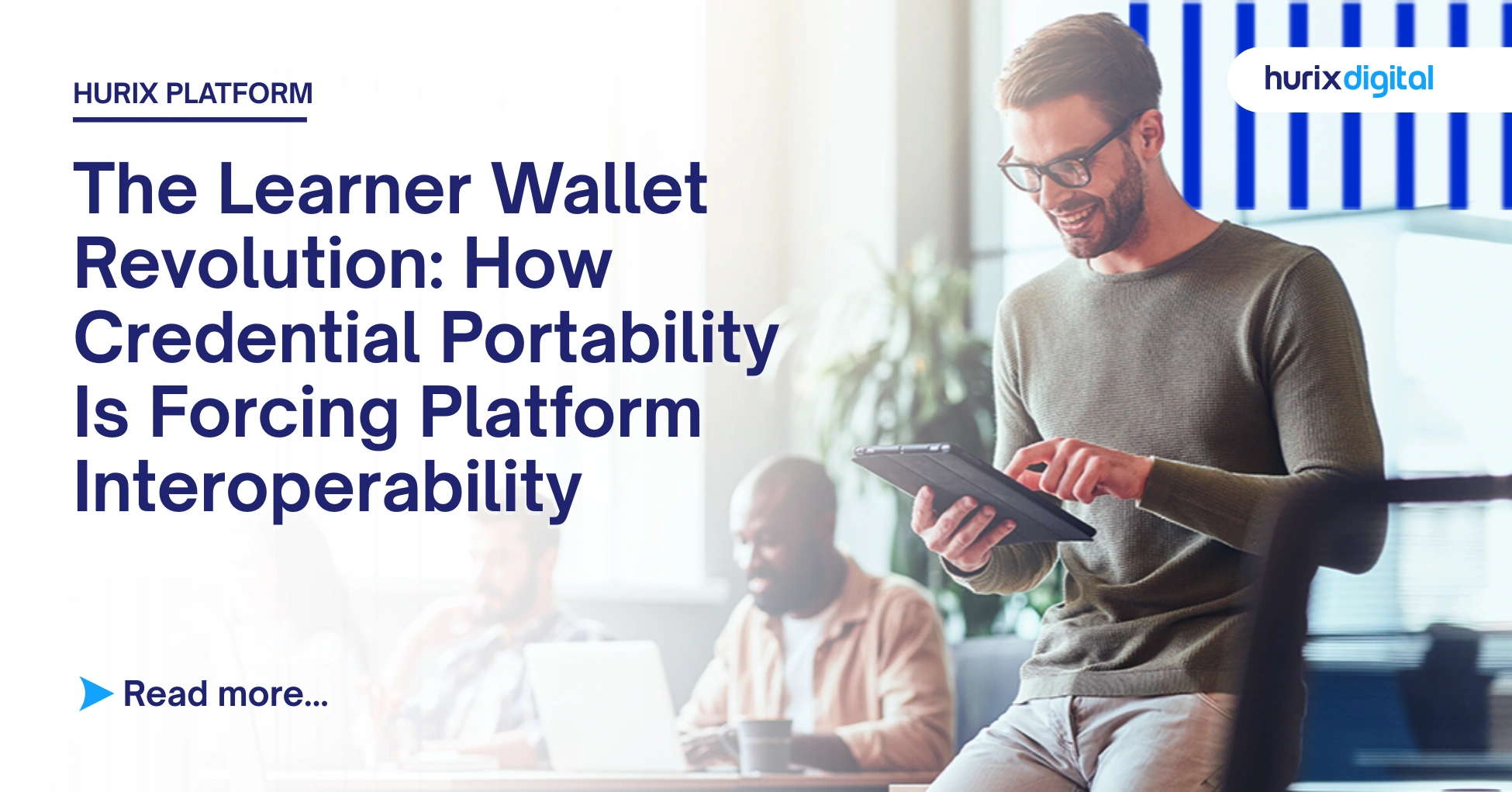
The Learner Wallet Revolution: How Credential Portability Is Forcing Platform Interoperability
Summarize with:
Ever tried to move your professional certifications from one platform to another, only to find yourself trapped in a digital “walled garden”? It is a frustrating reality for millions of professionals. You earn a badge here, a certificate there, and a micro-degree somewhere else, but they never seem to talk to each other. It’s like having a physical wallet where your ID only works at one specific grocery store.
But things are changing fast in 2026. The “Learner Wallet Revolution” is officially here, shifting power from the platform back to the person. This change in how we handle credentials isn’t just a win for the person holding the diploma; it is a loud wake-up call for companies to tear down and rethink their old-school digital setups. As the line between “learning a skill” and “getting hired for it” continues to blur, the need for enterprise AI solutions is going through the roof just to keep up with the massive flood of new data.
In this post, we’re going to pull back the curtain on how the rise of learner wallets is finally forcing platforms to play nice with one another. We’ll also break down why AI digital transformation isn’t just a buzzword anymore, it’s actually the only way for organizations to keep up with this shift without completely losing their minds.
Table of Contents:
- What is the Learner Wallet Revolution and Why Does It Matter Now?
- How Do Enterprise AI Solutions Bridge the Interoperability Gap?
- 5 Reasons Why Credential Portability Is Forcing Platform Interoperability
- In Conclusion
- Frequently Asked Questions
What is the Learner Wallet Revolution and Why Does It Matter Now?
For decades, academic and professional records were siloed. If you wanted to prove you had a skill, you had to log into a specific portal or, heaven forbid, request a paper transcript. The Learner Wallet changes that by giving the individual a secure, mobile-first “hub” to store verifiable credentials.
1. The Shift to Individual Ownership
Unlike traditional databases, a learner wallet is owned by the user. You hold your own “keys.” When you complete a course, the issuer sends a cryptographically signed credential directly to your wallet. You don’t need to ask permission to share it with a recruiter or a new university; it is yours to move as you please.
2. The Pressure on Legacy Platforms
Because learners now expect to take their data with them, platforms can no longer survive as closed loops. This is forcing a massive wave of AI integration across the EdTech and HRTech sectors. If a platform can’t export a verifiable credential to a user’s wallet, it risks becoming obsolete in a world that prizes mobility.
3. Standards-Based Interoperability
We are seeing widespread adoption of standards such as W3C Verifiable Credentials and Open Badges 3.0. These frameworks basically act as universal translators, ensuring a “wallet” from one company can actually speak the same language as a “verifier” from another. But let’s be honest, managing the messy complexity of all these cross-platform handshakes is a nightmare for humans. That is why so many organizations are leaning on enterprise AI solutions to automate the verification and map out those massive, diverse skill sets in a way that actually makes sense.
How Do Enterprise AI Solutions Bridge the Interoperability Gap?
You might be wondering: if everyone is using different “wallets,” how does a company make sense of it all? This is where the heavy lifting happens behind the scenes. Enterprise AI solutions act as the connective tissue in this new ecosystem.
They don’t just “read” the data; they understand it. If one learner has an “Advanced Python Certification” from a bootcamp and another has a “CS50 Backend Certificate” from a university, the AI can recognize that these represent the same core competencies. This kind of AI integration enables HR departments to search their entire talent pool, both internal and external, by verified skills rather than just job titles.
Furthermore, a generative AI platform can help individuals curate their wallets. It can look at a job description and suggest exactly which credentials from their wallet they should “present” to have the best chance of landing the role. It’s a win-win: the employer gets the right person, and the learner gets the job they actually deserve.
5 Reasons Why Credential Portability Is Forcing Platform Interoperability
Interoperability used to be a “nice-to-have” feature that software vendors would ignore to keep customers locked in. But when consumers start demanding portable data, the walls have to come down. Here are five reasons why this shift is happening right now:
1. The Death of the “Walled Garden”
In the past, switching from one Learning Management System (LMS) to another was a nightmare. You’d lose years of progress. Now, because the data lives in the user’s wallet rather than the vendor’s database, the “lock-in” strategy has failed. Vendors are now forced to compete on the quality of their tools rather than on how much data they can hold hostage.
2. The Demand for Real-Time Verification
Recruiters no longer have the patience for a two-week background check. They want proof of skill now. This pressure is forcing platforms to adopt API-first designs that allow for instant data exchange. This is a massive part of the broader AI digital transformation—moving from static records to living, breathing data flows.
3. Global Standardization
We have finally found a “Rosetta Stone” for credentials. With international standards reaching maturity in 2026, a certificate earned in Mumbai is now instantly readable by an Applicant Tracking System (ATS) in New York without any manual data entry. To manage these diverse, high-speed data streams, businesses are deploying enterprise AI solutions to translate and map these global skills directly to their specific internal job requirements.
4. The Rise of the “Skills-First” Economy
Degrees are great, but can you code in Rust? Can you manage a decentralized team? Employers are moving toward skills-based hiring. To make this work, platforms must be able to export granular “micro-credentials” to learner wallets. This requires a sophisticated generative AI platform to help institutions break large courses into smaller, portable units of evidence.
5. Regulatory Pressure
Governments are starting to realize that data portability is a worker’s right. New policies are emerging that encourage (and sometimes mandate) that educational institutions provide students with machine-readable, portable records. Implementing AI solutions for enterprise helps schools stay compliant with these shifting laws without hiring a small army of administrators.
In Conclusion
The Learner Wallet Revolution isn’t just a tech trend; it’s a fundamental shift in how we value human potential. At Hurix Digital, we are dedicated to helping organizations navigate this new landscape with confidence. Whether you are looking to overhaul your learning platforms or integrate advanced Enterprise AI Solutions, we have the expertise to make it happen.
Our focus on Digital Content Transformation ensures that your systems aren’t just modern, they’re future-proof. We help you break down silos, embrace interoperability, and put the power of data back where it belongs: in the hands of learners and innovators.
Ready to unlock the full potential of your talent ecosystem? Book a discovery call with us now.
Frequently Asked Questions(FAQs)
Q1: Will learner wallets replace traditional resumes?
While resumes aren’t going away tomorrow, learner wallets are definitely becoming the “source of truth.” A resume is a claim; a wallet credential is proof. Employers in 2026 are increasingly seeking the cryptographic verification that wallets provide, especially for technical and highly regulated roles.
Q2:How do enterprise AI solutions help with “fake” digital badges?
AI is the ultimate fraud detector. Advanced enterprise AI solutions use pattern recognition and cryptographic checks to ensure that a digital credential was actually issued by the organization it claims to be from. It can spot metadata inconsistencies that a human eye would miss.
Q3:Is credential portability expensive to implement for a mid-sized company?
It is an investment, but the “cost of doing nothing” is much higher. By utilizing modular AI enterprise solutions, mid-sized companies can upgrade their existing systems without a total “rip and replace” overhaul. The long-term savings in recruitment and verification costs usually far outweigh the initial setup.
Q4:Does this revolution impact privacy and data security?
Actually, it improves it. Because the learner owns the data, the enterprise doesn’t have to act as a permanent “custodian” for every tiny bit of information. This reduces the size of your data “honey pot,” making your organization a less attractive target for hackers while keeping you compliant.
Q5:Can generative AI platforms help in creating these wallets?
Absolutely. A generative AI platform can help learners curate their wallets by suggesting which credentials to highlight for specific job applications. It can also help issuers “package” learning outcomes into meaningful, verifiable micro-credentials that are much more useful than a generic participation certificate.
Summarize with:

Vice President & SBU Head –
Delivery at Hurix Technology, based in Mumbai. With extensive experience leading delivery and technology teams, he excels at scaling operations, optimizing workflows, and ensuring top-tier service quality. Ravi drives cross-functional collaboration to deliver robust digital learning solutions and client satisfaction