 A Space for Thoughtful

AEM and Platform Services: Enhancing Personalization and Customer Experience
Summarize with:
With the digital arena rapidly developing and a growing number of businesses moving online, there is a heightened need to manage and optimize digital content. The global market for enterprise content management is projected to reach USD 37.7 billion by the year 2026.
Adobe Experience Manager (AEM) plays a key role in this. A Content Management System (CMS) can help you manage your digital content, deliver it on a variety of channels, and create enhanced digital experiences for customers.
Using AEM platform services, you can develop digital experiences that are personalized to each user and deliver them in the best possible ways.
Table of Contents:
- What is Adobe Experience Manager?
- What is Adobe Experience Platform?
- Importance of a Personalized Digital Experience
- Core Features of Adobe Experience Platform and AEM Services
- What are the Major Advantages of the AEM Platform?
- 6 Key Practices For Successful AEM Implementation
- Top 3 Critical Pitfalls to Avoid
- Advantages of the AEM Platform and Adobe Managed Services
- How to Deliver Personalized Customer Experiences Using AEM Platform Services?
- Conclusion
What is Adobe Experience Manager?
Adobe Experience Manager (AEM) is a feature-rich and powerful content management system (CMS). This system provides content and digital asset management capabilities to present a customer-centric experience at each customer journey stage.
Data reveals that more than 129,000 websites are using Adobe AEM solutions in 2023. With Adobe CMS, you can easily build, publish, and manage web pages, including digital assets, and tailor content for different audiences.
The AEM CMS uses unique tools, such as AI-powered real-time targeting and analysis, to produce content once and repurpose it to match individual preferences, making it easy to personalize at scale across any channel.
What is Adobe Experience Platform?
Adobe Experience Platform (AEP) is a cloud-based technology that enables organizations to collect, analyze, and manage customer data in real-time across multiple touchpoints, including mobile applications, websites, social media, and physical locations.
It standardizes and centralizes content and client data from any system and leverages AI-driven insights to dramatically enhance the design and delivery of rich, personalized customer experiences at scale.
Importance of a Personalized Digital Experience
Adopting a generic one-size-fits-all solution for digital experiences can be more harmful than you think. A digital experience impacts customers’ perception of your brand. It influences their buying decisions and shapes lasting loyalties, leading to failure or success in competitive markets.
Here are some more reasons why a personalized digital experience is critical for your business:
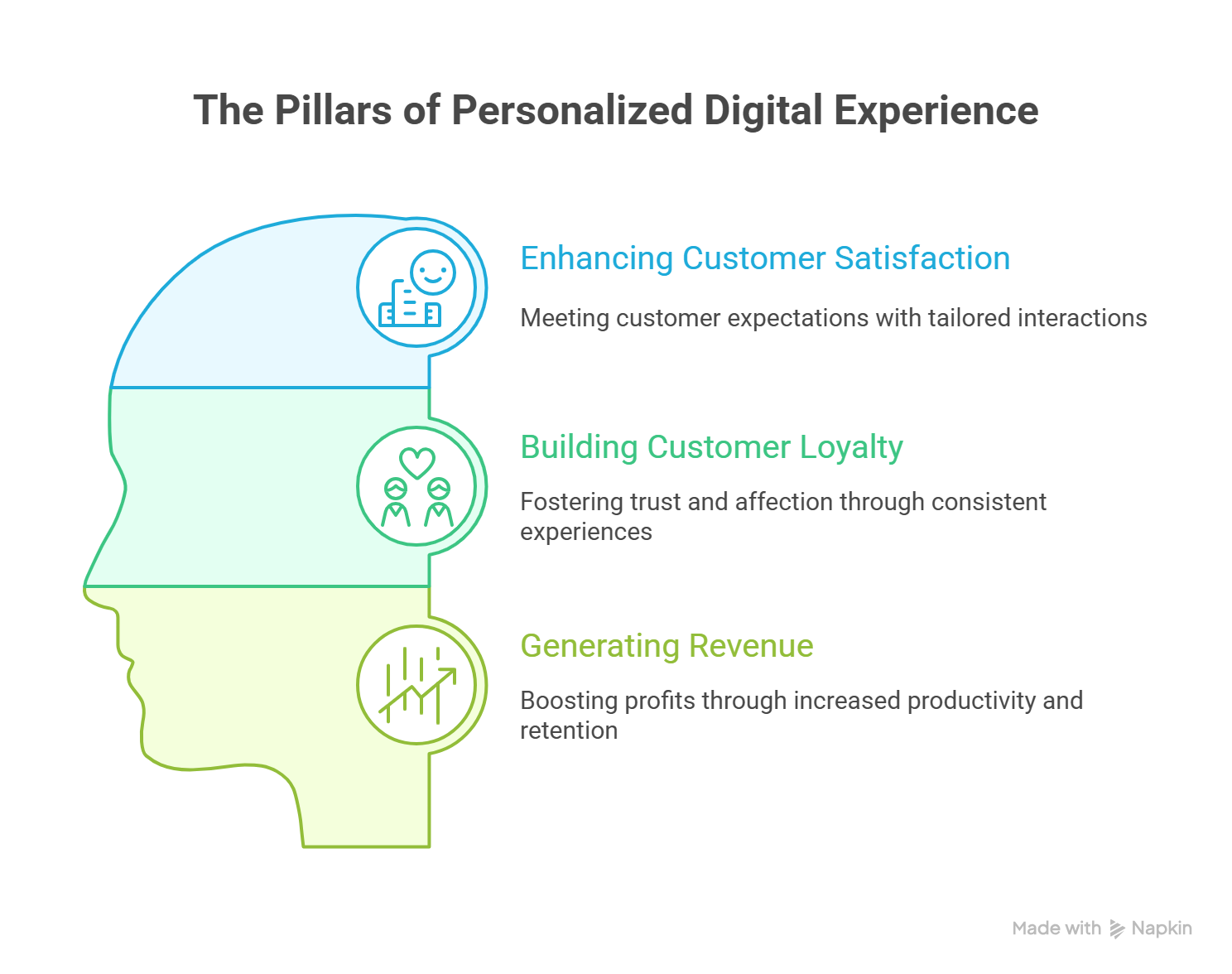
1. Enhancing Customer Satisfaction
Recent research reveals that 71% of customers expect personalized interactions from companies. And 76% get frustrated in the absence of a tailored approach.
These numbers highlight the importance of considering customers’ interests and past behaviors and rewarding them with a personalized experience to attract them to your brand.
2. Building Customer Loyalty
Consistent, high-quality interactions build trust and brand affection.
A great digital experience represents your brand’s value through helpfulness, fairness, and transparency. Trust and emotional connection create loyal customers and business promoters, leading to repeat business and consistent revenue.
3. Generating Revenue
Exceptional experiences boost productivity, minimize wasted effort resolving complaints or churn, reduce costs, and increase retention, leading to higher profits.
Research reveals that businesses leveraging personalization generate 40% higher revenue than the ones who adopt a cookie-cutter approach.
Core Features of Adobe Experience Platform and AEM Services
The following are some of the latest features of the AEM platform and Adobe CMS that are powering the next generation of customer experiences:
1. Actionable Consumer Profiles
The Adobe Experience Platform enables you to create and share real-time customer profiles across systems for better engagement.
These profiles include information from all touchpoints that help analyze customer experience workflows and tailor interactions based on the actions and preferences of each customer.
2. Machine Learning (ML) and Artificial Intelligence (AI)
The AEM platform uses ML and AI to analyze customer data and provide key insights into customer preferences, needs, and behavior.
This helps you build distinctive, personalized customer experiences at scale.
3. Digital Form Management
The Adobe Sensei is an AI-powered tool that automatically converts traditional input fields and legacy PDF forms to mobile-responsive, digital, adaptive forms.
This enables you to deliver an exceptional and seamless customer experience regardless of the devices your customers use.
4. Headless Content Delivery
The Adobe AEM comes with a single repository that allows you to reuse and manage digital assets.
It enables you to publish digital assets to SPAs (Single Page applications), the web, and mobile apps to provide a personalized and consistent experience across channels without impacting content velocity.
What are the Major Advantages of the AEM Platform?
AEM implementation has the potential to deliver five key benefits to your business in the short and long terms:
1. Complete Web Content Management
Businesses today operate across multiple digital channels, geographies, languages, formats, and more. It becomes challenging to organize and manage such a high volume of content, and this is where the AEM platform shines.
With its headless architecture and flexible tools for developers, it is possible to efficiently manage all the content and data in Adobe Experience Manager. By consolidating all content in one place and integrating the necessary tools to manage this data, the AEM platform enables you to create a robust digital foundation for your content.
2. Cross-Channel Capabilities
The digital journey of customers is not linear any longer. It branches out across a variety of channels and touchpoints, creating a complex network of data points for a business to measure.
Adobe Experience Manager provides tools to create a seamless, cross-channel journey across various touchpoints, like single-page applications, IoT devices, on-premises screens, etc.
Your business can truly deliver a stellar customer experience that isn’t broken and is context-aware at all times, helping you elevate personalization to the next level.
3. Personalization Capabilities
The importance of relevant content can’t be understated for the modern customer. Serving the most relevant and highly personalized offerings at every customer touchpoint has become essential.
Adobe Enterprise Manager offers a comprehensive set of machine learning capabilities, complemented by customer analytics, to provide your business with a clear understanding of the content preferences for each customer profile or cohort.
Targeted campaigns can be mobilized depending on data-backed analytics and automated workflow builders. You can adjust content flexibility, measure performance, personalize it for omnichannel use, and more.
4. AI-Backed Scalability
One of the most valuable benefits of AEM implementation is access to AI and ML-powered analytics. These powerful tools help you understand customers’ content preferences, enabling you to design hyper-personalized experiences at scale.
Your business can create meaningful customer interactions for thousands of customers simultaneously. This capability to design a customer journey based on AI-analyzed data at a large scale reduces the number of manhours invested in interpreting raw data.
4. Easy Development and Collaboration
Before a new experience is updated across the customer journeys that are already online, it needs to be thoroughly tested for efficacy. With Adobe Experience Manager’s flexible and adaptable environments that facilitate rapid development and testing amongst a team, it is possible for brands to quickly design, create, test, and launch new customer experiences across multiple channels and within record time.
6 Key Practices For Successful AEM Implementation
If your organization has decided to implement Adobe Experience Manager, it is time to bring your teams together and build an AEM implementation plan.
You can consider the best practices listed below for a smoother adoption:
1. Define a Clear Strategy
Before you begin the implementation, it is important to assess the following aspects of your business:
- What does the current content management ecosystem at your organization lack?
- In what ways is your organization seeking to transform the workflows and processes of the content systems for the better?
- What risks are you experiencing currently, and how can AEM address them?
You need to conduct a needs analysis and put a strategy in place to guide you through the implementation process phase-wise. It helps to know the direction in which the implementation is proceeding.
2. Select the Right Features
The AEM platform is a powerful tool with a plethora of features. Unfortunately, selecting the features that work for your organization makes it challenging.
Encourage your AEM implementation partners to adopt agile methodologies and prioritize the most mission-critical features first during the implementation.
Doing this facilitates rapid configuration and testing and creates room for reprioritization should any changes be needed. The demonstration sessions after testing also help display the system’s capabilities.
Your organization can have the entire CMS up and running within a few iterations in this manner.
3. Set Up Efficient Knowledge Transfer
More often than not, the biggest challenge in implementing Adobe Enterprise Manager is the restriction of information between the implementation partners and the organization team.
To ensure that AEM implementation is successful, it is mandatory to facilitate knowledge transfer without restrictions.
Your organization needs to appoint representatives and teams directly coordinating with the implementation partners to ensure that both sides stay on the same page. Doing this also ensures that:
- There is minimal delay in the implementation timelines.
- The reports and dashboards are set up in coordination between both sides.
4. Assign the Right Roles
One of the most critical aspects of any kind of implementation is to set up the right team to supervise and coordinate with the implementation partners.
For example, for implementing AEM-managed services, you need team members who can play the roles of:
- UI and UX designer
- Frontend and backend developers
- Quality assurance and control engineers
- Component developers
- Infrastructure engineers
- DevOps engineers
It works best to understand the exact extent of the professionals you would need for a successful AEM implementation. The process occurs smoothly when all the professionals understand the scope of their responsibilities in the implementation.
5. Stay Flexible
You may be familiar with other popular CMSs like WordPress and Joomla. Adobe Experience Manager platform is slightly different than these popular content management systems, though.
This is why it helps to have a flexible approach to the AEM implementation process. For example, you can begin with the base version of AEM instead of selecting cloud-based add-ons from the get-go.
This will help you understand the differences between other CMSs and AEM. Even out of the box, AEM is more powerful and feature-rich as compared to other popular CMSs.
6. Perform Quality Assurance
This best practice isn’t only applicable to AEM but to every end product that your business produces. Quality assurance engineers should test every module of the AEM platform implemented at your organization and objectively pass their verdict.
Before the CMS goes live across your enterprise, it is essential to ascertain that all the features are working as they should. Security checks and risks should take top priority in mitigation efforts.
Conducting quality assurance also helps your organization identify spikes in costs that can be completely avoided with a few configuration modifications.
Top 3 Critical Pitfalls to Avoid
Even with these best practices in place, your implementation team can run into several challenges along the way.
Listed below are three critical pitfalls that must be identified and avoided to prevent inefficiencies and cost overruns:
1. Failing to Prioritize
One of the classic challenges businesses run into with AEM is that they attempt to achieve too many goals simultaneously. It invariably results in cost overruns and implementation delays.
This is why it is crucial to prioritize implementation based on the needs analysis conducted by the organization and maintain some flexibility for future scaling.
2. Failing to Prepare the Data Limits
The second most critical pitfall is plugging in your AEM platform to every data source at the organization. While the AEM platform can pull data from any source at your company, not all of it may be useful.
This may lead to increased costs for data processing and storage. As a solution, allow the platform access to only the data you have scoped for.
3. Ill-Planned Personnel
The third pitfall is skimping on training and designated personnel who understand how to use the tool.
When launching the AEM platform organization-wide, enough employees must know how to leverage its capabilities fully.
Training and development sessions are important when implementing the AEM platform.
Advantages of the AEM Platform and Adobe Managed Services
Adobe Experience Platform and AEM consulting services offer a host of benefits to growing businesses. Some of these include:
1. Content Personalization
Adobe AEM Experience enables you to create content-driven and highly personalized customer experiences. This is done by leveraging AEM’s integration with Adobe Target and Adobe Analytics.
It automatically generates a visitor profile to deliver personalized content by collecting the necessary data.
2. Flexibility and Scalability
AEM platform is a highly scalable and robust platform with a wide range of features and functionality that can support the changing needs of large enterprises.
Whether you need to get large amounts of content across multiple channels, high-traffic sites, and dozens of languages or integrate with other systems, AEM has the tools to help you perform it.
3. Safety, Security, and Compliance
The secure cloud technology helps you keep the client data safe.
With AEP, you can establish data governance to comply with contracts, privacy, and regulations. It also simplifies the classification, enforcement, and management of restrictions.
How to Deliver Personalized Customer Experiences Using AEM Platform Services?
Here’s how Adobe’s suite of tools empowers your business to keep up with customer expectations and meet personalization goals:
1. Adobe Experience Manager (AEM)
With developer-facing tools and marketing-friendly templates, AEM is the ideal platform to create and deliver personalized content across various channels.
You can easily reuse and adapt the content to individual preferences, providing personalized experiences throughout the customer journey. Businesses can also rely on geolocation, AI, and translation to further improve the customer experience while taking the burden off their shoulders.
2. Adobe Experience Platform (AEP)
You can understand your customers’ preferences and behavior by leveraging real-time customer profiles, AI, and ML capabilities.
This helps develop tailored content that suits every customer’s requirement and delivers individualized experiences across all touchpoints. As a result, there’s increased engagement and conversions, raising the overall business revenue.
3. Adobe Analytics
Adobe Analytics allows you to analyze customer data from anywhere in the client journey. You can use reporting and predictive intelligence to recognize hidden opportunities and further personalize the experience.
Marketing analytics, more pulls data from any channel, and web analytics provide you with a 360-degree view of your customers.
Check out this EXCLUSIVE Press Release: Hurix Digital Joins Adobe Bronze Solution Partnership Program to Enhance AEM Consulting Services
Conclusion
Did you know that popular brands like Cisco, HP, and Samsung all use Adobe Experience Manager?
Adobe-managed services tremendously enhance the functions and operations of an organization. However, a tool is only useful if it is assembled correctly – which is what AEM implementation partners like Hurix Digital help you achieve.
Hurix Digital provides organizations with digital engineering and technology solutions that include smooth, seamless, and efficient AEM implementation. To know more, get in touch with experts today!
Summarize with:

Vice President – Content Transformation at HurixDigital, based in Chennai. With nearly 20 years in digital content, he leads large-scale transformation and accessibility initiatives. A frequent presenter (e.g., London Book Fair 2025), Gokulnath drives AI-powered publishing solutions and inclusive content strategies for global clients