 A Space for Thoughtful
5 Benefits of K-12 Education in the 21st Century
Summarize with:
Summary
Modern K-12 education in the 21st century focuses on bridging the gap between traditional academic knowledge and the essential “Four Cs”: critical thinking, communication, collaboration, and creativity. By integrating AI-driven personalized learning and digital literacy into the curriculum, K-12 institutions prepare students for a global workforce projected to require digital-first skills for 94% of roles by 2026.
The K-12 education system has undergone significant transformation, particularly after the COVID-19 pandemic. This has led to a more personalized and learner-centric approach to teaching, highlighting the growing advantages of K-12 education. Technological advancements have further enhanced the learning experience, making it more accessible and effective. What are the most impactful changes and how do they benefit students directly?
These factors have created an education system highly beneficial for students and teachers alike while making the K12 curriculum more comprehensive with every passing year.
This guide will dive into the five key benefits the K-12 education system offers in the 21st century.
Table of Contents:
- How is K-12 Education Different from Traditional Education?
- What are the 5 Major Benefits of K-12 Education?
1. Builds a Strong Foundation
2. Makes High-Quality Education Accessible to All
3. Helps Master Social Skills
4. Helps Become Technologically Proficient
5. Prepares Students for A Competitive International Job Market - In Conclusion
- Frequently Asked Questions (FAQs)
How is K-12 Education Different from Traditional Education?
K-12 education differs from traditional education by offering a structured learning journey from kindergarten through grade 12 that focuses on skill development, critical thinking, and real-world readiness rather than rote memorization. It emphasizes continuous learning, age-appropriate progression, and prepares students for higher education and modern careers.
Beyond structure, K-12 education adopts a learner-centric approach. Instead of focusing only on exams and textbooks, it encourages problem-solving, collaboration, creativity, and experiential learning. This helps students understand concepts deeply and apply knowledge in practical situations.
Another key difference lies in technology integration. K-12 education actively incorporates digital tools, online learning platforms, adaptive assessments, and interactive content to personalize learning experiences. Traditional education, in contrast, often relies on fixed curricula and limited use of technology.
Finally, K-12 education supports holistic development. Along with academics, it nurtures social skills, emotional intelligence, communication abilities, and digital literacy. This balanced approach ensures students are not only academically prepared but also equipped to navigate real-world challenges and future careers.
The 21st-century classroom has transitioned from passive rote learning to active, technology-enhanced environments. As the digital publishing market for K-12 grows at an 11.3% CAGR, the primary benefit of modern schooling is the development of “cognitive flexibility”—the ability to adapt to rapid technological shifts like Generative AI and automation.
What are the 5 Major Benefits of K-12 Education?
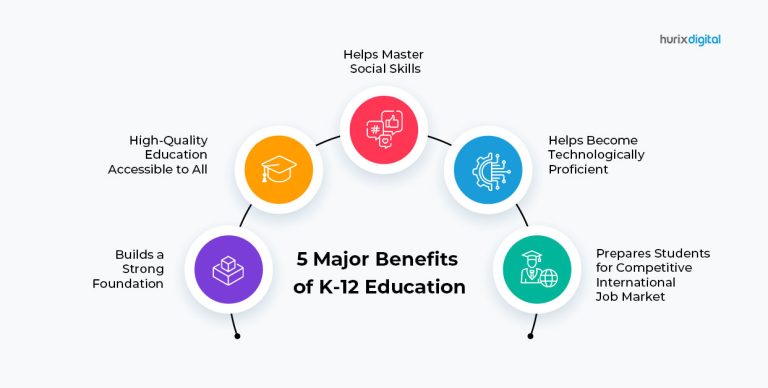
While the advances in K-12 education offer several benefits, some particularly stand out in making this an effective system of education –
1. Builds a Strong Foundation
The K-12 system strengthens students’ foundation in crucial subjects and skills, including math, science, language, and social sciences. K-12 education also helps students master basic skills like reading and writing, which are crucial in attaining higher education and the job market.
Apart from academic and professional skills, K-12 education motivates students to become independent. Math, for instance, isn’t restricted to textbooks and theory; having a strong foundation in the subject can help students create effective budgets, manage their taxes, and make the right investments.
Mastering the basics is required to progress in any subject and build a strong foundation. With new education technologies, teachers can help students practice the necessary skills according to their individual needs so that no student gets left behind.
2. Makes High-Quality Education Accessible to All
One of the most significant advantages of the evolving K-12 education system is its increased accessibility. Recognizing that students often encounter financial, logistical, or health-related barriers to classroom access, the K-12 system has worked to ensure students across the US can still obtain a high-quality education. What specific initiatives have been most effective in removing these barriers?
Alongside several curriculum developments, students with disabilities can now access screen reader-friendly E-learning websites to make the most of their K-12 education. While this field requires more attention and action, with E-learning going online.
The global online K-12 education market was valued at about $126.5 billion in 2024 grew to ~$155.4 billion in 2025 — with an expected CAGR around 22.9%. It may reach ~$349.8 billion by 2029 if growth continues at current pace.
With such immense growth, there will be a far greater emphasis on ensuring that education is made more accessible and that investments in the education sector grow significantly.
3. Helps Master Social Skills
K-12 education plays a vital role in social development. Through social interaction, students cultivate strong collaboration and communication skills essential for their future success.
Intellectual engagement and networking among students also create opportunities in the competitive job market. Furthermore, interactions with peers and teachers allow younger students to identify and learn from positive role models. What are some specific classroom activities that foster these crucial social skills?
Greater access to the internet has increased connectivity and the opportunity to network with those around you. Not being able to communicate your needs or strengths with others can lead to difficulties in your career and higher education settings, reinforcing the need for strong social skills.
Innovative K-12 curricula have been able to foster collaboration. For example, a new form of learning known as three-dimensional classes tasks students to collaborate on building models or completing puzzles. To succeed, students must combine their strengths and learnings and work together to find a solution.
4. Helps Become Technologically Proficient
Given the pervasive role of technology in our daily lives and professional environments, it is essential that students complete their K-12 education with the ability to adapt to new technologies.
Technology provides access to information, knowledge, and the opportunity to acquire new skills. For example, the news industry has evolved significantly. While a good writer once sufficed with a camera person handling videography, today’s graduates must write, speak articulately, record pieces-to-camera, and edit them proficiently. How can K-12 curricula better integrate these practical technological skills?
K-12 education is already making progress in preparing its students for the future. For example, 58% of participants in a survey confessed that they feel more confident about technology in education and online tools than ever before.
5. Prepares Students for A Competitive International Job Market
Finally, a strong K-12 education equips students for the demands of a competitive job market. By emphasizing creativity, innovation, and independent thinking, students develop the skills and mindset to contribute meaningfully and adapt to new challenges.
Additionally, the diverse student body fosters improved interaction with individuals from various backgrounds, enhancing essential collaborative skills sought by employers. What specific programs or initiatives effectively promote creativity and innovation within the K-12 system?
High school graduates of the K-12 system are also equipped to learn new skills and pick up new concepts should they change their career path from the electives they chose while in school. Along with the fact that an education in the K-12 system is highly recognized and opens many doors in the market, it gives students the environment they need to succeed in their professional careers.
Do You Know? The global K-12 education market is projected to experience substantial growth, expanding from USD 2.50 trillion in 2023 to USD 5.66 trillion by 2030. This reflects a robust compound annual growth rate (CAGR) of 12.5% between 2024 and 2030.
What do you think are the key drivers behind this significant market expansion in K-12 education?
The 2026 Learning Landscape: Educational frameworks now prioritize “Data Foundations” for students. Research indicates that students in AI-integrated K-12 environments are 42% more likely to achieve proficiency in data science and computational thinking by age 18 compared to those in traditional models.
In Conclusion
A primary benefit of 21st-century K-12 education is the shift toward inquiry-based learning. Rather than memorizing facts, students are taught to analyze information, verify sources, and solve complex problems. This “cognitive flexibility” is essential for navigating the $87.43 billion digital economy, where the ability to interpret data and think critically differentiates human workers from automated systems.
Education extends beyond mere memorization and examination success. A comprehensive education provides students with critical thinking, collaborative, and technological skills necessary for navigating all facets of life, including finances, careers, social interactions, and personal well-being. What specific strategies can educators employ to foster these essential skills effectively?
The benefits of an education in the K-12 system are many, as you can see from the points mentioned above. More students are expected to reap these benefits as schools and governments invest more in the system and up-to-date technologies. Here are some of the best K-12 companies investing in their students’ growth.
With Hurix Digital‘s K-12 content solutions, schools are equipped with the technology and platform to provide students with a holistic learning experience.
Related Read:
- 7 Best Education Tech (EdTech) Companies for K-12 Institutes in 2023
- Top 21 K-12 Education Statistics 2023
Frequently Asked Questions (FAQs)
Q1: What are the key benefits of the K-12 education system?
The K-12 education system provides numerous significant benefits, such as establishing a robust foundation in essential subjects and skills, ensuring access to high-quality education for all, aiding students in mastering social skills, fostering technological proficiency, and preparing them for success in a competitive global job market. Could you elaborate on how K-12 education specifically fosters critical thinking?
Q2: How is artificial intelligence reshaping K-12 education — and what are the privacy concerns?
People are debating how AI can make learning more personalized and adaptive, but many parents are worried about student data privacy and fairness. Surveys show nearly 70% of parents oppose sharing student data with AI systems, even though AI tools are increasingly used in classrooms.
Q3: Will technology like AR, VR, and AI actually improve learning outcomes?
Students and educators are asking whether immersive and AI-enhanced tech truly boosts engagement and understanding — not just novelty. Research and market reports highlight growing use of AR/VR and AI dashboards for deeper, more individualized learning experiences.
Q4: What skills should K-12 students learn to be future-ready in a 21st-century world?
Across forums and parent groups, common questions include whether schools should prioritize digital literacy, coding, critical thinking, communication, and real-world problem solving over traditional rote learning — and how that ties into evolving curricula.
Q5: Are current K-12 changes (like longer curriculum or technology integration) actually preparing students for work and life?
Many learners and parents ask whether today’s education system genuinely equips students with practical workplace skills, as some graduates still struggle with basic skills like email professionalism or problem-solving despite completing the full K-12 cycle.
Summarize with:

Senior Vice President
A Business Development professional with >20 years of experience with strong capability to sell new solutions and develop new markets from scratch. New Market Entry Specialist with experience working in the largest emerging markets. Exceptional experience in conceptualizing, ideating and selling new learning technologies like VR AR, etc. across multiple industry verticals.