 A Space for Thoughtful


A Complete Guide to Leadership Training and Development
Summarize with:
Leadership is an essential aspect of any organization, and having effective leaders is crucial to the success of any business. While some professionals have natural leadership qualities, leadership training and development can help every professional enhance their leadership skills and unlock their full potential. Behind every successful organization, there is a firm foundation of effective leadership.
This article provides a complete guide to leadership training and development, including what it is, its objectives, its importance, the benefits it offers, and various types of leadership training programs.
Table of Contents:
- What is Leadership Training?
- Leadership Training Objectives
- Why is Leadership Training Important?
- Benefits Of Leadership Training Programs
- How to Spot Leaders within Your Organization
- Types of Leadership Training Programs
- Delivering Effective Leadership and Skills Training
- Specialized Training: Cross-Cultural Negotiation for Procurement
- Conclusion
What is Leadership Training?
Leadership development is a specialized program of learning solutions directed at identifying high-potential individuals likely to become leaders while extending the capabilities and improving the skill sets of individuals who already perform leadership roles. This training keeps them at the top of their game.
Leadership training assists a company’s next generation of future leaders in stepping into their roles. It introduces them to new leadership techniques while refining old skills through assertive communication, motivation practices, and coaching.
These training programs can include workshops, seminars, one-on-one mentoring, on-the-job training, or a combination of these methods. Consulting firms or specialized agencies with field experience and expertise typically provide leadership development training services. By cultivating a positive work culture and mindset, leadership development services motivate others to work towards a shared goal.
Leadership Training Objectives
The primary objective of leadership training is to help individuals become better leaders by developing their leadership skills. The specific objectives may vary depending on the organization and the needs of its leaders.
Some common objectives of leadership training include:
- Developing Communication Skills: Effective communication is a critical aspect of leadership. Leadership training and development programs often focus on building communication skills, such as active listening, effective speaking, and nonverbal communication.
- Enhancing Decision-Making Skills: Leaders are often required to make important decisions that can impact the success of an organization. Leadership training programs can help individuals develop critical thinking and decision-making skills.
- Building Teamwork Skills: Leaders must work collaboratively with their teams to achieve organizational goals. Training programs can help individuals develop teamwork skills, such as building trust, effective delegation, and conflict resolution.
- Developing Strategic Thinking Skills: Leaders must be able to think strategically and create long-term plans for their organizations. Through leadership training programs, they can boost their strategic thinking skills, such as setting goals, designing plans, and implementing strategies.
- Enhancing Time Management Skills: Effective time management is a critical aspect of leadership. Leadership training can help individuals develop time management skills, such as prioritizing tasks, setting goals, and managing their time effectively.
Why is Leadership Training Important?
Leadership training and development have a significant impact on the success of organizations. As businesses rely on leadership training programs to direct their teams toward success, the value of responsive, resilient, and well-equipped leadership has become more apparent.
According to a study by the Center for Creative Leadership, companies that invest in leadership development programs had a 25% higher return on investment than companies that did not. Additionally, a study by the American Society for Training and Development found that companies that invest in training and development have 218% higher income per employee than companies that don’t.
Furthermore, leadership development is critical to driving business growth and success. A report by Deloitte found that companies investing in leadership development had 2.4 times (37%) higher revenue growth and 1.8 times (9%) higher profit margins compared to those that didn’t.
Here is why leadership training is pivotal:
- Improved Productivity: Effective leaders can inspire and motivate their teams to work harder and achieve their goals. Leadership training can hone individuals to become efficient leaders, leading to enhanced productivity and profitable results.
- Reduced Turnover: Employees are more likely to stay with an organization that has effective leaders. Leadership training helps organizations retain their top talent by developing leaders who create a positive work environment and provide opportunities for career growth.
- Increased Innovation: Effective leaders can encourage innovation and creativity within their teams. Training can help individuals develop the skills necessary to inspire their teams to think outside the box and come up with innovative solutions.
- Improved Employee Morale: Great leaders create a positive work environment that fosters collaboration and teamwork. Consequently, leadership training helps individuals develop the skills to build a positive work culture and improve employee morale.
Benefits Of Leadership Training Programs
Investing in leadership training programs helps you establish a high-performing team by preparing the next generation of accomplished leaders. Let’s examine the top advantages of leadership training programs that can maximize the success of your business.
1. Increase Productivity
Consistent leadership skills can increase the effectiveness of your workforce. Leadership training programs incorporate emotional intelligence to effectively engage and bridge the gap between managers and team members. Empathy ranks first among the abilities required by leaders to prevent burnout, according to the Global Leadership Forecast report. A leader who fails to leverage empathy to empower employees risks major employee burnout.
Training programs can help individuals learn to manage their time, delegate tasks, and prioritize their workload. As a result, they can develop their skills to advance toward their goals, leading to increased productivity and efficiency within the organization.
2. Boost Employee Engagement and Morale
Effective leadership has a significant impact on employee morale. Leaders who can communicate effectively, set clear goals, and provide feedback and recognition can create a positive work environment. This environment fosters employee engagement and loyalty, which helps reduce staff turnover. By assisting leaders and their teams in acquiring valuable insights, training programs drive productivity, efficiency, and participation.
3. Better Risk Management and Improved Problem-Solving Skills
Effective leaders must be able to identify and solve problems quickly and efficiently. Leadership training provides individuals with the skills and tools needed to approach problem-solving in a structured and effective manner. An element of risk is expected while navigating a complex business landscape. Leadership management courses educate both present and future leaders to embrace the competitive corporate environment by developing a strategic perspective and risk management competencies.
4. Enhanced Communication and Soft Skills
While good communication is crucial for all employees, for a leader, this skill can make or break their ability to connect with a team. Leadership training programs can help individuals develop better communication skills, which are critical for setting goals, inspiring people, and providing feedback. A visionary leader who lacks an effective communication strategy will fall short.
In addition to communication, other essential soft skills include:
- Empathy: The ability to understand and share the feelings of others, which is key for serving team members and customers effectively.
- Active Listening: Patiently letting others speak before offering a viewpoint. This skill is fundamental for adaptability and collaboration.
- Growth Mindset: The belief that abilities can be developed through dedication and hard work, which encourages continuous learning.
- Adaptability: The flexibility to take on new challenges in a rapidly changing business market.
5. Improved Confidence
Confidence is an essential but often unacknowledged leadership trait. Individuals cannot be impactful leaders if they lack self-belief. Leadership training programs emphasize personal growth to constantly improve leadership approaches. These courses boost leaders’ self-assurance and develop fundamental skills to approach challenges from a fresh perspective, enabling them to tackle difficulties without being intimidated.
6. Enhanced Decision-Making Ability
Leadership development helps leaders navigate challenging times by enhancing their ability to respond swiftly in unpredictable business environments. Problem-solving and crisis management skills make a strategic leader who avoids errors and navigates to safety if a mistake occurs. Leaders with significant emotional intelligence gain the perspective to make intelligent business decisions and learn from past mistakes. This enables them to craft calculated solutions during critical times such as workforce reductions, corporate restructuring, or new competition.
How to Spot Leaders within Your Organization
To find leaders within a company, you can follow these steps:
- Observe employee performance and look for individuals who take initiative, are proactive, and constantly seek ways to improve their work.
- Encourage professional development through training, mentorship, and job shadowing.
- Ask for employee feedback on their colleagues and their work to gain insights into potential leaders.
- Review employee qualifications, including relevant education, certifications, or leadership training.
- Promote from within to reward hard work and encourage a culture of growth and development.
- Provide opportunities for employees to take on leadership roles to build their skills and foster leadership potential.
Types of Leadership Training Programs
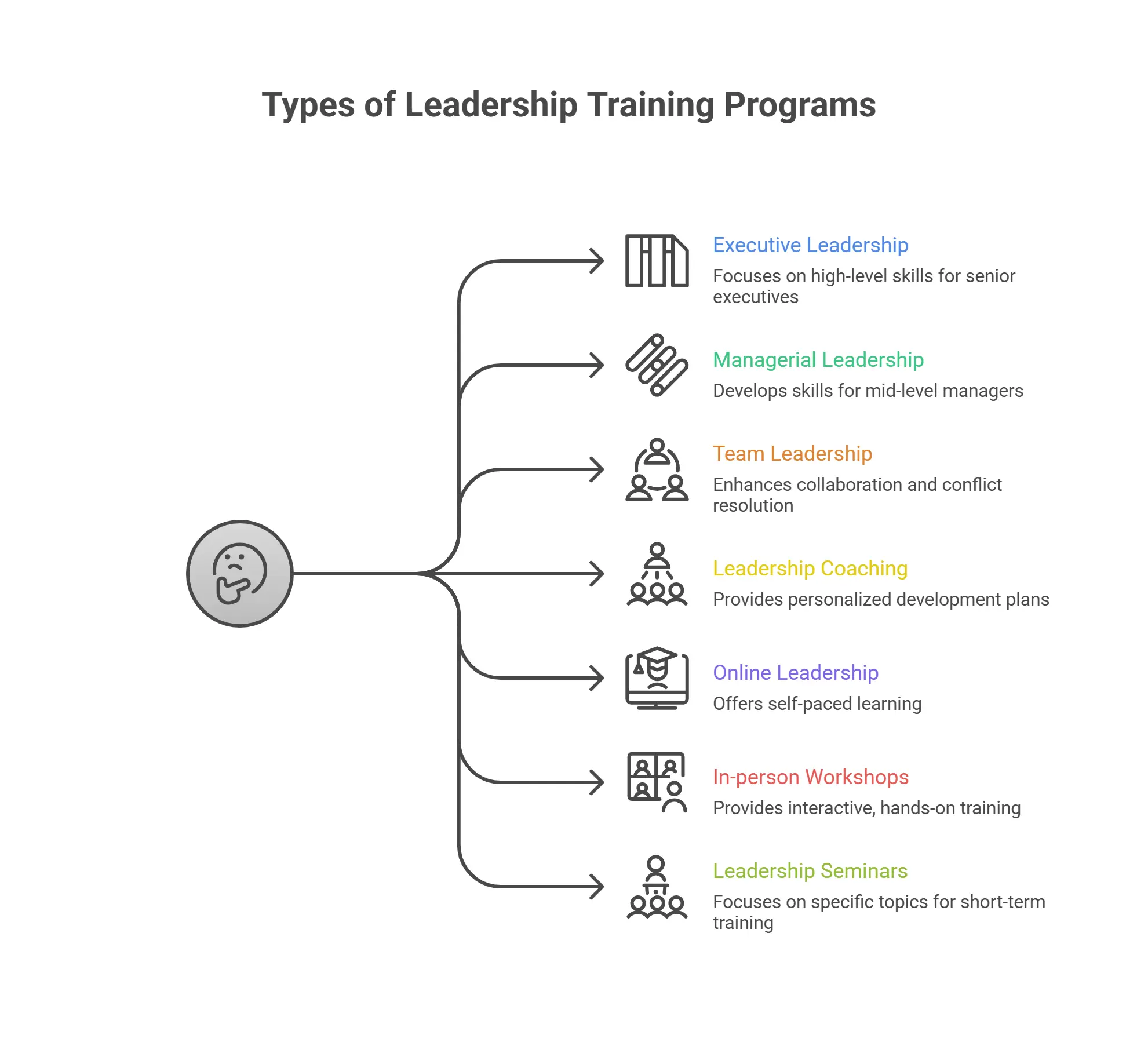
Several types of leadership training and development programs are available, each with its unique focus and approach. Some of the most common types include:
1. Executive Leadership Development Programs
These programs are designed for senior executives and top-level managers. They focus on developing high-level leadership skills, such as strategic thinking, decision-making, and change management. Typically, they are delivered through in-person training sessions, coaching, and mentoring.
2. Managerial Leadership Development Programs
Managerial leadership development programs are designed for mid-level managers and supervisors. These programs focus on developing skills in communication, delegation, team-building, and performance management. They are usually delivered through in-person or online training sessions, coaching, and mentoring.
3. Team Leadership Development Programs
Designed for project managers and team leads, these programs focus on developing skills such as collaboration, conflict resolution, and effective decision-making. Delivery methods often include in-person or online training sessions, group exercises, and role-playing scenarios.
4. Leadership Coaching
Leadership coaching is a one-on-one program designed to help individuals develop their leadership skills. Coaches work with individuals to identify their strengths and weaknesses and create customized plans for improvement. Coaching sessions can be held remotely or face-to-face.
5. Online Leadership Development Programs
Online leadership training and development programs provide self-paced training to individuals. These programs may include webinars, online courses, and virtual coaching sessions. They are ideal for individuals who cannot attend in-person training sessions or prefer to learn at their own pace.
6. In-person Leadership Workshops
In-person leadership workshops provide hands-on training to individuals. These workshops may include group exercises, role-playing scenarios, and interactive discussions. They are an ideal option for individuals who prefer a more interactive learning experience.
7. Leadership Seminars
Leadership seminars are typically short-term training programs that focus on specific leadership topics, such as time management or delegation. These programs are designed to provide targeted training to individuals who may not have the time or resources to attend a long-term leadership training program.
Regardless of the type of program, it is essential to choose one that aligns with an individual’s leadership goals and objectives. When selecting a program, consider its duration, cost, and delivery method to determine if it is the right fit.
Delivering Effective Leadership and Skills Training
To ensure training programs are impactful, organizations should focus on the delivery method. Here are some effective ways to deliver soft skills and leadership training:
- Create Targeted Content: Build a powerful training program by creating targeted, high-quality training solutions that cater to the unique needs of your employees.
- Leverage Mobile Learning and eLearning: In a globalized workforce, training must transcend location and language barriers. The benefits of mobile learning are immense, allowing employees to access training from their smart devices at their convenience.
- Provide Bite-Sized Learning Modules: Bite-sized learning is effective for improving skills like leadership and communication. These modules aid information retention and are ideal for employees with short attention spans.
- Use AR and VR: Augmented and virtual reality tools, including training simulations, offer immersive experiences that mimic real-life situations in a safe environment.
- Gamify the Training Process: Game-based learning is an effective method to deliver training because it allows teams to understand content better while having fun.
- Monitor Learning and Progress: Monitoring progress helps identify knowledge gaps and improve training material, allowing for personalized learning opportunities.
Specialized Training: Cross-Cultural Negotiation for Procurement
In a global market, specialized skills are often necessary. For instance, global procurement is a massive industry where cross-cultural negotiation skills are vital. A study found that companies lacking formal negotiation processes experienced a 63.3% decline in net income. Effective procurement training can reduce operational costs and strengthen supply chain resilience.
Key intercultural negotiation techniques include:
- Understanding Cultural Differences: Appreciating different communication styles, business practices, and decision-making processes.
- Avoiding Stereotypes: Approaching negotiations with an open mind to build trust.
- Identifying Nonverbal Cues: Recognizing that body language and tone of voice differ across cultures.
- Adapting Communication Styles: Adjusting language and tone to ensure clear understanding.
- Building Connections: Participating in shared activities to show respect for another’s culture.
- Finding Common Ground: Identifying shared values or goals to build a foundation for a mutually beneficial agreement.
- Creating Win-Win Situations: Meeting the needs of both parties to foster positive outcomes and collaboration.
Conclusion
To summarize, leadership training and development are essential for the success of any organization. Effective leaders can inspire and motivate their teams, improve productivity, reduce turnover, and foster innovation. Companies need to design a sustainable scheme to continuously train new leaders and refine the abilities of current ones.
Choosing the appropriate leadership development training services can make all the difference. As the business landscape continues to evolve, leadership development services companies like Hurix Digital will play a pivotal role in equipping the leaders of tomorrow with the skills and insights needed to navigate the dynamic terrain ahead.
At Hurix Digital, we provide a range of services, such as corporate learning solutions, e-learning, and more. Check out some of our latest blog posts to continue your learning journey, or get in touch with us to leverage our solutions for your organization.
Summarize with:

Senior Vice President – Business Development
at Hurix Digital, with over 25 years of experience in EdTech and workforce learning. He excels in business development, customer relationship management, and scaling digital learning solutions, driving global growth through innovative content, simulations, and AI‑driven training offerings