 A Space for Thoughtful
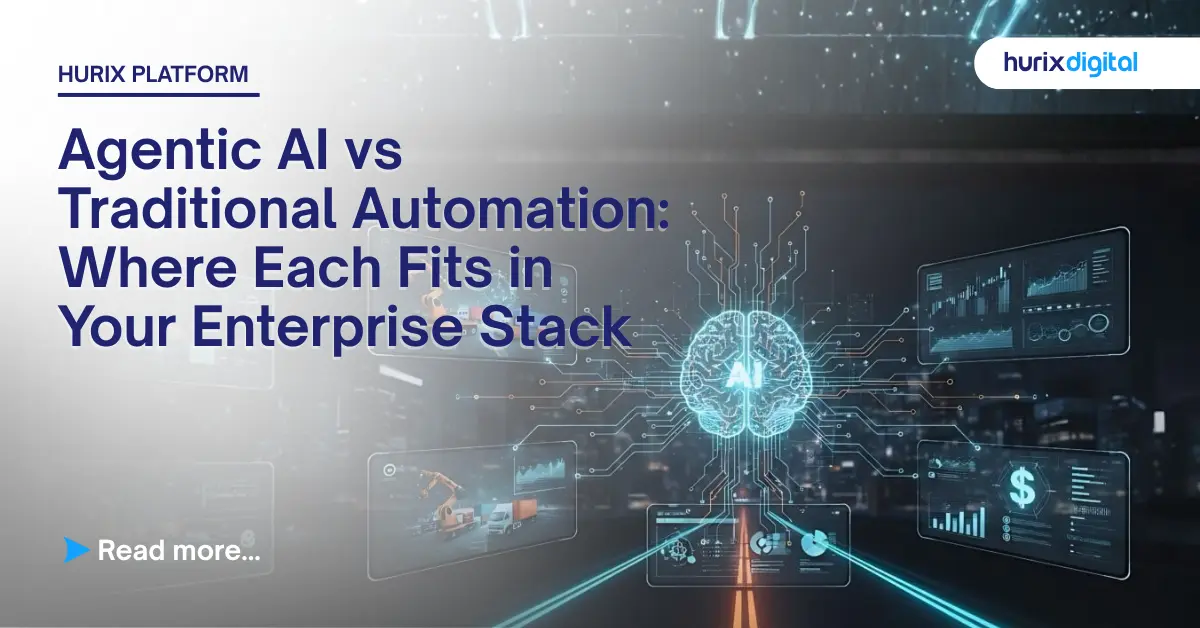
Agentic AI vs Traditional Automation: Where Each Fits in Your Enterprise Stack
Summarize with:
The promise of automation was always simple. You take the robot out of the human. We spent the better part of the last few decades hard-coding rules into software. It worked until it didn’t. The moment a variable shifted or a data format changed, the algorithm broke.
Now, we are staring at a different beast entirely. We are moving from tools that do to systems that think. This is the critical pivot of agentic AI vs. RPA. For the Chief Technology Officers (CTOs) and other tech leaders reading this, the question isn’t about replacing one with the other. It is about architectural hygiene. It is about knowing which parts of your stack need an obedient soldier and which need an autonomous strategist.
As we look toward the enterprise landscape of 2026, the distinction between rule-based scripts and true agency is becoming the defining line between stagnation and scale.
Table of Contents:
- What Distinguishes Traditional Automation from Agentic AI?
- Where Does Agentic AI Fit in the Modern Enterprise Stack?
- Emerging Trends for AI Agents
- How to Balance Cost and Capability in AI ML Solutions
- Partnering with Hurix Digital for IT Transformation Services
- FAQs
What Distinguishes Traditional Automation from Agentic AI?
To understand where to place your bets, we have to strip away the marketing fluff. Traditional automation is deterministic. It follows a script. If X happens, do Y. It is excellent for high-volume and low-variance tasks. It is the reliable backbone of legacy banking transactions and invoice processing. But it is brittle. It fails when ambiguity arises.
Agentic AI operates on a fundamentally different level. It is probabilistic and goal-oriented. You don’t tell an agent how to do a task; you tell it what the outcome should be. When evaluating agentic AI vs. RPA, the core difference lies in reasoning. An agent uses goal-oriented logic to figure out the correct steps and their order. It adapts to errors, navigates unstructured data, and even collaborates with other agents to get the job done.
Consider a procurement workflow. A traditional bot receives a purchase request. It checks whether the amount is under $5,000. If yes, it approves. If not, it emails a manager. If the vendor name is misspelled, the bot crashes or flags an error.
An AI agent behaves differently. It identifies the vendor name as misspelled and cross-references it with an external database to correct it. Then the scoop on the budget history. If it sees this purchase as an outlier compared to last quarter, it drafts a Slack message to the CFO summarizing the risk before approving.
The difference is beyond just core capabilities. Traditional automation fails when the environment changes because it cannot reason. Agentic AI thrives on that very complexity.
Where Does Agentic AI Fit in the Modern Enterprise Stack?
If you are a CIO, you are likely looking at a messy stack of legacy ERPs and cloud data lakes. You also have varied SaaS applications. Here is a pragmatic approach to AI integration.
The Execution Layer: Keeping Traditional Automation
Do not rip out your RPA bots. For static and high-volume tasks such as payroll processing or database migration, deterministic code remains superior. It is cheaper and faster. These systems form the hands of your stack. In the broader context of agentic AI vs. RPA, RPA is your precision tool for structured environments.
The Orchestration Layer: Introducing the Agentic Loop
This is where agentic AI sits. It acts as the brain. It ingests unstructured data, such as emails and PDFs. It structures that information. And then takes the decisions that used to need a human analyst.
The agentic loop is the core mechanism here. The agent observes the environment and reasons about the next step. It acts, perhaps by triggering an RPA bot, and then evaluates the result. This loop enables human-in-the-loop automation, where the agent handles most of the work and escalates to a human only when confidence is low.
Emerging Trends for AI Agents
We are seeing a shift from single-agent assistants to multi-agent systems. In this setup, agents have distinct roles:
- The researcher scours internal wikis and the web.
- The critic reviews the researcher’s output for hallucinations or logical errors.
- The executor formats the final report or executes code.
Research indicates that protocols like the agent-to-agent protocol will become standard. This allows agents from different vendors to communicate. A Salesforce agent could coordinate tasks with a Microsoft agent without human intervention. This interoperability will be the key to breaking data silos in the agentic AI vs. RPA ecosystem.
How to Balance Cost and Capability in AI ML Solutions
Let’s be honest about the risks. Trust is the currency of automation. Right now, trust is expensive. Many organizations are hesitant to trust fully autonomous agents. The reality of hallucinations is still a concern.
There is a trade-off between reliability and autonomy. Traditional automation is rigid but predictable. Agentic AI is flexible but probabilistic. A 95% accuracy rate is good for summarizing decades of news headlines. It is unacceptable for international wire transfers.
There is also a trade-off between cost and capability. Running large inference models for every trivial task is financial suicide. You need to use small language models (SLM) for routine reasoning. Save the heavy-duty LLMs for complex strategic tasks. Navigating the agentic AI vs. RPA cost-benefit analysis requires a tiered approach to model selection.
Partnering with Hurix Digital for IT Transformation Services
The transition to an agentic enterprise is not just about installing new software. It is about fundamentally restructuring how your organization manages knowledge and data. This is where the gap between potential and execution usually widens.
At Hurix Digital, we understand that the foundation of any intelligent system is pristine data and accessible content. Whether you are looking to deploy AI/ML solutions for automated content moderation or modernize your learning platforms, the quality of your underlying assets dictates your success.
Ready to future-proof your enterprise stack? Talk to an AI transformation expert today to see how Hurix can help you build the infrastructure for the agentic era.
Frequently Asked Questions(FAQs)
Q1: Does Agentic AI replace my existing RPA bots?
No. Think of Agentic AI as the “brain” and RPA as the “hands.” Agentic AI excels at decision-making and handling unstructured data (such as emails), while RPA is better at executing repetitive tasks in rigid systems (such as data entry in legacy software). Most enterprises use a hybrid model.
Q2:Why is Agentic AI considered more “expensive” than RPA?
RPA has a predictable cost per transaction, whereas Agentic AI relies on LLM “tokens” or inference costs, which can vary. Additionally, Agentic AI requires stronger oversight and guardrails to manage the “probabilistic” nature of its outputs, compared to the “if-then” logic of RPA.
Q3:Can Agentic AI handle legacy systems without APIs?
Yes, but often by using RPA as a tool. An AI agent can reason that it needs to fetch data from a 20-year-old ERP, but it will likely trigger an RPA bot to “screen scrape” or click the buttons required to get that data.
Q4: What are the main risks of choosing Agentic AI over RPA for a task?
The primary risk is “hallucination” or unpredictable behavior. Because Agentic AI is probabilistic, it might solve a problem differently each time. For highly regulated tasks (like tax filing), the deterministic, “black-and-white” nature of RPA is often safer.
Q5: How do I decide which to use for a specific workflow?
If the process is 100% predictable with structured data (Excel, SQL), use RPA. If the process involves interpretation, varying formats (PDFs, voice, chat), or requires the system to “find a way” when a step fails, use Agentic AI.
Summarize with:

Vice President & SBU Head –
Delivery at Hurix Technology, based in Mumbai. With extensive experience leading delivery and technology teams, he excels at scaling operations, optimizing workflows, and ensuring top-tier service quality. Ravi drives cross-functional collaboration to deliver robust digital learning solutions and client satisfaction