 A Space for Thoughtful
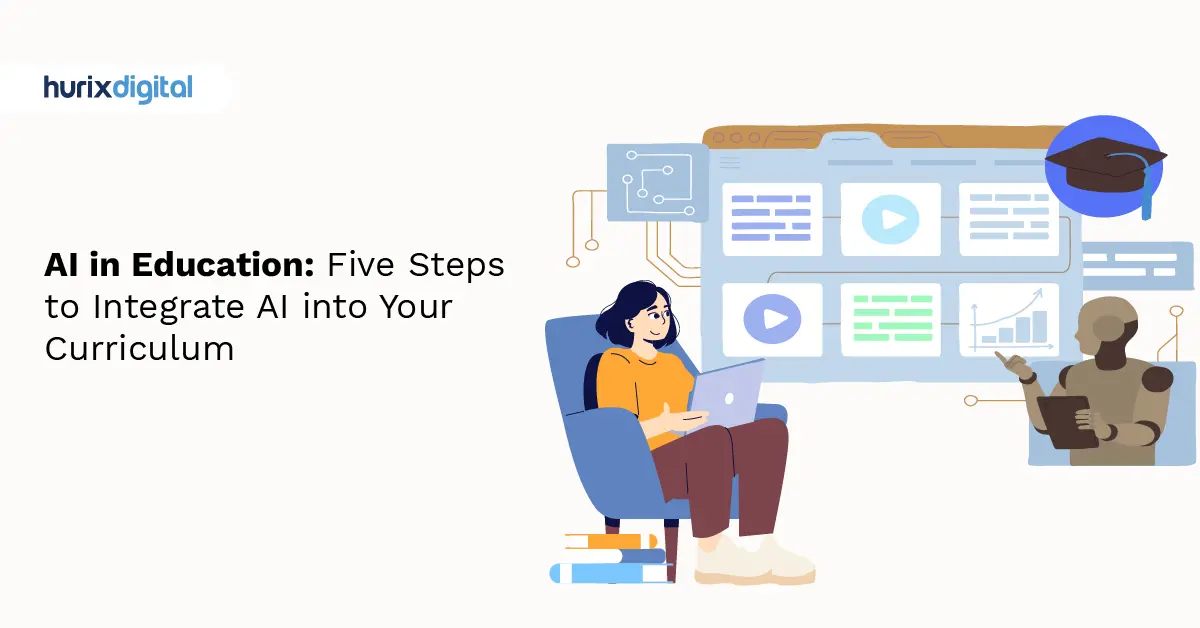
AI in Education: Five Steps to Integrate AI into Your Curriculum
Summarize with:
This may come as a surprise to most, but digitization is not the final frontier for education and eLearning. It is just the beginning of a new and modern educational institution.
An astounding 99.4% of higher educational institutions in the US mentioned they are already using AI in learning in some form, and the role of Artificial Intelligence in education will only increase as we move towards a fully digital era.
As a result, the AI education market is predicted to be more than USD 20 billion by 2027 since it brings innumerable benefits to students and teachers.
In this blog, we will delve deeper into the transformational role of AI in learning and understand unique ways of using AI in the classroom.
Table of Contents:
- The Opportunities of AI in Education
- The Challenges of AI in Education
- Uncovering Key AI Strategies for EdTech Startups
- Five Steps to Integrate AI in Learning in the School Curriculum
- What are the Top 5 AI Tools for Creation Tools for Educators?
- The Future of AI in Education
- The Bottom Line
The Opportunities of AI in Education
AI is evolving rapidly, presenting numerous opportunities for the education sector:
1. Creation of a Smart Virtual Campus
Students new to a higher education institution or who have arrived from an offshore location often find the initial experience overwhelming. They need to browse different information sources to get the correct answers to their queries.
Universities can leverage machine learning in education to solve this challenge. Chatbots built on an AI framework and posted on the university website can help students explore the facilities and options at their own pace in the desired language.
Any inquiry can be placed, and the chatbot delves into its knowledge base to provide a plausible response. If the answer is unavailable, the query can be forwarded to a university office bearer for the solution. Students can flag the responses to seek human intervention if any answer is unsatisfactory.
2. Facilitation of Personalized Learning
AI relies on a granular-level analysis of the learners’ performance to suggest customized knowledge assimilation techniques that cater to individual requirements. The personalized learning paths can potentially enhance study outcomes by plugging loopholes in the learner’s approach and aligning topics with their aptitude.
This was also revealed in the Bill & Melinda Gates Foundation study, which found that 93% of interviewed teachers believed in AI’s superpower.
3. Streamlining the Learning of Complex Topics
Learners often feel intimidated by the complexities inherent in mathematics and other subjects. AI-enhanced curriculum design can address this with student-facing instructional tools that adapt content responsively for individual needs and learning preferences.
Real-world scenarios can be simulated to promote critical thinking and the spirit of inquiry. AI can offer recommendations to assist learners in generating ideas that make navigating complex topics easier.
AI-enabled learning tools promote advanced thinking, creative problem-solving, and reasoning capabilities in students. The intuitively generated questions can help learners work through increasingly tougher challenges. Teachers can gain frequent guidance and insights to improve their instructional methods.
4. Making Teaching More Scalable and Cost-Effective
AI renders pedagogic technology more innovative. This can make classroom observation, work analysis of students, coaching, and other resource-intensive aspects of teaching scalable and cost-efficient.
AI assistants can relieve teachers by sharing the burden of cognitively challenging jobs like lesson planning, grading, communication, etc. Teachers can better focus on higher-leverage things like adapting instructional tools to enhance the learning experience.
AI tools can facilitate quicker and more efficient measurement of changes in teachers’ mindsets, beliefs, and practices. Edtech companies can collaborate with teachers to enhance the appeal of existing curricula.
5. Providing Proactive Intervention
AI has taken Data Analytics in education to the next level. AI-powered algorithms can quickly analyze large amounts of student-oriented data to segregate patterns and decisively predict potential pitfalls and improvement opportunities. This early warning mechanism can be used individually to provide effective interventions that guarantee learners’ success.
6. Making Learning More Innovative
AI will usher in innovative learning tools and frameworks, such as smart learning content recommendation systems.
Gamification and AI can combine to make learning more fun, immersive, and value-added. AI-powered educational apps can help deliver efficient learning experiences uniquely customized to students’ needs.
In fact, Education Week has reported that 78% of educators opine that AI-driven digital tools can positively impact teaching.
The Challenges of AI in Education
Indiscriminate use of AI in education can open Pandora’s box of challenges. They need to be addressed strategically to ensure that AI remains beneficial for learners and educators.
Here are the top challenges AI comes with:
1. Ensuring Equity and Inclusion
The rapid advancement of AI may subject third-world countries to technological discrimination as they are not economically strong enough to adopt and implement technological infrastructure on a mass scale. The children over there will fail to benefit from AI, which can create new social divides at the global level.
UNESCO says that almost 40% of the global population doesn’t have internet access. This can pose a challenge in eliminating disparities in AI-driven education.
2. Making Teachers Adapt to Radically New Technology
Teachers will be at the helm of disseminating knowledge through AI-driven technologies. They have to be rigorously trained to leverage AI technology and integrate it into classrooms efficiently. The challenge lies in bridging the knowledge gap and ensuring that educators are well-equipped to optimize digital tools’ usage.
3. Grappling with Algorithm Biases
The outcomes of AI can be biased if the systems are trained on biased data. MIT (Massachusetts Institute of Technology) has researched AI-driven facial recognition systems and found that they showcase biases based on race and gender. This is scary in the academic context, considering that diversity abounds in learning concepts. It will be a challenge to make algorithms fair.
4. Addressing Concerns about Student Privacy
AI systems generate a significant volume of data with sensitive, student-centric information. Safeguarding learners’ privacy while optimally using AI systems to make education more contemporary will be a challenge.
In a recent study, the Center for Democracy and Technology claims that only 25% of K12 learning centers have formulated policies to safeguard student data for AI learning modes.
5. Undoing the Overreliance on Standardized Assessment
AI can promote holistic learning, but its scope can be potentially limited by excessive dependence on automated assessment. The focus should be on providing a well-rounded learning experience where measurable results need to be personalized for proper mentoring.
Uncovering Key AI Strategies for EdTech Startups
Imagine an education system that adapts to each student’s unique needs, keeps them engaged, and unlocks their full potential. EdTech startups are harnessing the power of Artificial Intelligence (AI) to make this vision a reality.
EdTech startups have a vast arsenal of AI-powered tools at their disposal to personalize and optimize the learning journey. Let’s explore key AI strategies that can propel your startup to the forefront of personalized learning and future-proof your business.
1. Adaptive Learning Platforms
These platforms utilize machine learning to tailor the learning content and pace to each student’s individual needs and strengths. By analyzing data on performance, preferences, and learning styles, they create dynamic curriculum pathways that ensure mastery and engagement.
2. Intelligent Tutoring Systems (ITS)
These AI-powered virtual tutors provide personalized feedback and guidance based on a student’s understanding. They can answer questions, identify knowledge gaps, and offer additional resources, acting as a supportive and intelligent study companion.
3. Automated Grading and Feedback
AI can take over the burden of tedious tasks like grading essays and multiple-choice tests. This frees up valuable teacher time for personalized interaction and in-depth discussions, while also delivering immediate and consistent feedback to students.
4. Gamification and Learning Through Play
AI can power engaging and interactive learning experiences through game-based elements. These experiences can enhance motivation, reinforce concepts, and provide real-time feedback in a fun and immersive way.
5. Language Learning Tools
AI-powered language learning platforms utilize speech recognition and natural language processing to offer personalized pronunciation feedback, conversation practice, and adaptive vocabulary learning activities.
Five Steps to Integrate AI in Learning in the School Curriculum
Here are five actionable steps to help schools, colleges, and universities incorporate AI effectively:
1. Build a Strong Foundation with AI Knowledge
- Actionable Steps: Provide instructors with the opportunity for professional development first. Encourage educators to enroll in online courses or training centered on AI. Work together with industry professionals and curriculum specialists to determine how AI might be applied to various subject areas.
- Considerations: Based on how your students use AI on a daily basis in the real world, determine which AI tools are most applicable and easily available to them. For instance, language arts and social studies classes could use tools like chatbots, AI-powered writing aides, and virtual assistants.
2. Revise the Curriculum to Incorporate AI Concepts
Actionable Steps: Review your existing curriculum and identify areas where AI concepts could enhance learning objectives.
Align the curriculum with the AI4K12 Five Big Ideas, which include:
- Perception: Understanding how AI senses the world.
- Representation and Reasoning: Teaching how AI models knowledge to solve problems.
- Learning: Exploring how AI systems learn from data.
- Natural Interaction: An introduction to natural interaction.
- Societal Impact: Talking about the advantages and disadvantages of AI for society.
Considerations: To promote a comprehensive understanding of AI, make sure these concepts are incorporated into a variety of topics, from science and math to the humanities.
3. Set Clear Learning Objectives and New Assessment Criteria
- Actionable Steps: Establish specific targets that will align with the outcomes of subject areas specific to AI learning. Indicate precisely how students’ understanding of AI is leading to improvement in the solving, critical thinking, and creativity aspects of student operations.
- Considerations: To come up with new standards for assessing both general learning objectives, such as teamwork and creativity, and AI-specific competencies, like knowledge in machine learning or neural networks. Use formative assessment mechanisms such as projects, quizzes, and discussions on AI to measure progress.
4. Design Engaging, Interactive AI Learning Activities
- Actionable Steps: Create practical, project-based exercises that expose students to AI applications in the real world. For instance, assign students to design basic AI applications, develop predictive models, or evaluate data using AI technologies.
- Considerations: Scaffold activities progressively, starting from simple AI concepts like pattern recognition to complex tasks like developing machine learning models. Provide opportunities for students to explore AI through case studies, simulations, and collaborative projects that make learning interactive and fun.
5. Evaluate, Iterate, and Continuously Improve
- Actionable Steps: Evaluate student comprehension and the success of integrating AI into your program regularly. Get instructor and student input, and monitor the impact of AI instruction on overall learning objectives.
- Considerations: Use a combination of traditional assessments (tests, quizzes) and innovative methods (student reflections, AI project reviews). Adjust the curriculum based on student interest and evolving AI trends to keep the content relevant and engaging.
What are the Top 5 AI Tools for Creation Tools for Educators?
AI for learning has opened avenues of innovation, collaboration, and personalized learning routes.
Below are the top five content creation tools for educators that leverage the power of artificial intelligence to enhance the educational experience:
1. ChatGPT
ChatGPT shines as an AI course developer, offering a suite of EdTech solutions for educators. It excels in crafting engaging content, providing timely research assistance, and enhancing course materials.
For educators who create courses, ChatGPT can be quite helpful in the following ways:
A. Easy Content Creation
The capacity of ChatGPT to quickly generate a wide variety of content types is one of its most remarkable characteristics. It can effectively generate course outlines, lesson plans, activities, evaluations, and other written materials.
This is especially helpful in EdTech solutions for content creation that require a lot of information quickly and ensure it fits their pedagogical style and course objectives.
B. Quick and Precise Research
An essential component of developing a course is research. ChatGPT can help by rapidly supplying knowledge on a range of course-related topics. This saves time and guarantees that your course material is up-to-date and precise, both of which are essential for providing a top-notch learning experience.
C. Editing and Proofreading to Refine Content
ChatGPT assists in refining your drafts, spotting and correcting grammatical nuances and stylistic inconsistencies. This process ensures your educational content is not only informative but also engaging and easy to comprehend.
2. Canva
Canva is an AI-powered design tool that significantly enhances the process of creating educational materials.
Here’s what it seamlessly generates:
A. AI-Created Images and Videos
Canva’s ability to create pictures and videos with artificial intelligence is one of its best capabilities. The Text to Image tool is revolutionary because it makes it simple for instructors to turn written information into unique images.
Whether it’s crafting infographics to demystify complex subjects, designing diagrams to illustrate processes, or creating captivating images to engage learners, Canva streamlines the production of visually impactful content seamlessly.
B. AI-Powered Templates for Design
An essential component of producing engaging course materials is design. The Magic Design tool from Canva generates templates depending on user input, eliminating the need for speculation in design.
With minimal design experience, instructors may easily create engaging worksheets, brochures, presentations, and other resources. This function guarantees that the course material maintains a professional and uniform appearance while also saving time.
C. AI-Powered Textual Content
Written material still holds equal importance in the era of online learning. The Magic Write tool from Canva helps instructors by producing text for a variety of uses.
Education professionals can employ AI-generated materials to enhance their courses through blog articles, social media announcements, and email newsletters. This entails coming up with engaging discussions, reference sheets, and course summaries for students.
3. AI Quiz Maker
This is an indispensable AI-powered platform that has been carefully crafted to satisfy the unique needs of course developers.
Its extensive feature set makes it an indispensable tool for teachers, improving the quality of the learning process and simplifying the development of quizzes.
Here’s what it offers:
A. Perceptive Test Analytics
Course enhancement requires a comprehension of students’ performance. Quiz Maker offers comprehensive quiz statistics that shed light on the achievement of students.
With the power of AI-driven instructional design, course designers can precisely identify areas where students may need additional support and adapt their teaching methods accordingly. The entire extent of the learning process can be considerably improved by using this data-driven tool.
B. Various Question Types for Customised Evaluations
AI Quiz Maker provides a range of question formats, such as essay, open-ended, either true or false, and fill-in-the-blank problems that can be adapted to different learning styles and objectives.
Because of its adaptability, educators can design exams that perfectly match the students’ learning goals.
4. Lumen 5
Lumen5 is an innovative tool that empowers educators to transform their content into engaging and educational videos, even without prior video editing experience.
Its ability to convert text to video is one of its best features. Course designers can use this feature to turn textual materials into interactive multimedia presentations.
Here are the benefits of this tool:
A. Formulate Video Lectures
Teachers can go beyond the conventional, laden-with-text lecture format with the help of Lumen5. Thanks to the platform’s features, you may make interesting and educational video lectures. It not only enhances student engagement but also caters to diverse learning styles.
B. Plan Video Tutorials
With Lumen5, creating AI-driven e-learning materials is remarkably straightforward and effective.
Educators can seamlessly create detailed and captivating lessons covering a wide array of subjects. Whether it’s guiding students through software usage, solving complex math problems, or conducting scientific experiments, Lumen5 provides the essential tools to design tutorials that are not only informative but also engaging.
5. Curipod
Curipod is a dynamic tool that helps educators craft interactive and personalized classes rapidly using AI. This tool excels in its ability to tailor lessons to individual student needs across various subjects.
On this tool, instructors need to input a topic to create a ready-to-use lesson that includes text, graphics, and interactive elements like word clouds, questionnaires, and open-ended answers. Even activities that center on SEL check-ins can be incorporated into these materials, making it an even more comprehensive educational resource for students.
Here’s what it helps with:
A. Designing Quizzes
Using Curipod, you can incorporate quizzes that students can complete on their devices and have the outcomes displayed on the classroom’s large screen.
B. Using AI in Curriculum Development
With the use of this application, you can organize and produce lessons that can be shared, revised, and used again whenever required throughout the year. This will help you save time by assisting with evaluations and student development.
The Future of AI in Education
The future of AI in education is bright and brimming with possibilities. 67% of educators believe AI will play a significant role in improving student performance.
- Natural Language Processing (NLP) personalizes feedback and assessments by understanding student language, providing tailored responses, and identifying areas for improvement.
- Deep learning will create more sophisticated adaptive learning by analyzing vast amounts of data to predict individual needs and deliver highly customized learning paths.
- AI-powered tools will support social-emotional learning and mental health by analyzing student communication, identifying potential issues, and offering personalized resources and support.
- Wearables and brain-computer interfaces can now be integrated with AI to provide real-time insights into student engagement, emotional state, and cognitive performance, enabling personalized interventions.
- More advanced AI-powered tutors will be able to provide more nuanced feedback, answer complex questions, and even guide students through open-ended projects.
- Integration of AI with other technologies will seamlessly integrate with VR/AR, gamification, and other emerging technologies to create immersive and engaging learning experiences.
- Focus on social-emotional learning will be used to personalize social-emotional learning experiences, helping students develop essential life skills.
- Closing the equity gap is essential. AI-powered tools can be used to personalize learning for disadvantaged students, helping to close the equity gap in education.
The Bottom Line
The role of AI may still be in its nascent stages, but it will have a profound impact in the near future. AI in learning is changing through personalized experiences, smart content creation, task automation, 24/7 chat assistance, and proctoring.
As we move forward, the role of AI in education will continue to evolve and expand. It holds the potential to enhance adaptive learning further, advance educational research, and enable a more accessible learning experience.
If you are looking for a partner to transform and take your digital learning experience to the next level, Hurix Digital’s Learning management systems can help you do that. For a state-of-the-art educational transformation, get in touch with Hurix Digital.
Summarize with:

Senior Vice President – Business Development
at Hurix Digital, with over 25 years of experience in EdTech and workforce learning. He excels in business development, customer relationship management, and scaling digital learning solutions, driving global growth through innovative content, simulations, and AI‑driven training offerings