 A Space for Thoughtful
Designing, Developing, and Delivering Engaging eLearning Content: A Comprehensive Guide
Summarize with:
Organizations today face dual challenges around their workforce. They need to keep people skilled and engaged while adapting to new work models that range from traditional office settings to remote and hybrid environments. The key to meeting these challenges lies in creating eLearning content design that not only educates but truly engages learners at every touchpoint.
This comprehensive guide explores the essential strategies, methodologies, and best practices for designing, developing, and delivering eLearning content that drives measurable results and genuine learner engagement across all modern workplace configurations.
Table of Contents:
- Understanding Learner Engagement in the Digital Age
- The Three Pillars: Design, Develop, Deliver
- Effective eLearning Methods for the Modern Workforce
- Transforming eLearning Through Impactful Storytelling
- Addressing Common Challenges in Remote and Hybrid Workforces
- The Role of Learning Management Systems in Engagement
- Measuring Learner Engagement and Effectiveness
- Balancing Engagement with Learning Effectiveness by Avoiding Common Pitfalls
- The Future of eLearning Engagement
- Conclusion: Creating eLearning That Truly Engages
Understanding Learner Engagement in the Digital Age
Before diving into content creation strategies, it’s crucial to understand what learner engagement truly means. Learner engagement refers to the degree of attention, curiosity, interest, optimism, and passion that learners exhibit when learning or being taught. It extends beyond simple participation. It encompasses emotional, cognitive, and behavioral involvement with the learning material.
Engaged learners don’t just complete courses; they actively participate, ask questions, apply concepts, and retain information long after the training concludes. This level of engagement directly correlates with improved performance, higher retention rates, and better return on investment for organizational training programs.
The Engagement Challenge
Many organizations struggle with learner disengagement, which manifests as:
- Low course completion rates
- Minimal interaction with learning materials
- Poor knowledge retention
- Limited application of learned concepts
- Decreased motivation to pursue further learning
These challenges have been exacerbated by the shift to remote and hybrid work models, where physical distance can create a psychological barrier to learning initiatives.
The Three Pillars: Design, Develop, Deliver
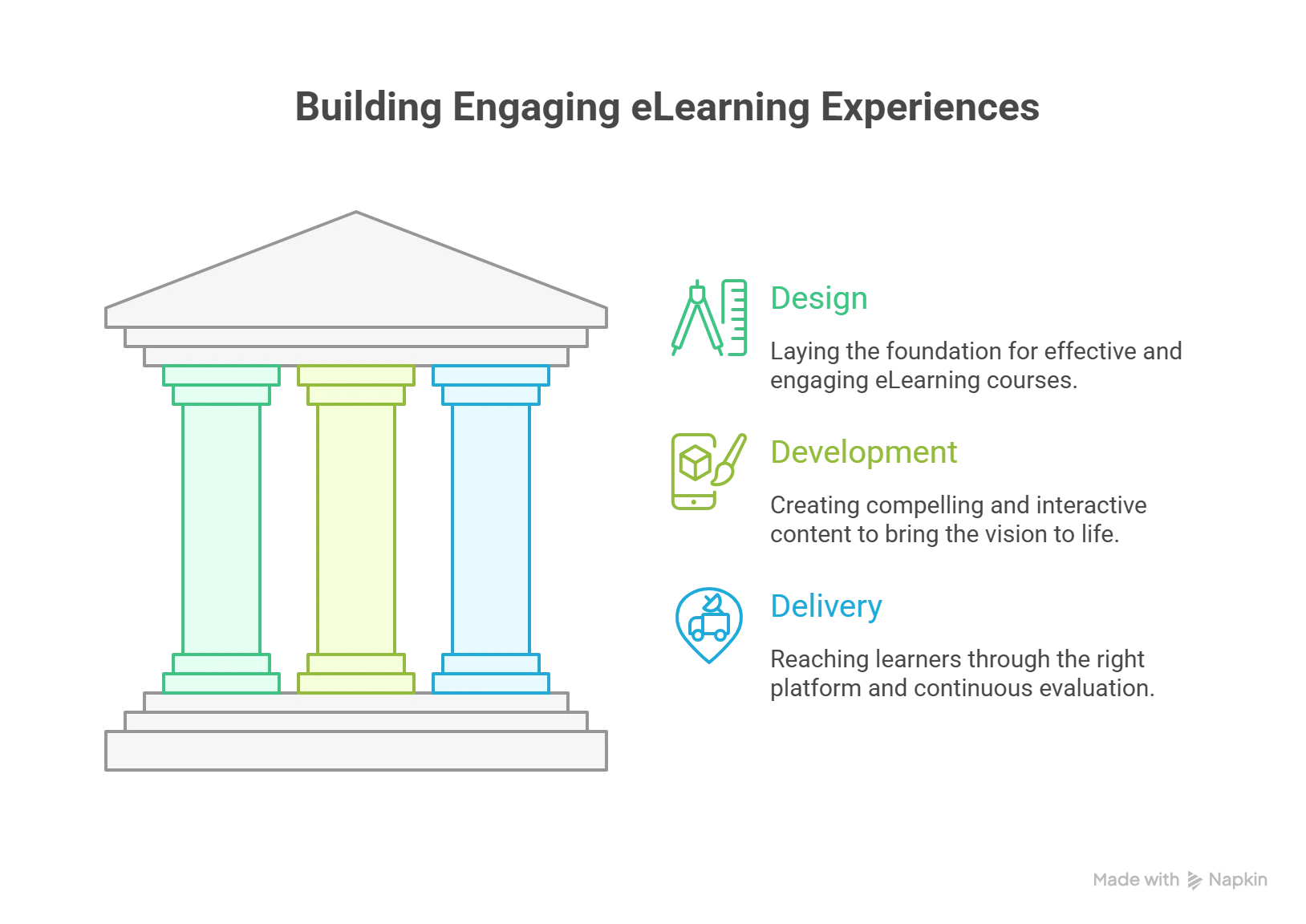
To combat disengagement, we need a structured approach to content creation. The “Design, Develop, Deliver” model provides a robust framework for building eLearning experiences that truly connect with your audience.
Phase 1: The Design Stage – Laying the Foundation
The design phase is the most critical part of the process. This is where you lay the groundwork for an effective and engaging eLearning course. A well-thought-out design ensures that the content is aligned with business goals, tailored to the learners’ needs, and structured for maximum impact.
Before you write a single word, you need to know who you’re creating the content for. Conduct a thorough audience analysis to understand their existing knowledge, skill levels, learning preferences, and motivations. Are they tech-savvy millennials who prefer bite-sized mobile learning? Or are they seasoned professionals who appreciate in-depth case studies? Tailoring the content to their needs is the first step toward engagement.
What should your learners be able to do after completing the course? Learning objectives should be specific, measurable, achievable, relevant, and time-bound (SMART). Clear objectives guide the content creation process and help learners understand what is expected of them. For example, instead of “Learn about project management,” a better objective would be “By the end of this module, you will be able to create a project timeline using our company’s software.”
Several instructional design models can help you structure your content. Some popular ones include:
- ADDIE Model: A classic framework consisting of five stages: Analysis, Design, Development, Implementation, and Evaluation.
- Merrill’s Principles of Instruction: Focuses on problem-centered learning, activation of prior knowledge, demonstration, application, and integration.
- Gagne’s Nine Events of Instruction: A systematic process that includes gaining attention, informing learners of objectives, stimulating recall, presenting content, providing guidance, eliciting performance, providing feedback, assessing performance, and enhancing retention.
Selecting the right model provides a proven roadmap for creating a cohesive and effective learning experience.
Phase 2: The Development Stage – Bringing the Content to Life
With a solid design in place, the development phase is where your vision becomes a reality. This stage involves creating the actual course materials, encompassing text, visuals, interactive elements, and assessments.
Content is king, even in eLearning. Your course material should be accurate, up-to-date, and directly relevant to the learners’ jobs. Break down complex topics into smaller, digestible chunks. Use clear and concise language, avoiding jargon whenever possible. Remember, the goal is to make learning as effortless and enjoyable as possible.
Humans are visual creatures. High-quality visuals can simplify complex concepts, enhance knowledge retention, and make your course more engaging and appealing. Incorporate a variety of visual elements, such as:
- Images and Illustrations: Use relevant images to break up text and illustrate key points.
- Infographics: Present data and statistics in a visually engaging format.
- Videos: Use short videos for demonstrations, expert interviews, or storytelling. An animated video can explain a complex business process in a simple, memorable way.
- Charts and Graphs: Help learners visualize trends and relationships in data.
When used thoughtfully, visuals transform a text-heavy course into a vibrant learning experience.
Passive learning is boring. Get your learners actively involved in the process with interactive elements. This not only keeps them engaged but also helps reinforce learning. Consider including:
- Quizzes and Polls: Check for understanding and gather feedback.
- Drag-and-Drop Activities: Use these for sorting, matching, or sequencing exercises.
Phase 3: The Delivery Stage – Reaching Your Learners
The final stage is delivering the content to your audience. The delivery method can have a significant impact on learner engagement and the overall success of your training program.
A Learning Management System (LMS) is the backbone of most corporate eLearning programs. A modern, user-friendly LMS makes it easy for learners to access courses, track their progress, and interact with peers. When choosing an LMS, look for features that enhance the learning experience, such as:
- Mobile-Friendliness: Learners should be able to access content on any device, anytime, anywhere.
- Social Learning Features: Discussion forums, chat functions, and collaborative projects can foster a sense of community.
- Personalization: The ability to recommend courses based on a learner’s role, interests, and past performance.
- Robust Reporting: Track key metrics like completion rates, assessment scores, and learner satisfaction to measure the effectiveness of your training.
An LMS like the one offered by Hurix can be a powerful tool for enhancing employee engagement. It centralizes learning, automates administrative tasks, and provides valuable data insights to help you continuously improve your training programs.
The delivery of a course is not the end of the journey. To ensure your eLearning content remains effective and engaging, you must continuously evaluate its performance. Collect feedback from learners through surveys and focus groups. Analyze the data from your LMS to identify areas for improvement. Are learners dropping off at a particular point in the course? Are they struggling with a specific assessment? Use these insights to refine your content and keep it relevant.
Effective eLearning Methods for the Modern Workforce
Different work environments and learning objectives require tailored approaches. Here are proven eLearning methods particularly effective for today’s diverse workforce:
1. Microlearning
Microlearning delivers content in small, focused chunks that learners can consume quickly. This approach is particularly effective for:
- Mobile learners
- Busy professionals
- Reinforcement of previously learned concepts
Each microlearning module focuses on a single learning objective and typically takes 3-10 minutes to complete. This format suits remote employees perfectly, allowing them to learn between meetings or during brief breaks.
2. Scenario-Based Learning
Scenario-based learning places learners in realistic situations where they must apply knowledge to solve problems. This method:
- Increases engagement through relevance
- Improves critical thinking skills
- Facilitates knowledge transfer to real work situations
- Provides safe practice environments
For hybrid teams, scenarios can specifically address challenges like communication across time zones, maintaining team cohesion with distributed members, or managing projects with varied work arrangements.
3. Gamification
Incorporating game elements into learning experiences taps into intrinsic motivation:
- Points and badges for achievements
- Leaderboards for friendly competition
- Progress bars and levels
- Challenges and quests
- Rewards and unlockable content
Gamification strategies can transform mundane compliance training into engaging experiences that learners actually want to complete.
4. Social and Collaborative Learning
Leverage the collective knowledge of your workforce through:
- Discussion forums and communities of practice
- Peer-to-peer knowledge sharing
- Collaborative projects
- Group challenges
- Expert panels and Q&A sessions
For remote teams, these social elements combat isolation and build connections between distributed team members. Virtual coffee chats, team challenges, and collaborative problem-solving exercises help maintain the social fabric of learning.
5. Video-Based Learning
Video content offers tremendous versatility:
- Recorded presentations and demonstrations
- Expert interviews
- Customer testimonials
- Process walkthroughs
- Animated explainers
Videos can be consumed asynchronously, making them ideal for global teams across different time zones. They also add a human element to digital learning, helping remote employees feel more connected to their organization and colleagues.
6. Blended Learning Approaches
Combining multiple methods creates richer learning experiences:
- Self-paced online modules followed by live virtual workshops
- Pre-work assignments before collaborative sessions
- Microlearning reinforcement after formal training
- On-the-job application with online support resources
Blended approaches leverage the strengths of different methods while accommodating various learning preferences and schedules.
7. Adaptive Learning
Adaptive learning systems use algorithms to personalize the learning experience based on individual performance:
- Content difficulty adjusts based on learner responses
- Additional support is provided in areas of struggle
- Advanced learners can skip mastered content
- Personalized learning paths optimize time and outcomes
This technology ensures that each learner receives an experience tailored to their needs, maximizing both engagement and effectiveness.
8. Mobile Learning
With a mobile-responsive design, learners can access content anytime, anywhere:
- Learn during commutes
- Review materials before meetings
- Access performance support tools on the job
- Complete quick modules between tasks
Mobile learning is essential for hybrid workers who move between office and remote locations and need consistent access to learning resources.
9. Virtual Reality (VR) and Augmented Reality (AR)
While still emerging, immersive technologies offer unprecedented engagement opportunities:
- VR simulations for high-risk training scenarios
- AR overlays for on-the-job guidance
- degree video experiences
- Virtual field trips and environmental exploration
These technologies are particularly valuable for hands-on skills training when physical practice isn’t feasible.
10. Performance Support Systems
Just-in-time learning resources help employees at the moment of need:
- Searchable knowledge bases
- Quick reference guides
- Video tutorials
- Interactive decision trees
- Chatbots for instant answers
Performance support bridges the gap between formal learning and daily work application, particularly valuable for remote employees who may not have immediate access to colleagues for quick questions.
Transforming eLearning Through Impactful Storytelling
One of the most powerful yet often underutilized techniques in eLearning design is storytelling. Humans are hardwired for stories—they engage our emotions, aid memory retention, and create meaningful connections with content.
Stories activate multiple regions of the brain simultaneously. When learners hear facts and figures alone, only the language processing parts of the brain engage. But when those facts are woven into a narrative, the sensory cortex, motor cortex, and emotional centers also activate, creating a richer, more memorable learning experience.
Key benefits of storytelling in eLearning include:
- Enhanced retention: Information embedded in stories is up to 22 times more memorable than facts alone
- Emotional connection: Stories create empathy and personal investment in the material
- Context and relevance: Narratives show how concepts apply in real situations
- Engagement: Stories capture and maintain attention far better than abstract instruction
- Meaning-making: Learners construct deeper understanding through narrative frameworks
Addressing Common Challenges in Remote and Hybrid Workforces
The shift to remote and hybrid work models has introduced specific challenges that eLearning content must address to maintain engagement and effectiveness. Below are the common challenges in remote employee training and engagement, and how to address them:
1. Isolation and Disconnection
Remote workers often feel isolated from their colleagues and company culture, which can significantly impact their engagement with learning initiatives. To combat this sense of disconnection, eLearning content design should incorporate social learning elements that actively build connections between distributed team members. Using video content adds a crucial human presence to training, helping remote employees feel more connected to their organization and colleagues..
2. Digital Fatigue
Remote employees experience significant screen time throughout their workday, leading to video conference fatigue and reduced attention spans that can undermine learning effectiveness. To combat this challenge, organizations should keep training modules brief, ideally between five to ten minutes when possible, allowing learners to absorb information in manageable chunks without adding to screen fatigue.
Varying media formats prevents monotony and re-engages different cognitive pathways—alternating between video, text, audio, and interactive elements keeps the learning experience fresh. Building in scheduled breaks and reflection time acknowledges the reality of digital fatigue and gives learners space to process information.
3. Technical Barriers
Home internet reliability, equipment limitations, and software access can create significant barriers to learning for remote employees. Not every worker has access to high-speed internet or the latest devices, and these technical constraints must be considered in eLearning content design. Implementing a mobile-responsive design ensures that learners can access training on smartphones when laptops aren’t available or convenient. Providing downloadable content for offline viewing accommodates those with unreliable internet connections or data limitations, allowing them to download materials when connectivity is good and learn at their convenience.
4. Distractions and Environmental Challenges
Home environments present unique distractions that are largely absent from traditional office settings: children needing attention, roommates moving through shared spaces, pets seeking interaction, and household tasks demanding attention. Effective eLearning content design acknowledges this reality rather than fighting against it.
Offering flexible, self-paced learning that allows learners to pause and resume at natural stopping points accommodates the unpredictable nature of home life. Avoiding mandatory live sessions at fixed times, or at a minimum, providing recordings of any synchronous elements, recognizes that remote learners may need to work around family schedules and personal commitments.
Creating engaging content that captures attention despite environmental distractions requires a higher bar for relevance and interactivity than traditional training. Most importantly, communicating clear value propositions that motivate completion helps learners prioritize training time even when competing demands vie for their attention, making the case for why investing their limited focus in learning will benefit them personally and professionally.
The Role of Learning Management Systems in Engagement
A robust Learning Management System is the backbone of effective eLearning delivery. The right LMS actively enhances engagement through features designed to motivate, track, and personalize learning rather than just hosting content. Below are some of the key LMS features that drive learner engagement
1. Personalized Learning Paths
Modern LMS platforms create customized learning journeys based on:
- Role and responsibilities
- Existing skill levels
- Career development goals
- Learning pace and preferences
- Performance on assessments
This personalization increases relevance and motivation, key drivers of engagement.
2. Social Learning Capabilities
LMS features that facilitate peer interaction include:
- Discussion forums organized by topic or cohort
- Peer review and feedback tools
- User-generated content sharing
- Expert directories and mentorship matching
- Social feeds showing learning activity
These features are particularly valuable for remote and hybrid teams, creating virtual communities that replace in-office social learning.
3. Gamification and Recognition
Engagement-focused LMS platforms incorporate:
- Points, badges, and certificates for achievements
- Leaderboards for friendly competition
- Progress visualization
- Streak tracking for consistency
- Unlockable content and rewards
Hurix’s Kitaboo LMS, for example, offers comprehensive gamification features that transform mandatory training into engaging experiences employees actually look forward to.
4 Mobile Accessibility
Mobile-responsive LMS design enables learning anywhere:
- Responsive interface that adapts to screen size
- Offline content downloads
- Push notifications for deadlines and new content
- Mobile-optimized assessments
- App-based access
5. Robust Analytics and Reporting
Comprehensive data helps optimize engagement:
- Individual progress tracking
- Completion and engagement metrics
- Assessment performance analysis
- Time-on-task measurements
- Content effectiveness indicators
- Predictive analytics for intervention
6. Integration Capabilities
Modern LMS platforms integrate with other business systems:
- HR systems for onboarding automation
- Performance management tools
- Content authoring platforms
- Video conferencing systems
- Collaboration tools like Slack or Microsoft Teams
These integrations create seamless experiences where learning is embedded in the workflow rather than separate from it.
Measuring Learner Engagement and Effectiveness
Creating engaging content covers only half the equation. You must also measure whether that engagement translates to actual learning and performance improvement.
Key Engagement Metrics
Essential metrics to understand learner activity and engagement levels are as follows:
- Completion rates: Percentage of learners who finish courses
- Time on task: How long learners spend with content
- Login frequency: How often learners access the LMS
- Assessment scores: Performance on knowledge checks and tests
- Participation rates: Engagement with discussions, forums, and collaborative activities
- Return rate: How often learners revisit content
- Content interaction: Clicks, video views, downloads, and other engagement indicators
- Learner feedback: Surveys and course evaluations
- Discussion quality: Depth and relevance of forum contributions
- Application stories: Examples of on-the-job implementation
- Manager observations: Behavior changes noticed by supervisors
- Peer feedback: Input from colleagues on skill development
Balancing Engagement with Learning Effectiveness by Avoiding Common Pitfalls
While engagement is crucial, it’s possible to create highly engaging content that doesn’t actually produce learning. The goal is to balance engagement strategies with solid instructional design principles by avoiding these common pitfalls
- Entertainment Over Education: Gamification, multimedia, and interactivity should support learning objectives, not distract from them. Every engaging element should have a clear instructional purpose.
- Complexity Masquerading as Engagement: Sometimes less is more. Overly complex interactions or needlessly elaborate designs can frustrate learners and impede rather than enhance learning.
- One-Size-Fits-All Engagement: Different learners are motivated by different things. Some love competition and leaderboards, while others find them stressful. Offer variety in engagement approaches.
- Measuring Activity Instead of Learning: High completion rates or lots of clicks don’t necessarily indicate learning. Ensure your metrics connect to actual knowledge and skill development.
Best Practices for Balanced Design
Follow these principles to create effective, engaging, and learner-centered content:
- Start with Learning Objectives: Every design decision should trace back to learning goals. If an element doesn’t support an objective, question whether it belongs.
- Apply Cognitive Load Theory: Manage the amount of information presented at once. Use multimedia strategically to distribute information across visual and auditory channels without overwhelming learners.
- Provide Meaningful Practice: Engagement shouldn’t replace practice. Ensure learners have opportunities to apply concepts in realistic scenarios with feedback.
- Built in Reflection: Include moments for learners to pause and reflect on what they’ve learned and how they’ll apply it. This metacognitive element enhances both engagement and retention.
- Test with Real Learners: Conduct usability testing and pilot programs with representative learners before full rollout. Their feedback reveals whether your engagement strategies actually work as intended.
The Future of eLearning Engagement
As technology evolves and workplace models continue shifting, eLearning engagement strategies will need to adapt. Several trends are shaping the future:
- Artificial Intelligence and Personalization: AI-powered systems will create increasingly personalized learning experiences, adapting in real-time to learner performance, preferences, and context. Chatbots and virtual assistants will provide instant support and guidance.
- Immersive Technologies: Virtual reality and augmented reality will become more accessible, enabling highly engaging simulations and hands-on practice in safe virtual environments.
- Microlearning and Just-in-Time Support: Content will continue fragmenting into smaller, more targeted pieces delivered exactly when needed rather than in lengthy formal courses.
- Social and Collaborative Learning: Learning experiences will increasingly leverage social elements, peer knowledge, and collaborative problem-solving, particularly important for distributed workforces.
- Data-Driven Optimization: Advanced analytics will enable a more sophisticated understanding of what drives engagement and effectiveness, allowing continuous optimization of learning experiences.
- Integration with Workflow: Learning will become more seamlessly integrated into daily work rather than existing as separate training events, with performance support and embedded learning becoming the norm.
Conclusion: Creating eLearning That Truly Engages
Designing, developing, and delivering engaging eLearning content requires balancing art and science. It demands understanding of learning theory, instructional design principles, multimedia production, technology platforms, and human psychology.
Whether you’re training remote employees, supporting hybrid teams, or developing any workforce segment, the principles remain constant: know your audience, design with purpose, develop with quality, deliver with support, and measure for improvement.
Organizations that invest in truly engaging eLearning content design build cultures of continuous learning that adapt, innovate, and thrive in an ever-changing business landscape rather than just training their people. With the right strategies, tools, and commitment to learner engagement, your eLearning initiatives can transform from obligatory training to valued development opportunities that employees actually look forward to.
If you’re ready to transform your organization’s learning experiences, Hurix Digital offers comprehensive eLearning solutions designed to engage modern learners across all work environments. From content development to LMS implementation to analytics and optimization, expert partners can help you create eLearning that delivers real business results.
Schedule a call with an eLearning expert to discover how our solutions can help you achieve your employee and learner engagement goals.
Summarize with:

Chief Learning & Innovation Officer –
Learning Strategy & Design at Hurix Digital, with 20+ years in instructional design and digital learning. She leads AI‑driven, evidence-based learning solutions across K‑12, higher ed, and corporate sectors. A thought leader and speaker at events like Learning Dev Camp and SXSW EDU