 A Space for Thoughtful
Explore Best 15 AI Assessment Tools for Higher Education
Everyone knows the impact assessments and feedback can have on learners. Assessment plays a vital role in grading students, improving their performance, advancing their knowledge, and motivating them to perform even better. AI assessment tools are increasingly used to assess pupils’ performance, monitor their development, and customize learning plans for improved results.
Artificial intelligence, or AI, is one of the most useful technological tools available. It can generate student-centric assessments to enhance learning outcomes. According to a survey by Forbes in 2026, 60% of educators use AI, with education leaders the most likely to do so.
Infact, 43% of teachers buy AI tools with their own money, and 89% prefer these tools to cost less than $10 per month.
Various forms of assessment, such as formative, summative, peer, and self-assessment, are traditionally used. Using AI in the assessment process can transform the education field.
However, AI-driven assessment is markedly different from traditional assessment methods. This article explores some of the methods for incorporating AI in assessments that can improve students’ learning outcomes.
This blog explores a handpicked list of cutting-edge AI assessment tools that innovatively cater to students’ diverse needs. Let’s explore each tool with its intrinsic features!
Table of Contents:
- What is an AI Assessment?
- Can AI Grade Essays Accurately?
- Traditional vs AI-Enabled Assessment
- What are the Advantages of AI Assessment Tools?
- Tips for AI-Driven Assessment Strategies
- Top AI Assessment Tools for Higher Education with Features & Benefits
- What is Dictera?
- Top 10 Benefits of Dictera over Traditional Assessment Generators
- Wrapping Up
- FAQS
What is an AI Assessment?
AI assessment uses machine learning and NLP to score objective and some subjective responses, produce personalized feedback, and power adaptive tests that adjust to learner performance. It supplements human grading and scales evaluation across large cohorts.
Can AI Grade Essays Accurately?
Studies show AI systems can approximate human grading closely in many contexts. One large study found AI within one point of human graders about 89% of the time, but reliability depends on rubric quality and calibration.
According to recent studies, AI-powered assessments can reduce grading time by up to 60%.
Traditional vs AI-Enabled Assessment
| Feature | Traditional Assessment | AI-Enabled Assessment |
| Feedback | Delayed | Instant and personalized |
| Grading | Manual | Automated |
| Adaptability | One-size-fits-all | Adaptive to the learner |
| Data Usage | Limited | Data-driven insights |
What are the Advantages of AI Assessment Tools?
Here is a snapshot of how AI assessment tools help enhance the testing and evaluation process for learners:
1. Personalization of Assessments
The traditional testing route followed a one-size-fits-all model. However, most learners, whether employees or students, have different proficiency levels. AI-based assessment enables the personalization of quizzes and tests based on a learner’s skills, knowledge, and capabilities. Such an approach increases motivation levels because assessments are never too easy or difficult for students to complete.
2. Automation of Assessment Processes
Human intervention in designing, delivering, and evaluating assessments is limited in an AI assessment framework. Traditionally, these have been extremely resource-driven, cumbersome processes. But with technological advances, AI-driven tools can curate assessments, evaluate performance, tally scores, and deliver results. Educators can channel their efforts towards more high-value needs.
There was a 74% increase in schools and districts providing AI training, although many educators still report needing more support to teach effectively with AI.
3. Wide Range of Assessments
The spectrum of assessment spans a wide range – from language testing and mathematics to coding. AI in educational assessment can deliver a wide range of testing methods. For instance, AI can be applied to a live simulation format that tests job skills.
AI brings innovation to the assessment process, making it more engaging for learners. Moreover, with generative AI, teachers can easily develop various types of questions based on the subject matter, even when conducting offline tests.
4. Use of Natural Language Processing
Use of AI in assessment can enhance learning through its Natural Language Processing (NLP) capabilities. For language learning, NLP enables superior speech recognition, which can be leveraged during oral assessments to test a learner’s grammar, syntax, and pronunciation of words.
NLP can also enhance writing skills by evaluating students’ essays and providing comprehensive feedback on grammar, structure, tone, and other elements.
Teachers can use NLP analysis to match reading materials to students based on their individual abilities, ensuring an appropriate level of challenge and engagement. This will help teachers identify areas of improvement and provide fair assessments to all students.
5. Deliver Instant Feedback
One of the top benefits of AI-enabled education is that learners can access instant feedback. Learners can view errors, correct responses, and receive an evaluation in real time.
This approach enables better retention. Moreover, further assessments can be personalized based on the learners’ performance in the previous one. Feedback can also be given in multiple ways – audio, visual, and text highlights – thus making it accessible to all learners.
Personalized/adaptive learning approaches (the kind AI enables) have been linked to material gains such as roughly 8 to 9 points improvement in reading and math, and up to ~30% better test outcomes in some studies.
6. Gamification of Assessments
The usage of AI in educational assessment has spearheaded an interesting trend. AI in education and assessments, in particular, can be integrated with gamification to enhance the learning journey further. How does it work?
These two technologies work well in conjunction with each other. For instance, introducing challenges, rewards, and recognition tools like leaderboards makes the AI assessment framework a much more engaging and challenging process for learners.
AI plays a crucial role in this journey, as every new assessment is based on the learner’s most recent performance, with ample scope for revision. This approach makes learning both engaging and challenging, and expedites the learning speed.
7. Enhanced Quality of Assessment Data
Another key benefit of using AI in assessment is that companies and education providers get access to massive amounts of advanced data analytics. Educators can leverage advanced data insights to understand learning and skill gaps and improve the quality of learning resources and assessment content.
AI can also predict future learner behavior through pattern recognition of a learner’s past behavior and habits.
8. Boost the Frequency of Assessments
The resource-intensiveness of traditional assessment methods made it difficult to host assessments frequently. However, the introduction of AI in assessment has made it easy for education service providers to increase testing frequency. This is an important value addition, as learning platforms can track learning effectiveness at every step.
AI adoption is accelerating broadly: 78% of organizations reported using AI in 2024, underlining why assessment tools built on AI are moving from pilot to production in many institutions.
Tips for AI-Driven Assessment Strategies
To use AI effectively, assessment objectives and goals must be stated for successful assessments. This means determining the anticipated outcome, the target audience, and what information to collect. The institution will thus be in a position to determine the kinds of tools needed based on requirements.
AI-based assessments enable institutions to scale personalized feedback without compromising academic integrity.
1. Establishing a Foundation
This is crucial for supporting AI-driven assessment strategies and involves investing in data storage, processing capabilities, and network infrastructure. Moreover, ensuring compliant data management systems is essential to safeguarding student privacy and maintaining data accuracy.
2. Data Literacy
Promoting a culture of data literacy and proficiency in AI among educators is key to AI integration. This entails offering training programs and development opportunities to equip educators with the skills needed to comprehend, analyze, and apply AI insights.
3. Collaborations
Collaborating with organizations or consultants who have expertise in AI can expedite optimizing assessments with AI. These specialists can offer advice and assistance and access to state-of-the-art technologies and industry best practices.
4. Streamline Processes
Deploying AI in assessment services gradually through pilot programs enables adoption, evaluation, and improvement over time.
5. Trial and Error
By initiating small-scale trials before expanding deployment, educational institutions can evaluate the efficiency of AI tools, identify obstacles, and make adjustments. This step-by-step approach guarantees enhancements and fine-tuning of AI-driven evaluations.
Top AI Assessment Tools for Higher Education with Features & Benefits
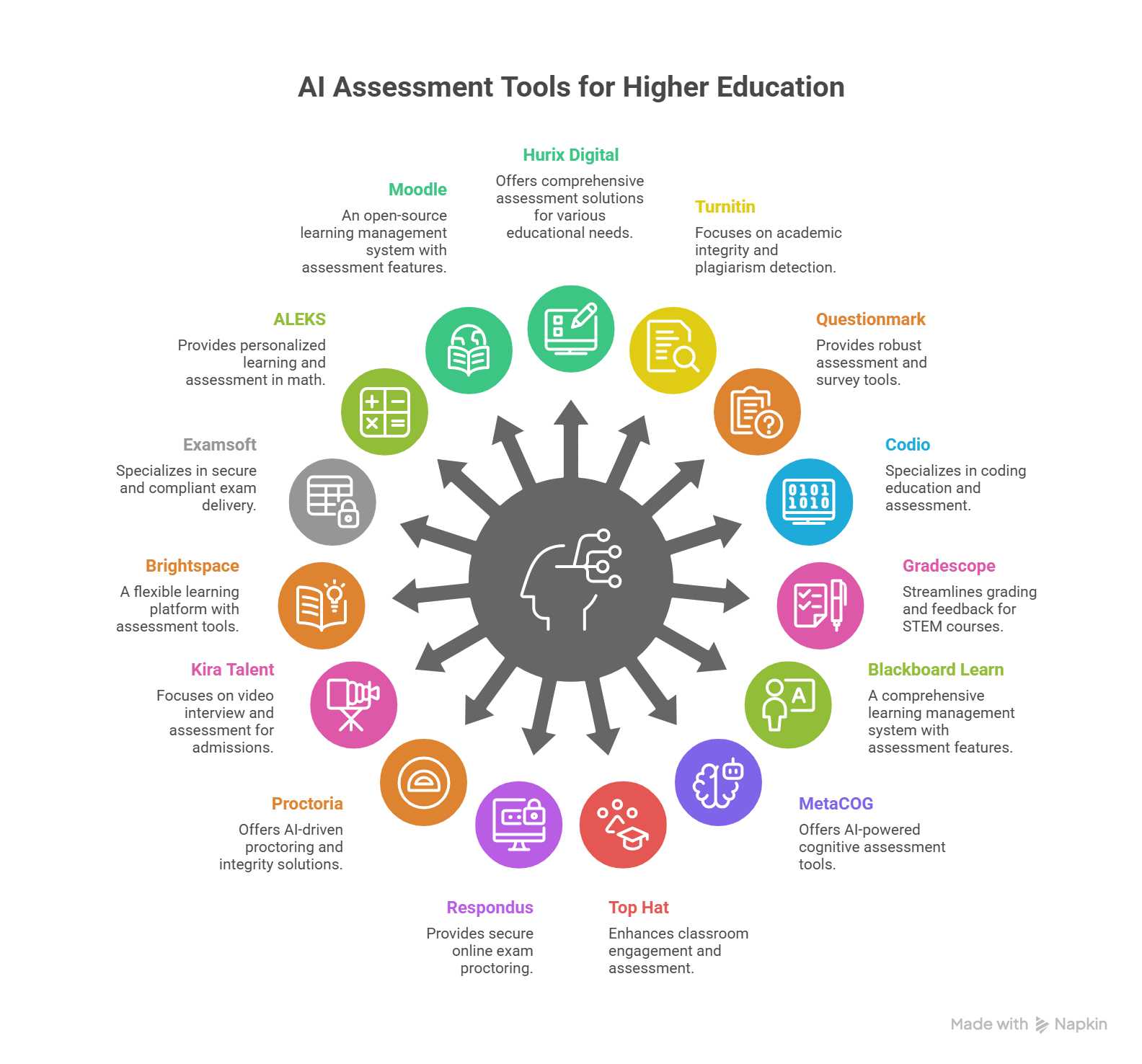
AI assessment tools benefit schools and universities by providing real-time feedback on student progress, fueling data-driven decisions, and supporting personalized learning. Moreover, AI can be useful in reducing assessment bias and is thus fair and just toward all learners.
AI assessment tools are platforms that use machine learning to automate grading, detect plagiarism, and provide personalized feedback in higher education.
Combining all these advantages, AI in assessment services provides a fair and influential assessment procedure. Let’s see the top 15 tools:
1. Hurix Digital
Hurix is a pioneering digital assessment tool that provides a thorough online monitoring and evaluation environment. The platform is intended for use by business educational providers, higher education establishments, and K12 educational institutions.
It provides AI grading systems, online assessment creation, and delivery for educators and trainers. You can also develop custom tests on the platform, such as multiple-choice, true/false, and questions with short responses in line with the curriculum.
Key Features
- Provides interactive assessment formats like gamified quizzes and multimedia-rich questions to improve outcomes.
- Allow teachers to monitor student development and pinpoint areas that need work with robust analytics and reporting features.
- Offers customizable assessments tailored to the K12 curriculum, which helps educators create assessments aligned with learning objectives.
2. Turnitin
Turnitin is a leading plagiarism detection software used by educators and students of higher education to ensure academic integrity. Additionally, instructors can use Turnitin Assignment to access features like PeerMark, Rubrics, and Feedback Studio that enable top-notch assessment services.
Key Features
- Compares submitted work against a vast database to identify any instances of plagiarism using the originality check feature.
- Provides detailed feedback on grammar, style, and citation errors with the feedback studio.
- Allows instructors to provide personalized feedback and grades directly on student submissions using Grademark.
3. Questionmark
Organizations use Questionmark to create, deliver, and analyze online assessments. It also offers AI-powered assessment options for item banking, test delivery, and outcome evaluation. Teachers can use its predictive analytics to pinpoint areas that need work and adjust their lesson plans accordingly.
Key Features
- Enables users to create a wide range of assessment types, such as quizzes, surveys, and exams, with customizable settings.
- Offers various secure delivery methods like remote proctoring and lockdown browser capabilities to ensure the integrity of assessments.
- Provides detailed insights into assessment results for informed decision-making.
4. Codio
Codio utilizes an integrated development environment (IDE) to instruct students in computer science and coding. The AI-powered coding tests from Codio assess students’ programming abilities and offer specific suggestions to improve their academic results.
Key Features
- Enables teachers to grade student code submissions according to pre-established standards using automated grading tools.
- Provides students with immediate feedback while they write and test their code inside the IDE.
- Offers customizable assessments that let teachers design unique coding assignments to gauge students’ comprehension and development.
5. Gradescope
Gradescope uses AI to read handwriting, spot patterns, and deliver immediate input as it streamlines test and project evaluation. Its highly advanced features ensure quick grading and assessment uniformity.
Key Features
- Allows instructors to grade assignments, exams, and projects with customizable rubrics.
- Provides students with detailed insights into their performance to aid in learning improvement.
- Uses Learning Management Systems (LMS) for seamless integration with existing course platforms and easy assignment submission and grading.
6. Blackboard Learn
Blackboard Learn is one of the leading AI-based assessment platforms popular for designing, distributing, and overseeing different kinds of tests, assignments, surveys, and quizzes. Teachers can create tests with a variety of question formats and assign due dates while offering students instant feedback.
Key Features
- Facilitates instructors to upload course materials, assignments, and assessments in a centralized location.
- Enables real-time interaction through discussion boards.
- Provides a platform for instructors to track and manage student grades efficiently through Gradebook integration.
7. MetaCOG
With the use of artificial intelligence, Metacog provides granular data on how students engage with internet-based materials through assessment analytics. With this data-driven strategy, teachers can modify their teaching methods based on their understanding of the learning behaviors of their students.
Key Features
- Incorporates advanced data visualization tools to interpret and communicate assessment results.
- Provides configurable options for assessments, which boost customized evaluations based on particular learning goals.
8. Top Hat
Top Hat provides dynamic instructional materials to teachers, providing individualized, pertinent, and beneficial instruction. This all-inclusive engagement platform helps educators deliver lectures, effortlessly track attendance, spark conversations, and assign homework, assessments, and tests.
Key Features
- Safeguard academic credibility in both in-person and online exams with adaptable, safe testing capabilities.
- Record discussion outcomes evaluated in the Top Hat grade book in addition to tests, surveys, and questionnaires.
- Offer students top-notch feedback with numerous attempts, hints, and right answers.
9. Respondus
Respondus has been at the forefront of online evaluation for twenty years. It is utilized in numerous colleges and schools worldwide to generate test questions, self-evaluations, and educational games.
Key Features
- Enables secure online exam delivery through features like a lockdown browser and automated proctoring.
- Allows for easy creation and management of assessments with question banks.
- Integrates smoothly with the LMS to ensure a user-friendly experience.
10. Proctoria
Proctoria is a reliable artificial intelligence (AI) proctoring tool that guarantees academic standards when taking online tests. Its sophisticated algorithms identify and discourage dishonest behavior from conducting remote tests in a safe and secure setting.
Key Features
- Offers flexible exam scheduling options to take exams at your convenience within specified timeframes.
- Provides real-time exam support like live chat assistance and troubleshooting to address any technical issues.
11. Kira Talent
Kira Talent enables higher education establishments to gauge applicants’ personalities, analytical skills, and interpersonal skills through AI video-based assessments. Its predictive analytics help identify the top applicants for enrollment.
Key Features
- Provides personalized and participatory evaluations with video-based assessments.
- Offers customizable scoring rubrics and assessment criteria.
- Assists institutions in making data-driven decisions during the assessment process by using AI-powered analytics and insights.
12. Brightspace
With Brightspace’s learning management system (LMS), educators can easily create, administer, and assess thanks to the integration of AI-driven evaluation instruments. Students benefit from individualized educational opportunities owing to adaptive learning attributes.
Key Features
- Provides a centralized platform for managing assessments and tracking student progress.
- Helps to seamlessly assign proper points to every question and calculate the final count.
- Allows educators to quickly generate or import questions, shuffle questions, and classify compulsory and extra questions.
13. Examsoft
Examsoft is a digital platform that is primarily popular for conducting safe and secure online exams. Additionally, Examsoft utilizes AI to evaluate test results and enhance the accreditation process.
Key Features
- Reduce the degree to which performance-based assessments are subjective and assess accomplishments in light of objective identifiers with ExamSCORE.
- Digitally confirms each exam taker’s self-identification from any place.
- Helps to verify student performance in line with the pre-defined learning goals.
14. ALEKS
A research-based online learning platform, ALEKS provides course materials in various subjects, including math, chemistry, statistics, and more. With a foundation built on two decades of research and analysis, ALEKS provides parents and teachers with detailed insights into each student’s learning advancement.
Key Features
- Evaluates a student’s understanding of mathematics in terms of its virtues and shortcomings.
- Derives the components used to create assessment questions from curricular standards.
15. Moodle
While not primarily an AI assessment tool, Moodle can integrate with AI-powered plugins and external tools to enhance its assessment capabilities.
Key Features
- Integrates seamlessly with AI-based plagiarism detection tools to ensure academic integrity.
- Promotes adaptive learning plugins that personalize assessments based on student performance data.
- Provides insights into student progress and performance trends with AI-driven analytics.
What is Dictera?
Dictera is an AI/ML-powered eLearning authoring tool or digital assessment generator that allows you to create digital learning content, including assessments, surveys, online courses, tutorials, tests, and much more.
The tool packs several interesting features, including multimedia integration, a variety of templates, assessment functionality, and other interactivity features that content creators can use to design engaging assessments, tests, and other educational materials.
Dictera leverages automated technology that allows educators to gamify the overall assessment-taking experience by incorporating various elements of challenges and rewards.
Compared to traditional assessment authoring tools, Dictera stands out by offering enhanced automation, improved user-friendliness, and superior flexibility in creating diverse, high-quality assessments.
Top 10 Benefits of Dictera over Traditional Assessment Generators
Dictera is a powerful AI assessment tool by Hurix Digital that comes with several interesting features and benefits.
Here are the top benefits:
1. Intuitive Interface
One of the top features and benefits of Dictera is its user-friendly interface. The tool boasts a simple design and excellent usability that allow both technical and non-technical users to create quizzes, surveys, tests, and assessments without much hassle. This not only saves time but also makes the process of assessment generation much more streamlined and productive.
2. Interactive Elements
Dictera offers various interactive features to help educators, content creators, and instructors create engaging content. These interactive elements not only keep learners engaged but also ensure that they develop a better understanding of the course content.
From highly engaging and interactive simulations, the Dictera AI assessment tool offers a range of interactive elements that enable instructional designers and training managers to customize their course content to cater to varied learning styles.
3. Customizable User Interface
Dictera boasts a fully customizable user interface, making it super easy to use for everyone, from students and teachers to assessment creators. As an automated assessment authoring software, Dictera also offers super flexibility to create relevant yet practical content for students with varying learning needs.
The tool leverages the power of AI and Machine Learning (ML) to help educators design high-quality content and accurately analyze their results via an intuitive platform.
4. Detailed Analytics
Dictera is one of the most powerful online authoring tools. It allows you to collect a massive amount of data and generate detailed reports. The tool offers high-quality data and insights on student performance across a range of metrics.
For instance, you can use Dictera to gather and analyze individual learners’ results and track their training progress. This helps identify trends, pinpoint areas for improvement, and make data-driven decisions to enhance the effectiveness of your training programs.
5. Anywhere, Anytime Access
Another advantage of this online assessment tool is its high flexibility in terms of where, when, and how learners can take the tests or assessments. The tool enables you to access and create assessments that can be taken on any device, including computers, smartphones, or tablets, for both online and hybrid courses.
6. Streamlined Assessment Creation Process
Generating high-quality assessments can quickly become challenging and overwhelming. Dictera is an excellent AI-powered question generator that automates the end-to-end process of creating assessments, helping you save much time and effort.
7. Varied Assessment Types
When it comes to assessment creation, different assessments require different types of quizzes. Dictera online assessment generator allows you to make any type of assessment to assess student understanding, polls to gather team input and feedback, and surveys to assess the unique skills, availability, and preferences of the learners.
8. Improved Quality of Assessments
The manual assessment creation process comes with many challenges in terms of quality and accuracy. This, in turn, leads to unreliable data and insights, which is paramount in building smarter and more comprehensive training. Dictera helps you navigate this challenge and frees educators from the worry of creating high-quality assessments.
9. Excellent Collaboration Capability
One of the other highlights of Dictera that gives it an edge over other assessment creation tools is its effective collaboration capabilities, which allow for better courses and assessments for learners.
AI technology can perform a wide range of tasks, from generating assessment tasks to identifying suitable peers for grading work and automatically scoring student submissions. The tool also features a sharing option that allows you to share your customized templates and assessments for reuse across authoring teams.
10. Security
Yet another important benefit of Dictera is robust security policies and permissions to help protect your assessment content. A powerful quiz generator, Dictera ensures security by giving users strong login credentials.
Likewise, Dictera ensures that assessments cannot be accessed until the test administrator publishes them. Additionally, it locks browser access, preventing learners from using external resources or visiting other websites during the test or assessment.
Wrapping Up
Online assessment authoring tools such as Dictera are an excellent way to create, administer, and manage assessments, tests, and surveys. Apart from offering a range of interesting features and benefits, Dictera also offers deeper insights into the knowledge and abilities that learners have acquired, making the evaluation process easier.
Dictera by Hurix Digital is a powerful assessment authoring software that speeds up and simplifies the process of creating assessments. The tool can help you generate a wide variety of assessments, including open-ended questions, multiple-choice questions (MCQs), question-and-answer questions, and more.
Using Dictera as an assessment creation tool can significantly enhance the overall experience. Apart from automating the end-to-end process of assessment generation, AI assessment generators also give you the benefit of customizing content to specific or unique learner needs.
Connect with us now to learn more about Dictera!
Frequently Asked Questions (FAQs)
Q1: How do AI assessment tools handle bias and fairness in grading?
AI assessment tools reduce bias by applying consistent evaluation criteria across all learners, but fairness depends on how models are trained and monitored. Institutions should choose tools that allow human review, explainable scoring, and continuous bias audits to ensure equitable outcomes across diverse student groups.
Q2:What data privacy and compliance standards should AI assessment tools meet?
AI assessment platforms must comply with data protection regulations such as FERPA, GDPR, and institutional data governance policies. Secure data storage, encryption, role-based access, and transparent data usage policies are essential to protect student information and maintain institutional trust.
Q3: Can AI assessment tools support accessibility and inclusive learning?
Yes. Many AI assessment tools support accessibility through screen-reader compatibility, alternative question formats, extended time accommodations, and adaptive assessments. When aligned with WCAG guidelines, these tools help institutions deliver more inclusive and equitable evaluation experiences.
Q4: How do AI assessment tools integrate with existing LMS platforms?
Most enterprise-grade AI assessment tools integrate with learning management systems like Moodle, Canvas, Blackboard, and Brightspace using APIs or LTI standards. Seamless LMS integration ensures assessments, grades, and analytics flow directly into existing academic workflows.
Q5: What role do AI assessment tools play in competency-based education?
AI assessment tools support competency-based education by continuously evaluating learner performance, identifying skill gaps, and mapping outcomes to predefined competencies. This allows institutions to move beyond one-time exams toward ongoing, mastery-based evaluation models.
Q6: Do AI-based assessment tools compromise academic integrity?
No. When implemented correctly, AI-based assessment tools strengthen academic integrity by combining plagiarism detection, secure testing environments, and transparent evaluation models.

Senior Vice President – Business Development
at Hurix Digital, with over 25 years of experience in EdTech and workforce learning. He excels in business development, customer relationship management, and scaling digital learning solutions, driving global growth through innovative content, simulations, and AI‑driven training offerings