 A Space for Thoughtful
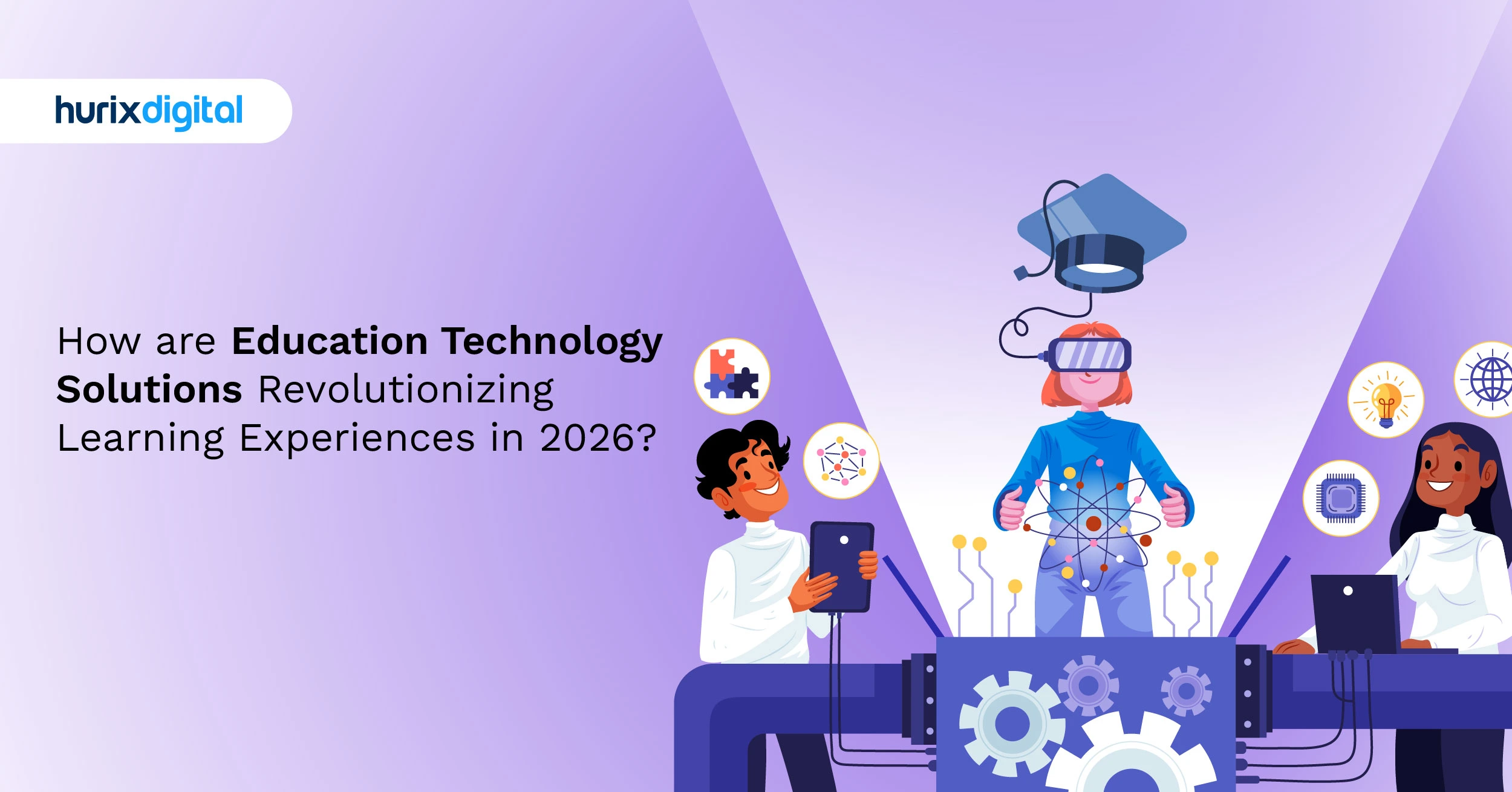
How are Education Technology Solutions Revolutionizing Learning Experiences in 2026?
Summarize with:
Education technology refers to technology that improves learning outcomes and performance in education. Since the COVID-19 pandemic, a large number of educational institutions and startups have shifted to a digital basis with education technology solutions.
Additionally, many companies decided to go digital with employee training programs. Certain studies estimate the EdTech industry to reach a value of more than $319 billion by 2029.
Education technology solutions are changing classroom and distance learning environments, providing students and teachers with access to a range of digital resources and platforms.
This article outlines the far-reaching impacts of education technology solutions in more ways than you can imagine. Read on to find more!
Table of Contents:
- What are the Types of Education Technology Solutions?
- What Are the Benefits of Education Technology Solutions?
- Existing Strategies and Challenges with EdTech Investments
- Achieving a Balanced Budget Allocation for EdTech
- What are the Ongoing Trends in Education Technology Solutions?
- Top 10+ Impacts of Using Education Technology Solutions
- Easy Access to High-Quality Educational Content
- Provides Opportunity for a Personalized Learning Experience
- Promotes Immersive and Experimental Learning
- Enables a High-End Retention Rate
- Helps in Tracking Progress and Provide Real-Time Feedback to Students
- Saves Time for Educators While Grading Assignments
- 7. Maximizes Student Learning Outcomes
- Facilitates Easy Student-Teacher Collaboration
- Makes Data Storage Easy and Budget-Friendly
- Promotes Unique and Interactive Modes of Teaching
- Bonus: Helps in Streamlining Fee Payment
- Summing Up
What are the Types of Education Technology Solutions?
There are different types of EdTech solutions, which include the following:
- Online learning management systems
- Online learning providers
- Interactive learning platforms
- Online studying and teaching services
- Language learning platforms
- Learning applications
What Are the Benefits of Education Technology Solutions?

Edtech solutions offer several benefits, which are listed below.
1. Easy to Customize
EdTech solutions are easy to customize to suit particular learning needs. With diverse classrooms and learning batches with different and complex requirements, customizing education solutions helps meet unique preferences and learning styles.
Educators can choose EdTech tools to meet the criteria they require for different learners or batches of students.
2. Improve Efficiency
Education technology solutions improve the efficiency of teaching and educational work. Automating several tasks and allowing for standardized learning content and processes enables you to prepare learning material for large numbers with reduced time and cost.
Edtech tools can save teachers from administrative tasks like grading and allow more time to develop course material and interact individually with students. Tasks like testing and assessments can be standardized without the teacher having to prepare each test separately.
3. Make Education More Accessible
One of the most important benefits of the EdTech boom is that it improved the accessibility of educational material and allowed a large number of learners to access it. With digital learning, students in diverse locations and remote areas can access learning material on a variety of devices.
It also made learning content more accessible through interactive features like branching scenarios, simulations, whiteboards, and game-based aspects. Additionally, features like text-to-speech and multimedia functions allow for a more convenient learning experience.
It is particularly helpful for learners with disabilities and makes the content easier to understand through features like audio recordings and one-to-one devices like tablets for each student.
In the classroom, large whiteboards allow for a touchscreen function that can be used with more features like file sharing and screen sharing. With all these technological features, EdTech has the potential to make learning a more interactive, engaging, and accessible experience.
4. Better Connectivity Between Learners and Teachers
Education technology solutions offer platforms and virtual spaces for learners to interact with each other and with educators. With chatrooms, video meetings, and more, communication becomes smooth and convenient.
Students can easily share notes and helpful links and ask doubts. This allows educators to reach students in different locations. It also saves on the time and cost involved in travel to classrooms.
Additionally, digital material like video course modules and digital textbooks reduces the time and cost of buying physical textbooks and delivering them.
5. Improve Workforce Learning
EdTech solutions make workforce learning more convenient, efficient, and effective. With interactive features and digital training, skill-building becomes engaging and accessible.
This is especially helpful in industries like healthcare, IT, and finance, where technology is rapidly changing market trends and consumer expectations.
6. Continuous Skill Development
Continuous skill development plays an important role in these industries and is a key employee expectation as well. Offering digital training with cutting-edge EdTech solutions can help your employees stay engaged and motivated.
It can also improve work performance and result in a well-trained workforce that is equipped to deliver services on par with the latest market requirements and industry standards.
7. Industry Benefits
Education technology solutions can transform workforce education and make it more efficient in terms of cost and time. They also allow you to identify learning areas or gaps in skills and where there is scope for growth.
High-demand industries like healthcare and advanced manufacturing are particularly likely to benefit from modern EdTech solutions.
Given the gap between the demand for skilled workforce in such industries and the availability of skilled workforce, these industries can be transformed by EdTech interventions. Total EdTech spending is projected to double in the next few years and reach $404 billion.
The growing EdTech sector is also leading to an increased demand for skilled professionals. Developers, UX designers, and cybersecurity analysts are just some examples of the roles that are arising and in demand in the EdTech market.
8. Change the Way Education Happens
E-learning platforms, ebooks, and learning apps have changed the way that education happens. With a growing number of EdTech companies collaborating with schools, educators, and students, tech-driven education is transforming the way learning takes place.
Certain EdTech companies directly provide online courses and programs like Coursera. Other companies work with teachers and administrators to build education programs, manage online learning, and track student progress.
9. Collaboration
With online platforms and applications, teachers and students can connect and collaborate. Certain education technology solutions allow students to collaborate, work on group projects, or just study together.
Other platforms allow teachers to share lesson plans, study material, helpful resources, and more. This allows teachers to spend less time creating new learning material and makes the process easier.
10. Improve Student Motivation
Making learning more participative and engaging can help students become more motivated. By enabling more effective learning, EdTech solutions can help improve student performance and make them more involved with the learning process.
Existing Strategies and Challenges with EdTech Investments
The pandemic played a role in rattling investment scenarios across all sectors. However, it was the educational sector that suffered the most significant impact. Although the capital markets changed after COVID-19, the educational industry was resilient.
Today, this industry has plenty of opportunities for growth and innovation.
One of the chief challenges today is the complexity of seeking funding from investors. Venture capitalists and other investors thoroughly scrutinize an EdTech company’s capabilities to balance novel technological innovations with tangible, feasible outcomes.
Currently, investors’ chief concern is investing in companies that can significantly improve learning outcomes. Furthermore, although artificial intelligence is also a highlight, investors are held back by the lack of proper integration and implementation methods of AI into EdTech systems at K12 schools.
Careful implementation and training are necessary to make AI functionalities truly usable at the student level. However, these aspects remain partially explored and largely unaddressed, a major roadblock in the investment scene.
Achieving a Balanced Budget Allocation for EdTech

Statistically, the education sector remains under-digitized, accounting for less than 4% of digital spending globally. With that said, reports predict that EdTech spending will nearly double, reaching a value of $404 billion by 2025.
Trends suggest that technologies such as AR/VR, AI, robotics, and blockchain will be in the highest demand in EdTech.
Let’s look at a few strategies to help you streamline your EdTech ROI (return on investment) from investing in educational technology.
1. Focus on User-Centric Design
A meaningful investment focuses on products designed with user intent and usage patterns in mind.
Assess your students’ educational needs before investing in developing or procuring EdTech products. This will ensure that the technology you invest in has a high chance of enhancing learning outcomes rather than increasing the complexity of the educational ecosystem.
You can work with students and teachers to establish continuous feedback loops to measure the technology’s performance.
2. Invest in Scalable Solutions
With educational institutions, scalability should remain the focus of any technological investment. The rapid adoption of digital learning solutions calls for a robust back-end that helps the administration adjust the delivery and scope of the technology according to needs.
Invest in infrastructure capable of handling increases or decreases in demand without compromising student experience with the portals or interfaces. Doing this helps ensure that innovative solutions remain accessible to a larger audience.
3. Emphasize Data Safety
It is important to consider investing in cybersecurity and data safety measures simultaneously. EdTech uses sensitive student data, which may include their learning preferences, patterns, capabilities, enrollment information, and more. It is important to have an integrated security system that can protect student data from attacks and breaches.
Consider investing in reliable security technologies like blockchain. Look for automation capabilities that track changing regulations and compliance requirements.
4. Collaborate with Educational Institutions
Invest in partnerships or relationships with other educational institutions to enhance learning integrity and knowledge sharing. This will help you understand how other schools are leveraging technology. Establishing reliable partnerships will help you align educational goals with technological innovations, allowing you to extract maximum benefit from the technologies you have invested in.
It helps you ascertain that these investments have high value in the educational process.
5. Continuous L&D
Invest in continuous learning and development. Conduct workshops for all stakeholders and invite speakers from the core industry who can share insights on the innovations in EdTech.
This will help your institution stay ahead by adopting high-value innovations into your workflows, thus setting an example for other institutions.
6. Continuous Monitoring
Although this is not directly related to investment, measuring the performance of your technology helps you understand where it can be better utilized.
Gauging student and teacher satisfaction with the implemented EdTech solutions is also important. The data you gather through monitoring can be used to refine education delivery.
What are the Ongoing Trends in Education Technology Solutions?
The global EdTech market was worth $106.46 billion in 2021, which was merely the start. This market is anticipated to increase by 16.5% yearly from 2022 to 2030 and to double in size between 2019 and 2025, reaching $404 billion.
Additionally, education technology solutions are fueling growth. Gamification, for instance, is frequently used in online classes to keep students interested and motivated. According to a survey, 84% of participants said that gamification increases their level of engagement, and 85% said they would use the software more frequently if it were gamified.
Artificial intelligence-powered self-learning algorithms are creating a major impact in the EdTech space and will have far-reaching impacts by making repetitive tasks like grading papers easier. They are expected to make remote learning personalized and automated.
Top 10+ Impacts of Using Education Technology Solutions
From the advent of AI to automated grading solutions, here are some significant impacts of education technology solutions on the pattern, way, and shaping of the new-age learning systems.
1. Easy Access to High-Quality Educational Content
Portable devices and blended learning platforms replace traditional learning methods because they provide several advantages. Interactive Language Solutions have improved accessibility and interest in language study.
These programs encourage independent learning and allow students to practice grammar, vocabulary, and pronunciation in a fun and engaging way with elements like gamification, worksheets, and interactive activities.
Students can easily access educational content using portable devices in their own time and space.
2. Provides Opportunity for a Personalized Learning Experience
Learning is becoming easier and more interesting because of artificial intelligence-powered education technology solutions like facial identification, processing of natural languages, and deep learning.
Additionally, AI-enabled learning environments can give students personalized educational experiences. It lets professors modify lessons to suit the needs of pupils by analyzing student data, including their performance, preferences, and profiles.
3. Promotes Immersive and Experimental Learning
Making learning more immersive and experimental is one of the key advantages of education technology solutions like Augmented reality and Virtual reality in education.
Instructors can model simulated situations to provide students with real-world learning experiences.
For instance, students can take virtual excursions using AR and VR. This will enable students to discover historical sites, biodiversity, and other sites of interest without leaving the comfort of their educational settings.
Additionally, AI-powered AR and VR provides smart education solution by modulating the classroom experience as per the learning style and pace of the student.
4. Enables a High-End Retention Rate
The notion of gamifying learning is already prevalent in many academic settings. Making learning more entertaining and engaging is the main objective of implementing game design features in educational settings.
Higher education technology companies use gamification in education to improve knowledge retention and enhance enthusiasm and participation. This is because game-like components, such as points and rewards, stimulate people’s innate drive for competitiveness and recognition.
5. Helps in Tracking Progress and Provide Real-Time Feedback to Students
Wearable technology can be immensely helpful for education and learning by giving students and teachers real-time feedback and data, including physiological, behavioral, and cognitive statistics. They can assess and enhance their learning outcomes and general well-being.
Wearables also enable personalized, adaptive learning by adapting the content, pace, and manner of education to each learner’s unique requirements, preferences, and goals.
6. Saves Time for Educators While Grading Assignments
Student software tools like automation assessments are increasingly used to evaluate progress. Automated evaluation tools can also offer analytical data to pupils to find their weaknesses and strengthen them.
Automated grading solutions save teachers time by enabling them to grade assignments precisely and swiftly. This is done by reading and comprehending textual responses using algorithms.
AI can evaluate the quality, integration, and appropriateness of the students’ responses using machine learning techniques.
7. Maximizes Student Learning Outcomes
Adaptive learning platforms, which enable courses to be tailored according to each student’s specific needs, are becoming a significant trend in education technology solutions. Educational institutions are adopting this cutting-edge, data-driven strategy to support personalized learning experiences.
As a result, teachers will be better able to fulfill the requirements of students of various backgrounds and maximize student learning results. Teachers could also personalize students’ learning speeds and pathways using adaptive learning platforms.
8. Facilitates Easy Student-Teacher Collaboration
Education technology solutions have changed traditional learning methods in the classroom. Additionally, it has assisted educators in identifying their areas of pedagogical expertise and honing them as required.
As a result, educators have the opportunity to develop into mentors. Mentors who help students collaborate, solve problems, and develop other crucial skills necessary for thriving in the quickly evolving digital world.
By utilizing the potential of the best education tools like Learning Management Systems (LMS), schools have transformed into thriving centers that foster creativity where both instructors and students are actively engaged in the learning process.
9. Makes Data Storage Easy and Budget-Friendly
Cloud computing, a new development in educational technology solutions, provides robust authentication features to guarantee data protection.
To access and store data more efficiently, cloud computing will become a crucial tool for schools. Additionally, because cloud-based books are accessible from anywhere, students can save time and money spent on costly books.
10. Promotes Unique and Interactive Modes of Teaching
The potential of social media to encourage interaction and collaboration is one of the biggest effects that education technology solutions have on education. Even though social media use in education is still in its infancy, it has profoundly affected how you learn.
Beyond the classroom’s physical space, students and teachers can easily communicate with one another, share resources, and engage in unique ways of learning.
Bonus: Helps in Streamlining Fee Payment
Blockchain technology can change the face of higher education solutions by creating new, more accessible avenues for learning and upending the current dynamic between institutions and students.
Students, guardians, scholarship funding bodies, private lending enterprises, federal and state departments, and the frequently massive bureaucracy of university financial departments are all involved in the labor-intensive process of handling student tuition fees.
This procedure can be streamlined using blockchain, which lowers administrative expenses and consequently reduces tuition prices.
Summing Up
Education technology solutions can change how you facilitate education and the quality of learning. By enabling better interactivity and connectivity, they can help create a better learning environment. They can also allow you to ensure that learners stay motivated and engaged.
Trends in education technology solutions have advanced significantly, impacting classrooms, curricula, and instructional strategies. These trends are expected to have a bigger effect on the context of education in 2026 and beyond, ushering in a period of creativity and enhanced teaching and learning.
Hurix Digital offers several EdTech solutions, which include teaching platforms, learning management systems, training and e-learning software, and corporate learning solutions. With the latest technologies, our EdTech products and services can help change your education.
Get in touch with us now!
Summarize with:

Senior Vice President – Business Development
at Hurix Digital, with over 25 years of experience in EdTech and workforce learning. He excels in business development, customer relationship management, and scaling digital learning solutions, driving global growth through innovative content, simulations, and AI‑driven training offerings