 A Space for Thoughtful


How to Convert PDF to ePUB3? A Detailed Guide for 2026
Summarize with:
Summary
PDF to EPUB conversion is a critical workflow for transforming static documents into reflowable, interactive, and accessible digital books. By leveraging the HTML5-based EPUB3 standard, publishers can ensure 100% compatibility with modern e-readers and mobile devices. This blog provides a technical 6-step framework to convert legacy PDFs while maintaining structural integrity for a global eBook market projected to reach $24.7 billion by 2026.
Interactive storytelling is a growing need in the publishing world today. Readers want to engage with interactive multimedia content and enjoy an immersive experience from anywhere and everywhere. As of 2026, the global eBook market has surpassed $20 billion, with mobile-first reading driving the demand for high-quality PDF to ePUB conversion. With the enforcement of the European Accessibility Act (EAA), conversion is no longer just about format; it’s about ensuring content is accessible to all users.
Earlier, readers used PDFs for eBooks comprising text, static images, and hyperlinks to connect to related content on the Internet. However, PDF-based eBooks have limitations and may not serve the needs of a significant demographic of users. While PDFs have long been the standard for digital documents, they lack the flexibility and interactivity required for modern digital publishing.
Publishers, brands, authors, and social influencers publishing eBooks are now looking for enhanced interactivity and accessibility that cuts through language, readability, and cost barriers. This is where the feature-rich ePUB3 file format makes a difference, revolutionizing the world of eBooks.
In this blog, we will explore the growing relevance of ePUB3 in 2026 and explain how businesses and influencers can convert PDF to ePUB3 seamlessly. We will cover the benefits, best practices, and a step-by-step guide to help you create high-quality digital content.
Table of Contents:
- When Should You Convert PDF to ePUB?
- eBook Challenges Faced by Publishers, Authors, and Brands in 2026
- What is an ePUB3 File?
- Unique Features of ePUB3
- 5 Best Practices for Converting PDF to ePUB3
- How to Convert eBooks from PDF to ePUB3?
- The Power of ePUB3 in Revolutionizing Digital Storytelling
- Reflowable vs. Fixed Layout: Which Conversion is Right for You?
- The Takeaway
- FAQS
When Should You Convert PDF to ePUB?
If you are new to digital reading, you might wonder if converting all your materials into ePUB3 is necessary. The answer is a resounding yes. There are several benefits of converting PDF to ePUB. While the Portable Document Format (PDF) is a widely used file format for documents, ePUB3 is a whole different ball game for readers.
Some of the primary reasons you should shift to ePUB3 are:
1. Accessibility
PDFs are often not accessible to readers with visual or hearing impairments. In contrast, the ePUB3 format supports various accessibility features such as text-to-speech, adjustable font sizes, and alternative text for images. If accessibility is a priority, converting your PDFs to ePUB3 can make your content more inclusive and accessible to a wider audience.
2. Interactivity
PDFs are static documents that offer limited interactivity. With the ePUB3 format, you can use various multimedia elements, including audio, video, and interactive features such as quizzes, forms, and hyperlinks. If you want to add more engagement to your content, converting your PDFs to ePUB3 can help you achieve that.
3. Device Compatibility
PDFs can be challenging to read on small screens or mobile devices, and the formatting may not display correctly across different devices. Meanwhile, the ePUB3 format is designed to be responsive. It can adapt to different screen sizes and orientations, making it easier to read on various devices, from smartphones to eReaders.
4. Distribution
If you plan to distribute your content through digital channels such as online bookstores, libraries, or educational platforms, the ePUB3 format is often preferred. It is a widely recognized standard for digital publishing, ensuring your content reaches its intended audience without compatibility issues.
The global eBook market is valued at $24.7 Billion in 2026, with educational institutions accounting for 41% of total usage.
eBook Challenges Faced by Publishers, Authors, and Brands in 2026
Several developments were brought about by the World Wide Web Consortium’s (W3C) publication of ePUB 3.3, including expanded accessibility features and better compatibility with web technologies. These advancements highlight the challenges content creators face in the digital landscape.
1. Large-Scale Conversion from PDF to ePUB
Many publishers and brands have extensive libraries of content in static PDF format. While PDFs are widely used, they are not optimized for today’s demands of interactivity, accessibility, and cross-platform compatibility.
To stay relevant, businesses often need to:
- Republish in Multiple Languages: Reach global audiences by creating multilingual versions of eBooks.
- Enhance Accessibility: Add features like read-aloud and adjustable text sizes to cater to readers with different needs.
- Embed Multimedia: Include videos, audio, animations, and interactive elements to create engaging and dynamic experiences.
- Ensure Device Compatibility: Adapt content for seamless readability across smartphones, tablets, eReaders, and desktops.
ePUB Accessibility 1.1, integrated with ePUB 3.3, allows businesses to make their eBooks compliant with global accessibility standards, such as the European Accessibility Act.
2. The Growing Demand for Interactivity
Modern readers expect more than just plain text and static images. They want immersive experiences with multimedia integration, real-time interactivity, and tailored content.
Modern digital publishing now revolves around interactive storytelling, which requires the incorporation of audio, video, animations, and interactive quizzes or polls to increase reader involvement.
Publishers must balance cost control and satisfying these needs. Nowadays, digital publishing platforms provide scalable solutions that let artists embed these components without paying a high price, guaranteeing a competitive edge in a saturated industry. Technologies like augmented reality (AR) are also being used to provide distinctive reading experiences where users can examine 3D models or interactive maps directly inside eBooks.
3. Adapting to Rapid Technological Advancements
The ceaseless fluctuations throughout the digital publishing industry do not come as a surprise to most readers.
New tools and technologies are being developed to improve the reader’s experience. Instead, authors, publishers, and even brands are likely to battle with keeping up with the following advancements:
- AI-Powered Personalization: Using AI to tailor content recommendations and improve reader engagement.
- Augmented and Virtual Reality Integration: Creating immersive storytelling experiences through AR and VR elements.
- Advanced Analytics: Leveraging data to understand reader behavior and improve content strategies.
In keeping with current trends, many more resources must be invested in various systems, human resources, and networking to integrate such technologies into ebook production and distribution channels. Failure to adapt can leave businesses struggling to meet reader expectations and falling behind their more tech-savvy competitors.
Overcoming these challenges in 2026 will be crucial for publishers, authors, and brands to tap into the growing digital readership and maximize their reach in an increasingly globalized and tech-savvy audience.
What is an ePUB3 File?
Unlike a PDF file, an ePUB file is an innovative format that enables reflowable text. Thus, the content format automatically adapts to the screen resolution of the device used.
PDFs tend to be heavier than ePUB files because the latter are stored in a zip file and use HTML to proceed. ePUB3 is the latest version of ePUB, and one of its key advantages is that it enables files to be embedded with videos, audio, and interactive multimedia elements.
Moreover, any content, such as an eBook produced with ePUB3, can be more engaging. This is great news for publishers, businesses, and content creators who aim to deliver high-quality, accessible content.
ePUB3 has the potential to revolutionize the way we present eBooks, from food and science textbooks to children’s books. It helps publishers bring creativity to their storytelling while consumers get access to highly user-friendly eBooks.
ePUB 3.3’s MathML support and multilingual features make it ideal for sophisticated educational and scientific publications such as K12 STEM textbooks.
Unique Features of ePUB3
Here are some reasons why more and more publishers, authors, and readers are now looking for new ways to convert PDF to ePUB3:
- Consumers can use a spectrum of fonts and text styles, enabling them to have more control over how they consume content.
- It removes language barriers by enabling compatibility with multiple languages. It also allows books to be written in languages like Arabic, which is traditionally written from right to left.
- K-12 publishers especially can leverage the ePUB3’s capabilities for directly embedding MathML, or Mathematical Markup Language, an XML-based language used to describe mathematical notation. This is a useful feature when creating science, math, and engineering textbooks.
5 Best Practices for Converting PDF to ePUB
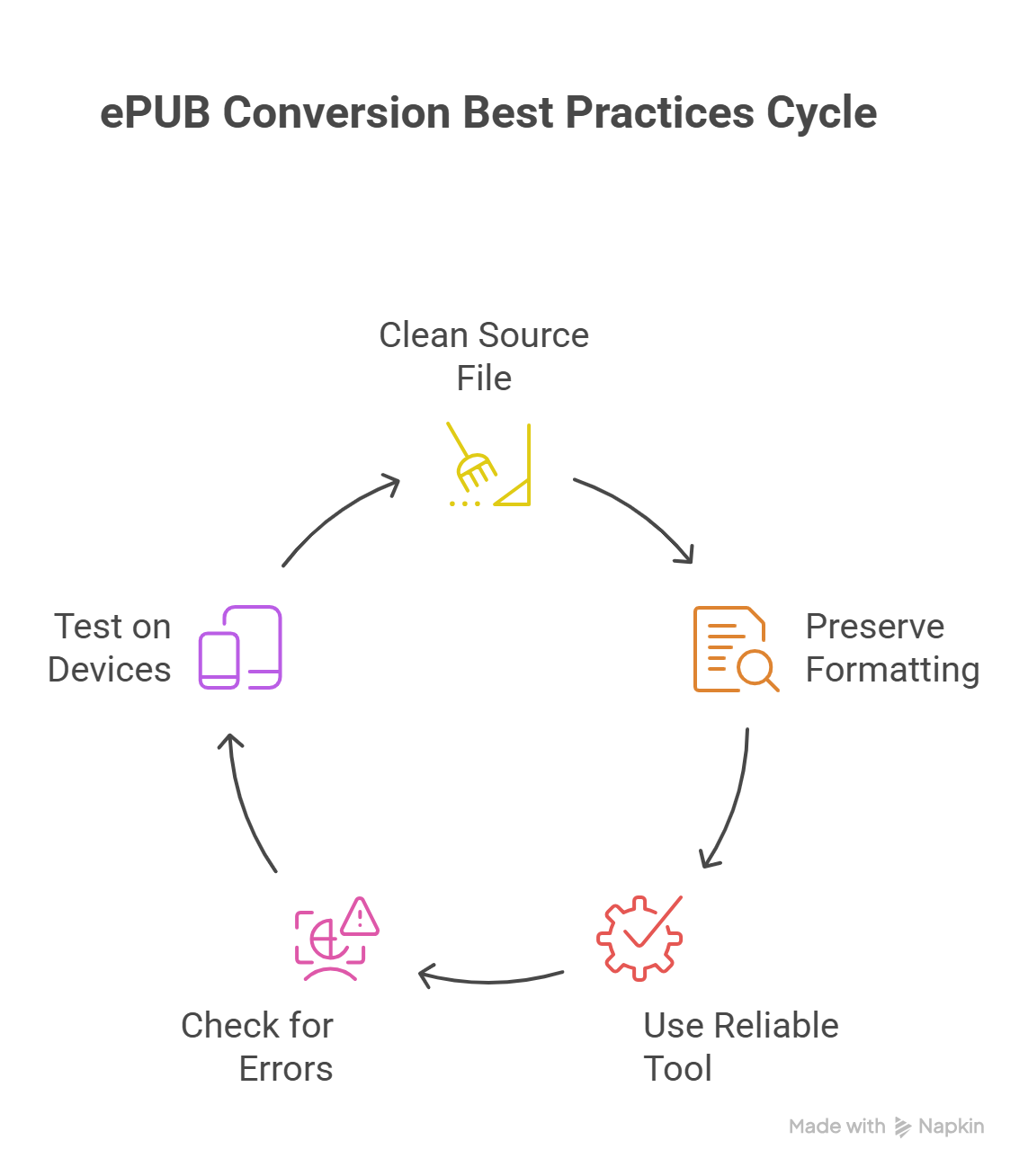
Ready to convert your PDFs to ePUB? While you can always use ePUB conversion services to help you get the ideal output, there are a few easy tips to follow to ensure high-quality results. These include:
1. Always Clean up the Source File
Before you start the PDF to ePUB conversion, it’s essential to clean up the source file. Remove any unnecessary elements such as headers, footers, page numbers, and redundant hyperlinks. This step helps ensure that the converted ePUB3 file is free of errors and formatting issues.
2. Preserve the Formatting
When converting a PDF to ePUB, it’s essential to preserve the original formatting as much as possible. This includes keeping the same font styles, sizes, and colors, and maintaining the layout and structure of the original document. Careful attention here prevents a disjointed reading experience.
3. Use a Reliable Conversion Tool
Various tools are available for converting PDFs to ePUB3, including free and paid options. Using a reputable tool that supports the ePUB3 format and provides accurate results is recommended. Knowing which tool you are using will also help you understand the level of manual formatting needed in the source file so that the output is ideal.
4. Check for Errors
Despite using the best ePUB3 converters, errors can still be introduced. After converting, it is important to check the file for formatting issues. This includes checking for broken links, missing images, or incorrect text flow. It’s recommended to use an ePUB3 validator tool to ensure that the file meets the required industry standards.
5. Test on Different Devices
Before publishing the ePUB3 file, it’s crucial to test it on different devices. This ensures that it displays correctly and is compatible with various screen sizes and orientations. A file that looks great on a large tablet might not render well on a smaller smartphone screen.
How to Convert eBooks from PDF to ePUB3?
Today, several tools are available to convert PDF to ePUB3 files easily and cost-effectively. However, the most secure approach for businesses is to use credible digital publishing software, which keeps files secure and confidential.
Easy and Fast 6-Step Guide to Convert PDF to ePUB3
Here is an easy and quick step-by-step guide to PDF to ePUB3 conversion for a secure reading experience:
- Step 1: Register and create your account on a reliable conversion platform or tool.
- Step 2: Import your PDF file. Click on the “Import PDF” or “Upload File” option and select the PDF document that needs to be converted.
- Step 3: Choose the output layout. You can select a fixed-layout ePUB3 template or a reflowable-layout template according to your needs. If you do not want to change the format, choose the fixed-layout template, as you will have more control over the outcome.
- Step 4: Check conversion settings. Before converting, review the settings for font choices, spacing, and other formatting options. You can often use the existing font, a similar one, or a font from a specific URL. The default is typically the font used in the original PDF.
- Step 5: Convert, preview, and edit. Click the “Convert” button. Once the conversion is complete, download the output ePUB file and open it in a preview tool. Look for any errors and make edits. This is the stage to enhance your eBook by adding relevant links, videos, and images to improve the experience.
- Step 6: Once you are satisfied with the final PDF to ePUB3 conversion, you are ready to publish. Click the “Publish” button to distribute your eBook to your audience.
A professional digital publishing platform also comes with digital rights management, which enables the secure distribution of the eBook to authorized audiences. Hence, make sure that when you convert PDF to ePUB professionally, you choose a solution that keeps your content secure.
In 2026, 74% of digital readers consume content on smartphones, making reflowable ePUB conversion a necessity over static PDFs.
The Power of ePUB3 in Revolutionizing Digital Storytelling
The digital reading world is expanding at an unprecedented rate, with eBook format innovations taking the spotlight again. eBook revenues are projected to reach $29.9 billion by 2033, a testament to the rising requirement for dynamic, interactive digital content. But why is this shift happening, and how does ePUB3 fit into this growth?
The rise of emerging technologies has made it clear that static, PDF-based eBooks are no longer enough to capture the attention of today’s readers. Whether you’re an author, a brand, or a publisher, the demand for more engaging, interactive, and immersive eBook content is undeniable. And ePUB3 is here to meet that demand.
Here’s how businesses and creators are leveraging this format to deliver an unparalleled reading experience:
1. Adaptable Layouts
The best part about the digital format is that it can be smoothly adjusted to fit any screen size or device. Whether your audience reads on a smartphone, tablet, or eReader, ePUB3 ensures the content automatically adapts to deliver a seamless experience.
2. Global Appeal
Multilingual support and the usability of various script systems are some of ePUB3’s most inspiring components. These features allow publishers to extend their services to global markets without restrictions due to language differences.
3. Future-Proof Content
The expansion of ePUB3 matches the expansion of technology. With features such as MathML support, better accessibility, and thorough multimedia incorporation, ePUB3 encourages content creators to design their eBooks in a way that remains current with the changes in digital storytelling.
Reflowable vs. Fixed Layout: Which Conversion is Right for You?
| Feature | Reflowable ePUB | Fixed Layout ePUB |
| Best For | Fiction, Text-heavy books, Journals | Cookbooks, Textbooks, Children’s books |
| User Experience | Text size is adjustable by the reader | Layout stays exactly like the PDF |
| Device Support | Optimized for all screens (Mobile/E-reader) | Best viewed on Tablets/Desktops |
| Accessibility | High (WCAG 2.2 Compliant) | Lower (Harder for screen readers) |
The Takeaway
EPUB3 is the definitive standard for 2026 digital publishing, balancing high-fidelity design with universal accessibility. While automated tools handle simple conversions, professional workflows utilizing semantic cleanup are required to ensure content remains future-proof for AI search tools and specialized e-readers.
Converting PDF to ePUB3 is essential for publishers, authors, and content creators to make their content more accessible and compatible with various devices. The ePUB format also helps streamline large-scale digital publishing projects and is apt for those who want to take their digital publication to the next level. When you convert PDF to ePUB3, it becomes a newer, more versatile file format that can be read on a wider range of devices.
This is an incredible marketing opportunity waiting to be tapped. However, the opportunity is not restricted to publishers. Growing brands and social influencers can leverage eBooks to build visibility and brand loyalty. The usage of ePUB3 is expected to drive up the demand for eBooks.
Access to a comprehensive, superior digital publishing platform like Hurix Digital enables seamless conversion of PDF to ePUB3 formats and the delivery of a high-quality finished eBook. Early investments in this tech-enabled solution will equip publishers and brands with the tools for success.
Explore how our professional ePUB services can help you achieve your goals today.
Frequently Asked Questions (FAQs)
Q1: What is the difference between Reflowable and Fixed Layout ePUB3?
The choice between layouts depends entirely on your content type: Reflowable Layout is the industry standard for text-heavy books (like novels), where the text automatically adjusts to fit any screen size, allowing the reader to change fonts and sizes. Fixed Layout is essentially a “digital replica” of the PDF, keeping every image and text block in a precise position. It is best for highly designed materials like children’s picture books, comic books, or complex technical manuals where the visual relationship between text and graphics is critical.
Q2: Can I convert a scanned PDF to ePUB3 without losing quality?
Converting a scanned PDF (which is essentially a series of images) requires OCR (Optical Character Recognition) technology to “read” and extract the text. If you convert it without OCR, you will end up with an ePUB that is inaccessible to screen readers and cannot be searched or resized. For high-quality results, the PDF must first be processed through OCR software to create a “text-under-image” layer, which can then be exported into a clean, semantic ePUB3 structure.
Q3:Why does my formatting break when converting PDF to ePUB?
Formatting often breaks because PDFs use absolute positioning (telling an element exactly where to sit on a page), whereas ePUB3 uses relative positioning based on HTML and CSS. When automated tools try to bridge this gap, they often fail to handle multi-column layouts, complex tables, or non-standard fonts correctly. To prevent this, you must “flatten” the PDF structure by removing headers, footers, and page breaks before conversion, or manually edit the resulting CSS to define how elements should behave on different screen sizes.
Q4:Is ePUB3 better than PDF for accessibility compliance?
Yes, ePUB3 is significantly better for accessibility and is the preferred format for meeting WCAG 2.1 and European Accessibility Act (EAA) standards. Unlike PDFs, which are often “tag-heavy” and difficult for screen readers to navigate, ePUB3 supports native HTML5 features like ARIA roles, semantic tags, and MathML. This allow users with visual impairments to use text-to-speech effectively, navigate via a logical heading structure, and customize the reading environment to suit their specific needs.
Q5:What are the most common errors in automated PDF to ePUB3 conversion?
The most common errors include broken character encoding (causing weird symbols like “”), improperly nested tags that crash eReader apps, and gigantic file sizes caused by unoptimized images. Another frequent issue is “garbage text,” where the converter picks up “running headers” or page numbers from the PDF and inserts them into the middle of a paragraph in the ePUB. These errors highlight why professional manual QC (Quality Control) and validation via “ePubCheck” are essential after any automated conversion.
Summarize with:

Vice President – Content Transformation at HurixDigital, based in Chennai. With nearly 20 years in digital content, he leads large-scale transformation and accessibility initiatives. A frequent presenter (e.g., London Book Fair 2025), Gokulnath drives AI-powered publishing solutions and inclusive content strategies for global clients