 A Space for Thoughtful
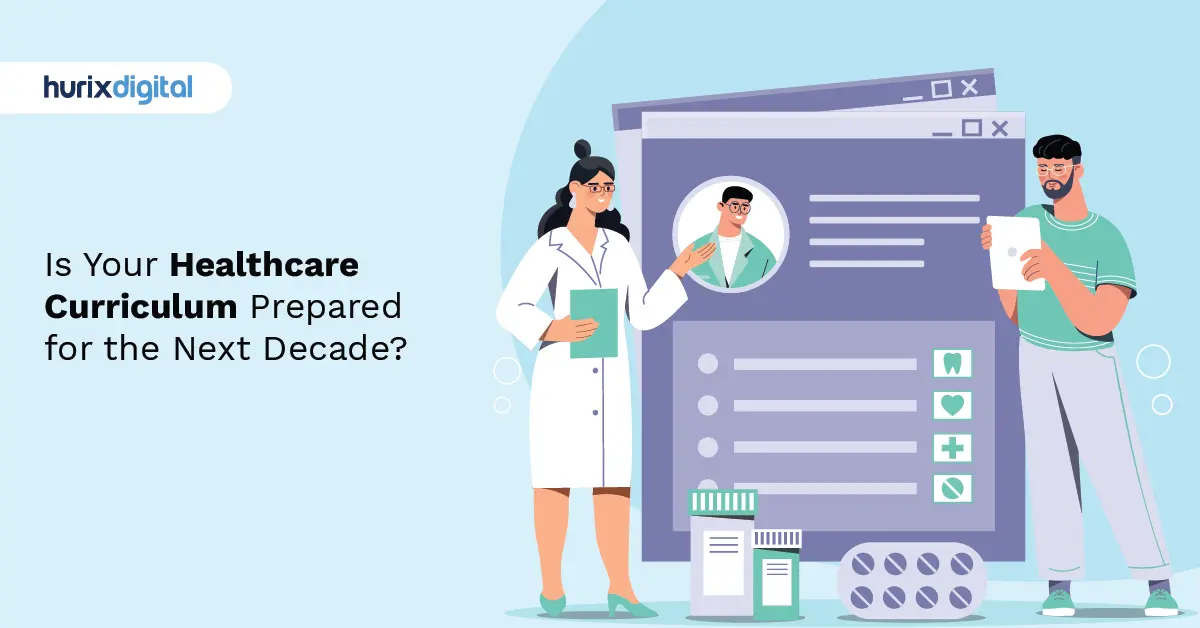
Is Your Healthcare Curriculum Prepared for the Next Decade?
Summarize with:
Medical education is unlike any other field. The stakes are incredibly high. When a student in a history class misses a concept, they might fail an essay. When a medical resident misses a concept, patient safety is on the line.
Over the course of the 2020s, the old ways of teaching medicine-relying solely on thick textbooks and endless lectures-have evolved. We are now looking at a landscape defined by agility, technology, and a desperate need to bridge the gap between theory and life-saving practice.
This guide explores the architecture of a modern healthcare curriculum. We will walk through how to build learning paths that don’t just inform students but transform them into competent professionals ready for future challenges.
Table of Contents:
- The Blueprint: Why Instructional Design Matters More Than Ever
- Going Hybrid: The New Standard for Healthcare Education
- The Assessment Ecosystem: From Diagnosis to Competency
- Simulation and Performance-Based Assessment
- Evaluating the Outcomes: Rubrics and Criteria
- Future-Proofing the Curriculum
- Conclusion
The Blueprint: Why Instructional Design Matters More Than Ever
You wouldn’t build a hospital without a blueprint. You shouldn’t build a medical course without one, either. Instructional design is that blueprint. It is the bridge between raw medical knowledge and the moment a doctor treats a patient.
In the past, medical instruction often ran the risk of being fragmented or overly academic. Today, we use systematic higher education instructional design to ensure every lesson has a purpose and a measurable outcome.
The Core Phases of Medical Curriculum Production
To move beyond casual instruction, successful institutions rely on structured frameworks. While models like Gagné or ADDIE have been around for decades, their application in healthcare has become more sophisticated.
- Analysis: This is where we stop and ask, “Who are we teaching?” A curriculum for nurses differs vastly from one for neurosurgeons. We analyze the specific roles, tasks, and gaps in current knowledge before writing a single word of content.
- Development: Here, we define the “win.” What does success look like? We draft clear learning outcomes and performance objectives.
- Design: This is the creative spark. We decide on the medium. Will this be a VR simulation? A lecture? A peer-review session? This is where we craft targeted events that align with the goals set in the development phase.
- Implementation: The curriculum goes live. Execution is everything; even the best plan fails if the delivery is clumsy.
- Evaluation: This isn’t just grading the student; it’s grading the course. Did it work? If not, we iterate.
The Impact on the Learner
When you apply rigorous instructional design, you aren’t just ticking boxes for accreditation. You are changing how students learn.
We can now create individualized learning experiences that adapt to a student’s pace. If a student grasps cardiology quickly but struggles with neurology, the curriculum should flex to accommodate that. This personalized approach boosts retention and ensures that complex concepts stick.
Furthermore, modern design encourages multimodal learning. We know that staring at a wall of text induces fatigue. By weaving in gamified instruction, audio, video, and interactive graphics, we cater to different learning styles. This variety doesn’t just make learning “fun”—it makes it effective.
Going Hybrid: The New Standard for Healthcare Education
The concept of sitting in a classroom for eight hours is increasingly obsolete, especially for working professionals. Healthcare demands hands-on skills, yes, but the theoretical components need flexibility.
This is where hybrid curriculum development shines. It is the blend of traditional face-to-face instruction with digital, tech-enabled learning. By combining these worlds, we address the chronic shortage of time that medical professionals face.
The Pillars of a Hybrid Curriculum
If you are looking to modernize your healthcare education, consider these essential pillars:
Doctors and nurses have some of the most grueling schedules on the planet. A hybrid model respects their time. It allows them to consume lectures or theoretical content digitally, on their own terms, while reserving precious face-to-face time for practical mentorship and clinical rounds.
We live on our phones. Your curriculum should, too. Optimizing for mobile isn’t an afterthought; it is a requirement. The mobile learning market has seen explosive growth over the last few years, and healthcare is a primary beneficiary. Professionals need to be able to pull up a micro-lesson on a tablet between patient visits or review a protocol on their phone during a commute.
You need a robust infrastructure to deliver this content. A modern Learning Management System (LMS) does more than host videos. Powered by AI, it can analyze learner behavior, predict who is falling behind, and suggest resources automatically.
We don’t have to guess what works anymore. Data mining in healthcare education allows us to see exactly where students pause a video, which quiz questions everyone fails, and which modules are skipped. This feedback loop allows for real-time curriculum improvement.
Medicine is a team sport. Nurses, doctors, pharmacists, and specialists must work together. A hybrid curriculum facilitates collaborative learning, allowing students from different disciplines to solve problems together in digital forums before meeting in the ward.
The Assessment Ecosystem: From Diagnosis to Competency
Designing the course is only half the battle. How do you know they learned it?
Assessment in healthcare curriculum design is the compass that guides both the teacher and the student. It isn’t just about passing or failing; it’s about verifying competency in a field where incompetence can be fatal.
We need to look at assessment as a journey, not a destination. It starts before the teaching even begins.
Step 1: Diagnostic Assessment (The Pre-Check)
Imagine trying to teach advanced calculus to someone who struggles with basic algebra. You would be wasting everyone’s time. The same applies to medicine.
Diagnostic assessments act as a probe. They happen before instruction to uncover learning gaps and existing knowledge. Unlike a final exam, these are low-stakes. They are not graded for the record; they are used to inform the strategy.
Why use them?
- Strategic Planning: If a diagnostic test reveals that 80% of your class already understands a specific pathology, you can skip that lecture and focus on something they don’t know.
- Personalized Paths: They help track student progress from day one. You can group students based on their starting proficiency, ensuring beginners get extra support while advanced learners are challenged with enrichment activities.
- Motivation: It gives students a roadmap. When they see exactly where their gaps are, they have a clear direction for their study efforts.
You can use formal standardized tests for this, or informal methods like concept maps and self-assessment journals. The goal is simply to know your audience before you start speaking.
Step 2: Formative Assessment (The Check-Up)
Once the course is running, you need to check the pulse. Formative assessment is continuous. It happens during the learning process.
Think of it as feedback, not judgment. It helps students identify their strengths and weaknesses in real-time. In a competency-based medical education (CBME) model, formative assessments might involve virtual patient encounters or quick quizzes after a module. This allows students to course-correct before they reach the high-stakes exams.
Step 3: Summative Assessment (The Certification)
Eventually, a decision must be made. Is this student ready to be a doctor? Is this nurse ready for the ICU?
Summative assessment is used for these major milestones: graduation, licensing, or recertification. Historically, these were written exams. However, written exams are imperfect proxies for clinical skill. You can ace a multiple-choice test on surgery and still have shaky hands.
To make summative assessments more reliable, we are moving toward methods that mirror real clinical practice. We need to verify that the student can synthesize knowledge, not just regurgitate it.
Simulation and Performance-Based Assessment
This brings us to the most critical evolution in healthcare curriculum: the move from “knowing” to “doing.”
Performance-based assessments evaluate a student’s ability to integrate knowledge, empathy, and technical skill in a clinical setting. Since we cannot always practice on real patients, we turn to technology and structured scenarios.
Objective Structured Clinical Examinations (OSCEs)
An OSCE is the gold standard for testing clinical skills. Students rotate through a series of “stations.” At one station, they might take a patient’s history. Next, they might interpret an X-ray. At the third, they might break bad news to an actor playing a patient.
The Power of Simulation
Simulation has transformed from a novelty to a necessity. Whether it is a high-fidelity mannequin that “breathes” or Augmented Reality/ Virtual Reality headsets, these tools provide a safe harbor for mistakes.
In simulated learning environments, students can practice a procedure a hundred times without endangering a soul. They can manage a cardiac arrest or a complex birth scenario, building muscle memory and confidence. While often used for training, simulations are increasingly being used for summative assessments to verify that a student can handle the pressure of a crisis.
Evaluating the Outcomes: Rubrics and Criteria
How do we measure the subjective elements of medicine, like bedside manner or ethical decision-making? We need robust assessment strategies.
Criteria-Based Assessment (CRA)
CRA moves away from comparing students to each other (grading on a curve) and focuses on comparing the student to a standard. It asks: Did you meet the criteria for this procedure? This is essential in healthcare. We don’t care if you were the “best” in the class at inserting an IV; we care that you did it correctly and safely according to the medical standard.
Developing Rubrics
Rubrics are the transparent framework for grading. They clarify expectations. For a research paper or a clinical presentation, a rubric outlines exactly what distinguishes “competent” from “expert.”
To develop an effective rubric:
- Review the learning objectives.
- List the criteria for performance (e.g., “Hygiene,” “Patient Interaction,” “Technical Accuracy”).
- Describe the levels of quality for each.
- Assign a score.
This transparency reduces anxiety for students and ensures fairness from evaluators.
Future-Proofing the Curriculum
As we move ahead, the integration of tools like AI trends into curriculum design will only deepen. We will see more multimedia elements and adaptive learning paths that change in real-time based on student performance.
The goal remains constant: to produce healthcare professionals who are not just knowledgeable, but agile, empathetic, and skilled.
A Continuous Loop of Feedback
A well-designed healthcare curriculum fosters a culture of lifelong learning. Through feedback mechanisms and self-directed learning modules, we teach professionals to stay curious. In a field where medical knowledge doubles every few months, the ability to learn continuously is the most important skill of all.
Conclusion
Developing a healthcare curriculum is a complex, high-stakes endeavor. It requires a delicate balance of rigid medical standards and flexible, human-centric learning methods. By leveraging instructional design, hybrid learning models, and a comprehensive assessment ecosystem, we can build educational experiences that save lives.
Institutions that invest in these innovative education solutions are not just teaching students; they are shaping the future of public health.
If you are ready to modernize your training infrastructure, Hurix Digital is your partner in this journey. Whether you need to build a custom learning experience, integrate simulations, or incorporate assessment tools into your LMS, we have the expertise to make it happen.
Reach out by booking a discovery call now.
Summarize with:

Chief Learning & Innovation Officer –
Learning Strategy & Design at Hurix Digital, with 20+ years in instructional design and digital learning. She leads AI‑driven, evidence-based learning solutions across K‑12, higher ed, and corporate sectors. A thought leader and speaker at events like Learning Dev Camp and SXSW EDU