 A Space for Thoughtful

Mastering 5 BIG Cloud Management Challenges for Faster, Safer, and Scalable Operations!
Summarize with:
Cloud infrastructure management, an organization’s ability to have complete control over its cloud environment, is gaining rapid popularity and has been one of the most disruptive forces in the IT world in the last few years. Organizations leverage cloud computing services primarily to save money and effort that would otherwise be spent on managing an on-premise computing solution.
While the cloud offers a lot of advantages, establishing an efficient enterprise cloud management strategy requires not only time and resources but also brings in a host of challenges in cloud computing that come with the process.
By 2025, 51% of IT spending is projected to shift to cloud solutions from traditional IT tools. More than half of IT leaders are considering moving sensitive consumer data and corporate financial data to the cloud.
To be able to enjoy the benefits of cloud management, businesses need to be aware of all these potential roadblocks and take effective measures to overcome public cloud management challenges.
In this blog post, we are going to discuss the challenges of cloud computing that you can encounter and tips to overcome cloud management challenges.
Table of Contents:
- Understanding Cloud Management Platforms
- What are Multi-Cloud Management Platforms?
- What are Single-Cloud Management Platforms?
- What are the Pros and Cons of Multi-Cloud vs. Single-Cloud Management Platforms?
- Choosing the Right Cloud Management Platform
- Overcoming Common Cloud Management Challenges
- Why Use Integrated Cloud-Based Solutions for DevOps?
- Summing Up
Understanding Cloud Management Platforms
Cloud management platforms are designed to enhance a company’s cloud use. They are collections of tools to efficiently manage cloud resources, enabling organizations to monitor, automate, and govern their cloud environments effectively.
Whether single-cloud or multi-cloud provider arrangements, they help smooth operations, reduce costs, improve performance, and provide many other multi-cloud and single-cloud advantages. They are crucial for modern IT infrastructure since they give the business full visibility and control of cloud resources, enabling it to harness the power of the cloud.
So, let us understand how single-cloud and multi-cloud platforms work.
What are Multi-Cloud Management Platforms?
The multi-cloud management platform allows an enterprise to operate simultaneously with several services provided by different providers. Such a strategy brings great flexibility and resiliency; a business can use just the best from every provider.
Not being locked into one vendor enables enterprises to optimize cloud strategies for many needs and risks.
Benefits of Using Multi-cloud Platforms
Multi-cloud management would let organizations optimize performance since individual cloud providers have unique areas of expertise. Utilizing the best cloud management platforms for specific workloads ensures optimal performance at the lowest costs.
The most significant advantage of multi-cloud management is the elimination of vendor dependencies. Multi-cloud strategies reduce dependence on any single provider, minimizing the risk of being bound to one vendor, which would be detrimental to business operations if that vendor suffered an outage or raised its prices, among other things.
Since workloads are placed across multiple clouds, organizations can easily achieve more redundancy and uptime, as the failure of one provider will not impact the whole infrastructure.
What are Single-Cloud Management Platforms?
Single-cloud management platforms are designed to manage resources within a single provider’s ecosystem. Their simplicity makes management much more manageable, and it can also mean that companies often integrate more with that provider’s tools and services.
Benefits of Using Single-Cloud Platforms
A single cloud strategy is all about maximizing the many benefits of a chosen cloud provider. The approach will, therefore, be how best to use these providers’ native tools and services to improve performance and efficiency. Key considerations include providers’ offerings and the organizational goals they may be aligned with.
Therefore, developing a single cloud strategy would mean reviewing the offerings provided by the vendors against those goals, aligning them, and relentlessly leveraging native tools to monitor and adjust the strategy toward better outcomes.
This strategy is effective for less complex operations or those looking to squeeze every little bit of efficiency from within a single provider. The advantages associated with single cloud management are obvious. One of the major multi-cloud benefits is easier management; managing resources within one cloud provider’s ecosystem is simpler.
What are the Pros and Cons of Multi-Cloud vs. Single-Cloud Management Platforms?
The pros and cons of multi-cloud and single-cloud management platforms must be your basis of choice between the two approaches. The multi-cloud strategy offers flexibility, resilience, and optimized performance but increases complexity, integration challenges, and related costs due to specialized management tools and expertise.
In contrast, single-cloud management simplifies operations, reduces costs, and enables tight integration within a single provider’s ecosystem.
On the other side, it opens one to vendor lock-in dangers, limited flexibility, and a wide variety of issues or outages affecting only one provider.
| Multi-Cloud | Single-Cloud | |
| Pros | ||
| Flexibility | High flexibility | Simplified operations |
| Resilience | Increased resilience | Lower costs |
| Performance | Optimized performance | Tight integration |
| Cons | ||
| Complexity | Higher complexity | Risk of vendor lock-in |
| Integration | Integration challenges | Limited flexibility |
| Costs | Higher costs | Vulnerability to provider issues |
Choosing the Right Cloud Management Platform
When choosing the right cloud management platform, you must consider your organization’s unique requirements, goals, and resources. Such factors involve business needs, budget, scalability, compliance, expertise, and vendor support. This has to be based on assessing what your organization requires in terms of performance, scalability, and compliance.
The costs of each option must be reviewed in contrast to the potential savings and eventual long-term financial implications. Ensure the chosen platform will scale with your business through growth and other changes. It is important to check the regulatory and security requirements that the platform must comply with.
Another vital issue is what in-house expertise would be available to manage the platform and whether extra training or staff recruitment may be required. Equally important, however, is the support and resources available from the cloud provider, including customer service and technical support.
Overcoming Common Cloud Management Challenges
The success of any cloud computing infrastructure project is heavily reliant on a continued effort by businesses to systematically address all the challenges, ranging from technological concerns to regulatory ones.
Let’s see what the most common cloud management challenges are:
1. Security and Privacy
Keeping confidential data safe and secure is among the topmost priorities for businesses. Cloud security essentially refers to a set of robust technologies to safeguard data.
Earlier, most enterprises used corporate firewalls to keep their sensitive data safe and secure. Now, with cloud migration becoming an increasingly prevalent practice, the challenge of keeping the data safe makes businesses extremely cautious.
There are multiple ways to mitigate this challenge, such as:
- Implementing security applications, encrypted file systems, and data loss software to prevent attacks on cloud infrastructures
- Adopting a tight security protection protocol that includes training the internal IT staff on security issues and how to handle them
- Cloud service providers must take strong measures and reassure their clients of the security of their data by preventing hacking and other malicious activities that could compromise their systems
- Using security tools and adopting a corporate culture that upholds data security discreetly
2. Interoperability
Another common challenge that businesses face while using cloud infrastructure is how to avoid the prospect of being locked into a service. Every business out there expects the freedom of portability that would allow them to migrate in and out of the cloud without any issues. When that is not possible due to lock-in periods and other similar problems, the desire to collaborate with a cloud service provider dampens.
Cloud service providers need to have the ability to integrate a client’s cloud computing requirements with their on-premise IT operations in a seamless fashion. This is also important as many businesses cannot afford to continue their operations within the cloud and on their own-premise operations separately.
3. Cloud Costs
Costing is a significant challenge in the adoption, migration, and operation of cloud computing management services, especially for small and medium-sized businesses.
Although, for the most part, cloud computing helps businesses save money as organizations can easily ramp up their processing capabilities without having to make large investments in new hardware. However, the scalable and on-demand nature of cloud computing services makes it difficult at times to define and predict quantities and costs.
There are several ways to control cloud costs. For example, organizations can optimize costs by automating governance policies, conducting more effective financial analytics and reporting, or maintaining a streamlined management reporting practice, thereby reducing cloud computing cost issues.
The other way to overcome this challenge is by preparing a cost estimate budget right from the beginning. Make sure to involve experts to assist you with cloud cost management or create a centralized team to manage and oversee the budget details.
4. Cloud Migration
Cloud migration refers to the process of moving all the applications and data from on-premise storage to the cloud. Moving business operations to another cloud service provider can be very challenging and can affect the functioning of all other systems. Among the other challenges involved with cloud migration are:
- Security configurations
- Capital investment
- Time-consuming process
- Slow data migrations
- Extensive troubleshooting
- Application downtime
The ideal way to overcome cloud computing issues and challenges is by undertaking detailed pre-migration testing. To assess the situation better, make sure to stick to your budget and project deadlines during the testing phase.
You can also hire the services of professional cloud service providers with expertise in cloud migration.
5. Managing Multi-Cloud Environment
Instead of using a single cloud, companies today are using multiple public and private clouds. Managing a multi-cloud environment sometimes hinders its management. Using a multi-cloud set-up brings in many other complexities and challenges that IT teams have to deal with.
One of the best ways to overcome this cloud challenge is by utilizing proper tools such as cloud cost management solutions, automation, auto-scaling features, and other such tools that help manage a multi-cloud environment efficiently.
Further, hiring a professionally qualified team of skilled workers can also help you train your existing staff.
Why Use Integrated Cloud-Based Solutions for DevOps?
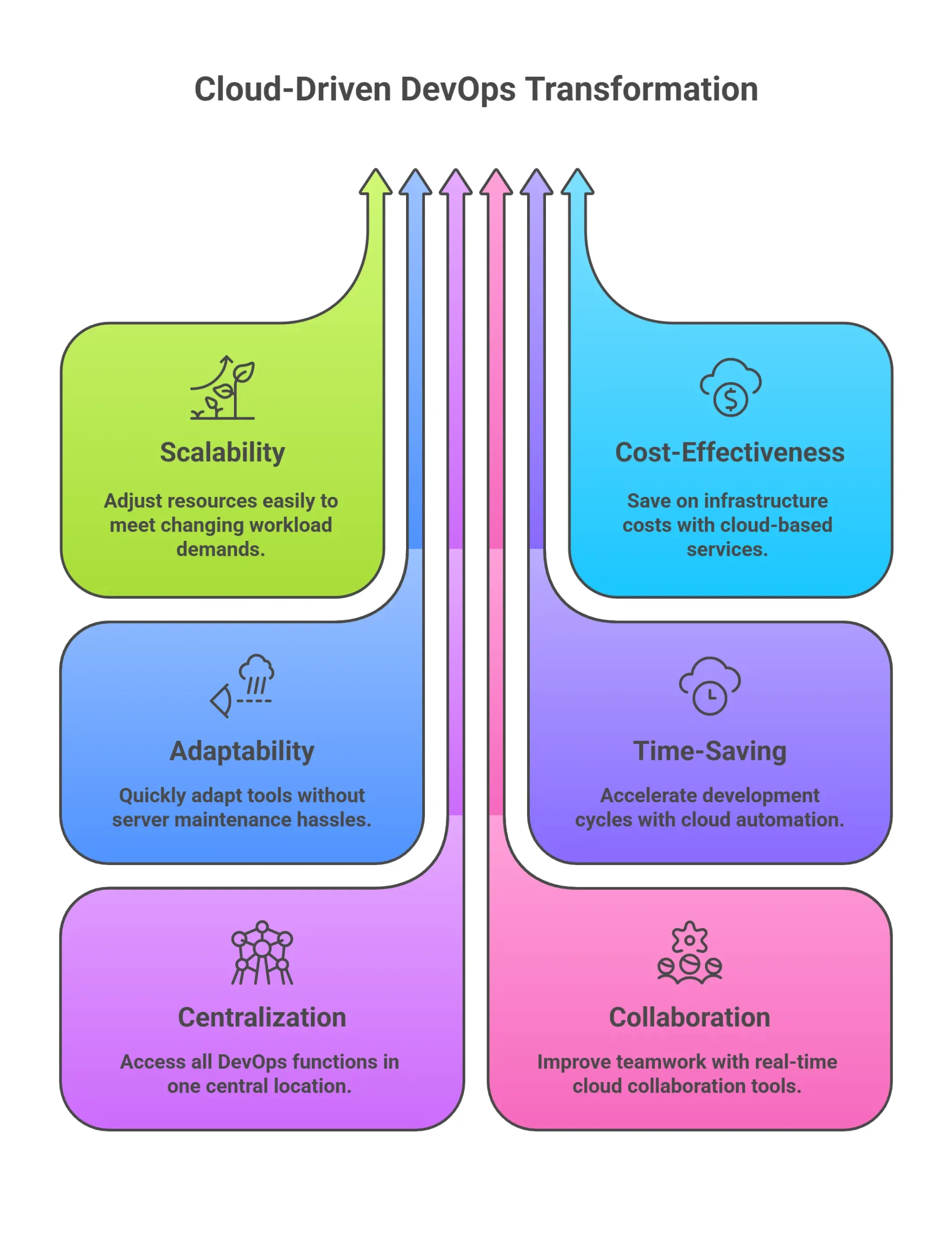
Integrated cloud management solutions offer several benefits for DevOps, including:
1. Scalable
With cloud solutions, you can scale resources according to demand. This is easier to adjust based on workload demands. This allows for optimum resource use and is one of the key features of cloud-driven DevOps transformation.
2. Cost-Effective
The cost of setting up server space, along with purchasing software, devices, and hardware, is high. However, with cloud-based services, you save on expensive on-premise infrastructure. This way, you only pay for the resources you use.
3. Easy to Adapt
Tools hosted on the cloud are much easier to adapt. You don’t have to ensure server space and worry about maintaining the hardware and software configurations. Setting up is easy. You simply purchase the plan and access the cloud management platforms.
4. Time-Saving
Cloud-based DevOps allows teams to configure resources and respond to feedback quickly. It speeds up development cycles and allows for quicker time-to-market.
5. Centralization
DevOps encompasses a range of processes, including coding, building, testing, deploying, and monitoring. With cloud solutions for DevOps, these functions are available in a centralized format that can be easily accessed by any of the teams at any point in time.
6. Easier Collaboration
Cloud management for DevOps enables better collaboration at each step. It avoids the hassle of sending files back and forth.
Multiple individuals can develop software simultaneously. Further, developers, operators, and testers can all access the same tools and resources and collaborate in real time. Since it allows them to work remotely, people can access it from wherever they are.
7. Smoother Automation
Effective automation requires tools that help report bugs, document requirements, speed up communication between teams, and keep up with technological innovation and changing user expectations. Such automated processes are easier to carry out through the cloud.
With DevOps cloud integration, you save on setting up servers and installing software, and can also run automated tests easily. By automating repetitive tasks, you can focus on those that require judgment and innovation and avoid doing tedious, repetitive tasks.
8. Encourages Innovation
Since cloud-based solutions are more flexible and scalable, they enable the team to try out new technologies with ease and encourage innovation and improvement.
9. Disaster Management
Cloud-based solutions allow you to easily handle disaster recovery through backed-up data and applications that can be promptly restored. This allows the smooth continuance of business.
Summing Up
Cloud management challenges and solutions for DevOps have transformed the way organizations develop, test, and deploy software. By using cloud-based tools, DevOps teams can improve flexibility, collaboration, and delivery.
Hurix Digital provides a range of cloud services to suit your diverse needs. So, whether you’re migrating to the cloud or improving existing infrastructure, our cloud solutions will help you manage and streamline your DevOps.
Connect with us today to get started!
Summarize with:

Vice President & SBU Head –
Delivery at Hurix Technology, based in Mumbai. With extensive experience leading delivery and technology teams, he excels at scaling operations, optimizing workflows, and ensuring top-tier service quality. Ravi drives cross-functional collaboration to deliver robust digital learning solutions and client satisfaction