 A Space for Thoughtful

Measuring Success in Instructional Design, Simplified!
Summarize with:
Modern corporate businesses need to invest in employee development, instructional design, and enterprise learning to stay competitive. Corporate learning services demonstrate substantial power because they provide double benefits to employees and their organizations over the long term. A primary element of this financial commitment involves understanding how instructional design affects the return on investment (ROI). Organizations use this metric to determine the success and cost-efficiency of their training programs.
This article provides a comprehensive guide to instructional design, its importance, and how you can measure its success to maximize your training ROI.
Table of Contents:
- What is the ROI of Instructional Design?
- Why is the ROI of Instructional Design So Important in Workforce Learning?
- Why Assess and Evaluate Learning Outcomes?
- What are the Types of Assessment?
- Planning Assessment In Instructional Design
- A Framework for Calculating eLearning ROI
- 7 Methods of Instructional Design ROI Measurement
- Best Practices for Maximizing Training ROI
- Indicators that Your Instruction Needs Improvement
- Summing Up
What is the ROI of Instructional Design?
The ROI of instructional design is a metric used to evaluate the effectiveness and efficiency of training programs. Specifically, it quantifies the benefits gained from these programs in relation to the costs incurred. It answers the question: “Is the investment in instructional design providing a worthwhile return?” Ideally, the ROI for your firm is based on the success of learning and retention, which are nuanced aspects that can be difficult to measure and cannot be equated with a learner simply signing off on completion.
Calculating ROI helps L&D leaders justify training budgets, align programs with organizational goals, and demonstrate the tangible impact of training on business performance.
Why is the ROI of Instructional Design So Important in Workforce Learning?
The ROI of instructional design is important as it helps assess the effectiveness of the training materials. For instance, creating educational materials that align with the enterprise’s needs can produce a positive ROI. In all this, it would be helpful to bear in mind that employee training is a long-term investment. It is important to approach training as a long-term investment as not all training will yield immediate results, such as an increase in your bottom line. While some training will show up almost immediately in terms of costs and revenues, employee training, by and large, is about building a foundation for progress and growth. It will yield significant financial returns but over a longer period.
Let us examine the main reasons ROI is important in workforce learning.
- Justification of Investment: Demonstrating a positive ROI assures stakeholders that resources are being utilized efficiently for employee development. An inspiring and effective ID will impact business metrics such as sales, productivity, operating costs, employee job engagement, employee retention, job promotion, and other targeted measures. So, the pertinent question is: Do the monetary benefits of the increase in business impact outweigh the costs of the plan and design of the instructional program? If yes, then the investment is justified.
- Continuous Improvement: Measuring the return on investment in training programs provides insights into what works and what doesn’t, allowing for refinement and enhancement of training programs. Furthermore, it helps identify challenges and weak areas in the program and enables course correction earlier rather than later.
- Strategic Decision-Making: It empowers decision-makers to allocate resources effectively, focusing on initiatives that yield the highest ROI. Consequently, the cost-effectiveness of instructional design goes a long way toward ensuring a positive ROI.
Why Assess and Evaluate Learning Outcomes?
Assessment and evaluation enable you to confirm that the instruction is designed to achieve the planned learning outcomes. It helps determine:
- Whether instructional goals are in line with the program requirements.
- Whether lesson plans, learning materials, and assessments are integrated with specific learning needs.
- Whether any changes need to be made to the instruction to make it more effective.
- Whether the execution of the learning design provides satisfactory instruction, helps achieve the instructional objectives, and helps learners obtain the requisite skills and knowledge.
- Whether it equips learners to transfer their learning into applied skills and relevant contexts.
Outcome-based assessment is a key component of evaluating programs, which focuses on student learning outcomes and the impact of learning. Learning outcomes assessment can help you understand a course’s strengths and possible drawbacks and determine areas of improvement.
What are the Types of Assessment?
There are two main types of assessment that are crucial for measuring instructional design success. These are as follows:
1. Summative Assessment
This includes tests, quizzes, and other graded assessments that measure student performance. Performance evaluations are usually conducted at the end of the course or module and display what the participants have learned. These are effective ways to measure the knowledge and skills employees have gained from the program.
2. Formative Assessment
This usually takes place on an ongoing basis through the learning process. For example, students receive input, guidance, and feedback on their performance that can enable them to improve. This can be done face-to-face or through comments on assignments, rubrics, emails, and other ways of giving feedback.
Planning Assessment In Instructional Design
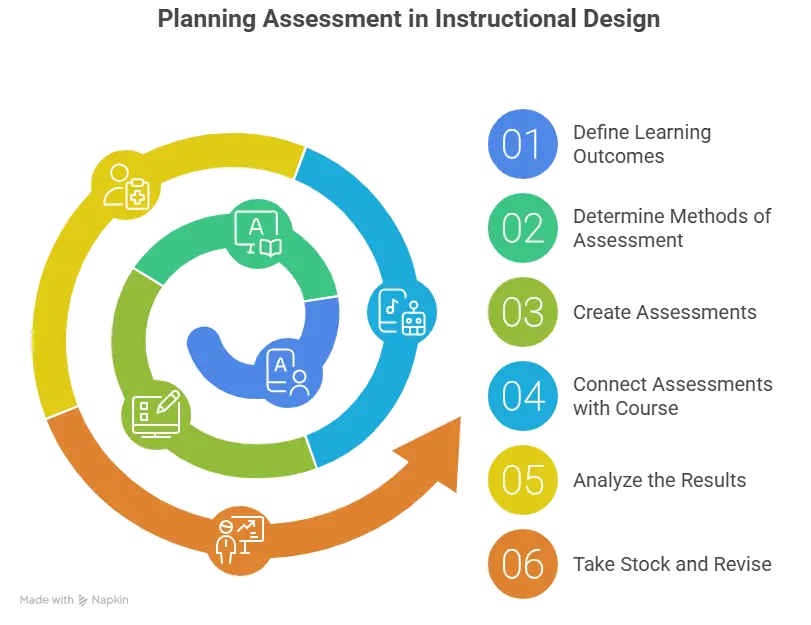
Assessment is more successful if it is defined in a plan, whether you are assessing course learning or the whole curriculum. Here are some of the key steps in coming up with an assessment plan.
1. Define Learning Outcomes
The first step in measuring the impact of an online learning program is to clearly define the learning and performance objectives. These objectives should be aligned with the organization’s overall business goals and should specify the knowledge, skills, and behaviors that employees are expected to exhibit on the job. In the context of workplace learning, defining the performance objectives in terms of what the learners should be able to do at the end of the training is critical.
2. Determine Methods of Assessment
As an instructor, you must decide how you will determine that students meet the learning outcomes through assignments or other assessment forms. This can include quizzes, tests, or simulations.
3. Create Assessments
You must then create formats and performance criteria for the assessments you have chosen. This process ensures that the evaluation is consistent and fair for all learners.
4. Connect Assessments with Other Components of the Course
The main assessment forms can be integrated with smaller assignments and ongoing learning, such as lectures, discussions, and other activities. This integration helps reinforce the learning material in different contexts.
5. Analyze the Results
This step involves reading and scoring assignments and comparing them to set performance objectives. The analysis provides clear data on how well the instructional design is working.
6. Take Stock and Revise
After the assessment, instructors can develop learning and assessment plans for the rest of the course based on the areas of strength and improvement identified. Ultimately, the success of online learning programs depends on the ability of organizations to measure their impact and continually improve them over time.
A Framework for Calculating eLearning ROI
The traditional method of calculating the return on investment was to divide the benefit or return on actual investment by the cost incurred. Similarly, to calculate the eLearning ROI, financial gains can be considered as the benefits achieved from the training program and divided by the actual amount spent on the program.
To calculate ROI for course development, use this simple formula:
ROI (%) = [(Monetary Benefits – Training Costs) / Training Costs] x 100
For example, if a company invests $100,000 in training and gains $400,000 in increased revenue or cost savings, the ROI is 300%. This clear measure helps executives see the financial value of training programs.
The cost of an eLearning program includes the cost of course development, the cost of a learning management system, the administrative cost of managing the initiative, as well as infrastructure costs. All of these are to be considered while calculating the ROI.
Calculation of ROI can also be rationalized with the use of Kirkpatrick’s model of evaluation by adding a fifth level for Return on Investment. Given below is the framework for training evaluation as per the Kirkpatrick model.
- Level 1: Reaction – This factor can be measured by taking feedback from the learners.
- Level 2: Learning – At this stage, you gauge the knowledge and skills gained from the learning program, often measured with tests and assessments.
- Level 3: Behavioral Changes – Organizations need to utilize a blend of strategies to assess the amount of newly acquired learning that is being applied at work.
- Level 4: Results – Here, the organizations measure whether the course helped improve business results.
Additionally, tools like the Phillips ROI Methodology can help provide a complete picture of the training program’s impact, covering both financial and other benefits.
7 Methods of Instructional Design ROI Measurement
Measuring ROI in learning and development is complicated. When it comes to training, for instance, determining the value of an investment isn’t as clear as measuring the value-added of new manufacturing equipment meant to expedite production. The gains in employee competency and efficiency are less concrete, albeit measurable. For example, training employees to use new software could have variable productivity gains across your workforce.
Some employees may increase their efficiency by 50 percent, while others by 30 percent, yet others may not improve at all. Since it involves navigating a learning curve, changes in productivity will be slow initially as workers build familiarity and gradually increase as their comfort level and familiarity rise. This makes estimating the ROI difficult. As a result, companies need to focus on specific, measurable points when designing training programs.
For instance, job completion rates during a defined period in highly repetitive roles can be a way out. Here are seven evaluation methods you can consider while measuring your ROI in instructional design.
- Pre- and Post-Test Scores: Compare employees’ knowledge or skill levels before and after training. A significant improvement indicates the effectiveness of the program.
- Surveys and Feedback: Collect feedback from participants about the training’s relevance, clarity, and usefulness. Surveys before and after the training session will help gauge the change in perceptions. Positive feedback suggests a higher ROI, though it doesn’t provide hard data on business outcomes. Its value lies in capturing the engagement element, which is an important, albeit indirect, link to your ROI.
- Application and Performance Metrics: Evaluate how well employees apply what they’ve learned on the job. Increased proficiency directly correlates with a positive ROI. Identifying key performance indicators (KPIs), which are specific metrics used to assess the effectiveness of a training program and aligned to the firm’s goals, is crucial. These include employee engagement, customer satisfaction, creativity, and productivity. They help by providing objective criteria to measure if the training program is achieving its objectives.
- Cost Analysis: Measuring the cost of training is crucial to determining the ROI of instructional design. The training costs include direct costs such as course material costs and a trainer’s fees. It also includes indirect costs such as loss of employee time and productivity. Compare the costs of developing and implementing the training program to the benefits gained, such as increased productivity or reduced errors, thereby determining if the investment was worthwhile.
- Time-to-Competency: Measure the time it takes for employees to reach a desired level of proficiency after completing the training. A shorter duration implies a higher ROI. This is because the quicker the agents become proficient, the more productive they become. Time to competency can be reduced by setting clear goals, contextualizing new learning material through scenarios, and differentiating content delivery modes.
- Employee Retention Rates: Determine if training programs increase retention rates. Investment in employee L&D has proved highly beneficial in meeting employees’ needs for progress and improvement. This implies reduced turnover, which can lead to substantial cost savings.
- Business Impact Assessment: Identify specific business outcomes influenced by the training, such as increased sales, improved customer satisfaction, or enhanced product quality. For example, sales training is a great opportunity to connect training outcomes to points of impact related to revenue.
Best Practices for Maximizing Training ROI
To make sure course development efforts yield the best possible ROI, think about these key practices:
- Tailored Training Programs: Customize training to meet the exact needs of different departments or teams. Programs that fit are more likely to tackle each group’s unique challenges and goals, leading to better results.
- Engage Leadership: By getting buy-in from upper management, lower-level managers can emphasize the value of training and its purpose concerning the organization’s goals. Engaging leadership builds value around a program and reinforces its legitimacy.
- Ongoing Evaluation: Continually tracking performance metrics, obtaining employee feedback, and looking at financial results helps you see if training remains effective and ensures that training can turn into continuous learning and adaptation.
- Integrate Training with Development Plans: Link training to individual development plans and employee advancement. This allows employees to see a clearer connection between organizational goals and job performance.
- Communicate Success Stories: Use success stories and case studies to show how training positively impacted business outcomes. These stories help build the value of training and secure a renewed commitment to funding.
- Keep Courses Short and Precise: Lengthy content can be tiring. The micro-learning approach works best, splitting lengthy content into bite-sized modules for better retention. A good LMS allows you to integrate short videos, infographics, and animations.
- Leverage Mobile Compatibility: A good LMS provides a responsive design that is accessible on any device. Since many learners prefer using mobile devices for convenience, device compatibility allows them to continue from where they left off and significantly improves course completion rates.
Indicators that Your Instruction Needs Improvement
Assessing and evaluating learning outcomes is a great way to gauge whether your instructional design needs improvement. Here are key indicators that it does:
1. Low Completion Rates
If learners are losing interest in the course and failing to complete it, it may indicate that you need to change your instruction. The content may be cumbersome, the assessments may be too challenging, or learners may find it difficult to relate to the course. The industry average for online course completion is still low, with even free MOOCs experiencing high training dropout rates.
2. Low Engagement
Engagement rates can indicate whether your course is effective. If learners rarely ask questions, are not participative, and do not engage in discussions with fellow learners, it shows they are disengaged. If engagement drops during the course, this must also be factored in.
3. Negative Feedback
Reviews and feedback are key indicators of the effectiveness of your instruction. Negative reviews, particularly if there are several of them, can signal a cause for concern and require investigation.
4. No Change in Behavior
One of the primary ways of measuring learning effectiveness is to see if it results in a behavior change. You can assess learners’ behavior for changes to see if there is progress in their abilities after the training.
Summing Up
Assessing and evaluating learning outcomes is integral to designing effective courses and curricula. It enables instructors to determine whether the course achieves the desired learning goals and provides a clear path for continuous improvement. By defining a plan for assessing outcomes, focusing on key metrics, and leveraging analytics, organizations can make data-led assessments of their course design.
Measuring the ROI of instructional design is not just about proving the value of training—it’s about demonstrating its impact on business performance and aligning learning initiatives with strategic goals.
Hurix Digital offers comprehensive eLearning services and higher education solutions. Our team applies proven instructional design models and theories in diverse domains to meet unique client needs. We help organizations create and deliver competency-based education, design and develop educational content, and offer business learning consulting and solutions. Ready to elevate your training initiatives? Connect with us today to learn more.
Summarize with:

Senior Vice President – Business Development
at Hurix Digital, with over 25 years of experience in EdTech and workforce learning. He excels in business development, customer relationship management, and scaling digital learning solutions, driving global growth through innovative content, simulations, and AI‑driven training offerings