 A Space for Thoughtful


5 Online Teaching Strategies That Improve Student Learning
Summarize with:
Before the COVID-19 outbreak, remote learning was never the norm. Traditional learning was predominantly a group activity in a classroom where students could engage in experiments and discuss theories for new and exciting ideas.
It was easy to communicate with children because everyone was in the same place at the same time. Learning united us and made the experience enjoyable for all. Until the pandemic outbreak caused schools and universities to shut worldwide.
Since then, online learning has turned into an individual activity that most students are performing while isolated in their homes.
What used to be a joyful experience for instructors, of spending the day in front of a drawing board explaining topics to children and answering questions, has now turned into a cumbersome, anxiety-inducing struggle to get everyone on the same page virtually.
As we move towards the online mode of learning, the human element must not be lost. At the current rate, we risk dehumanizing the entire learning process and losing out on a lot of what makes learning fun. Here’s how educators must try and maintain the human element in remote learning.
In this article, we look at some online teaching strategies that educational institutions can adopt to improve student learning and ensure that they have a successful learning experience.
Table of Contents:
- 5 Trusted & 8 Modern Teaching Methods in Online Education
- Top 6 Tips to Help Develop Confidence & Comfort During Teaching Sessions
- Conclusion
5 Trusted & 8 Modern Teaching Methods in Online Education
Online platforms for education today leverage the following 13 types of modern teaching methods to maximize the learning impact and key takeaways from each module:
1. Flipped Classrooms
Flipped classrooms follow the concept of reversing the setting of traditional classrooms. While in a conventional classroom, the educators teach a lesson and let students do assignments on their own time, a flipped classroom is completely the opposite.
Students consume pre-recorded lectures or read prescribed materials at their own pace and in their own time. The online class is then invested in interacting with students and addressing their queries.
2. Tactile Learning
The term “tactile” signifies active collaboration and participation in an activity that an educator demonstrates for the learners. In an online classroom, this teaching method engages students in tasks designed to explain educational concepts.
For example, during a student’s formative years, educators may leverage simple mathematical activities to teach them numbers and fractions.
For the more advanced learners, these activities may constitute developing mastery in the practical application of concepts.
3. Project-Based Learning
Project-based learning involves creating project work for the learners to engage in. These projects are typically based on real-world situations and aim at enhancing communication and teamwork between students if it’s a team-based project.
Students are required to apply critical thinking and strategic approaches to devise solutions for real-world problems. It helps drastically improve engagement and also expands student perspectives through sharing ideas.
4. Problem-Based Learning
Problem-based learning is, in essence, the same as project-based learning. However, there is one critical difference in the method of teaching. While in project-based learning, the students are taught a concept and given a project to work on; the problem-based model presents the problem to the students before teaching them anything.
They are allowed to work together or individually to arrive at the best possible solution, gradually easing them into the concept of the subject.
5. Inquiry-Based Learning
Inquiry-based learning aims at stimulating the curiosity and free thinking of students. In this method, the teachers provide the students with an open-ended inquiry, which they are supposed to develop on their own.
The students are free to theorize and bring their proofs of concept. They can start from scratch and develop their analytical methodologies and work towards the optimum output by being resourceful and innovative at the same time.
6. VAK Learning
VAK stands for Visual, Auditory, and Kinesthetic learning. It is a teaching method that focuses on inclusivity to ensure that all three types of learners – visual, auditory, and kinesthetic – stay on board with the lesson.
It offers visual stimulations (like videos and presentations), audio representations (like podcasts and debates, and kinesthetic presentations (like activities) for each concept within a lesson. The lessons thus become more engaging for every learner, no matter what method they prefer.
7. Collaborative Learning
Collaborative learning helps develop key skills in students:
- Leadership skills: since these projects involve forming and guiding a team, leadership skills can be learned along the way.
- Collaboration and teamwork: The project or activity can be completed resourcefully when all team members work together. Collaborating is not just about working together but contributing each individual’s unique capability to the project.
Educators also aim to inculcate better time management through such projects.
8. Game-Based Learning
Gamification has proved extremely effective in boosting learner engagement in a lesson. Educators can get the entire online classroom on board with specially designed games and deliver game-based learning of concepts. It may include analytics quizzes or logical reasoning games – the options are endless.
This teaching method also promotes healthy competition and encourages each student to perform better and better with each game played.
Also Read: How Game-Based Learning Solutions Raise Productivity and Drive Business Growth?
9. Think-Based Learning
While this method is not a teaching method in itself, it can be used to augment all other teaching methods. In this method, the educators present the students with a fact or a premise and then challenge it while inviting comments from the students about the nature of truth or fallacy.
This helps students think outside the box and apply their minds to understanding deeper concepts.
10. Cooperative Learning
This method is similar to collaborative learning. However, in cooperative learning, each student has their own fixed role. Depending on the individual performance of every student in their role, the result of the entire team is decided.
This method puts the entire team at stake over the performance of its members, which helps teach students accountability and responsibility.
11. Competency-Based Learning
Competency-based learning is the most popular method of augmenting other methods of teaching. In this method, the educators provide students with a test or an assessment. Depending on their performance, the educators judge whether or not a learner has grasped what was intended from a lesson before they let them progress to the next module.
12. Independent Learning
Independent learning is the method where the only involvement of the educator is to provide the course and be present to answer queries. The students decide what they will learn, how they will learn and progress, how they will evaluate their performance, etc.
Students get complete control of their lessons. The teacher can interfere in case a learner is facing challenges.
13. Adaptive Learning
Adaptive learning leverages the power of AI and ML tools to make a course flexible according to the needs of each student. The lesson progress adjusts itself to the speed and capacity of the learner, allowing them enough time to grasp the concept while still moving forward in the course.
Top 6 Tips to Help Develop Confidence & Comfort During Teaching Sessions
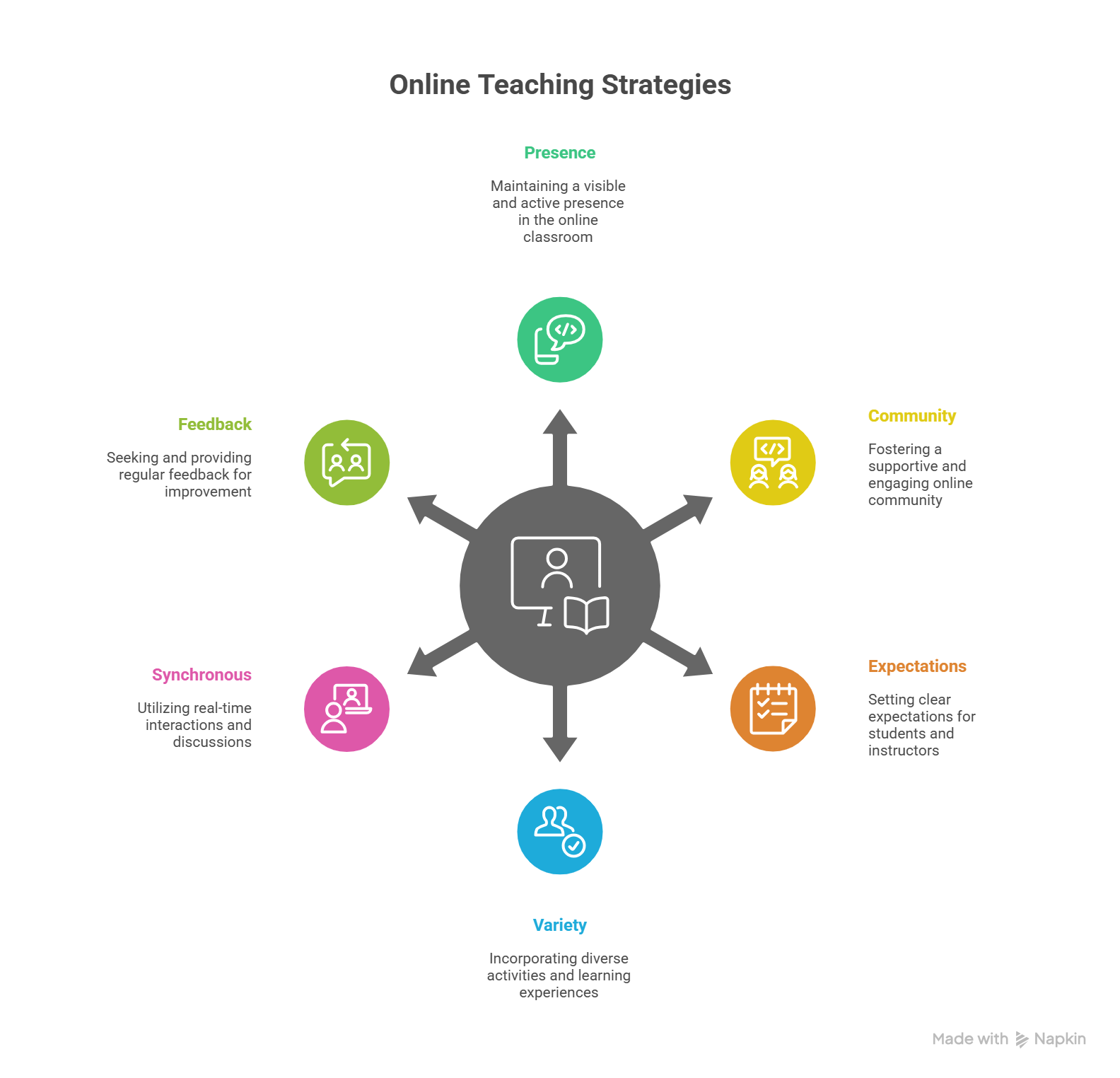
Several studies have shown that these practices significantly contribute to an effective and efficient learning and online teaching experience for both students and teachers. To maintain a quality environment in online teaching sessions, these tips are top-tier as they help develop confidence and comfort during teaching sessions. Let’s dive in:
1. Make Your Presence Felt
The use of communication tools is key to being ‘present’. Tools like announcements, discussion board postings, and forums are great for communicating with students and letting them know that their opinions and concerns are heard. Building a healthy connection between faculty and students can be challenging when it doesn’t occur in a physical classroom. However, once you make the most of these tools, you might eventually see better responses than physical classrooms.
The future of higher education is digital. According to students, the ‘best online faculty’ are the ones who show their presence several times a week, or best, a day. Setting clear expectations regarding course policies at the beginning of the course is crucial, and it can help you reduce the need for daily online presence if that is something you want to avoid. You can also set a particular time when you will be available to answer emails, texts, and calls.
2. Create Supportive Online Course Community
The key to developing a supportive course community online is to design a course that has a balanced set of dialogues – meaning that the three dialogues of faculty to student, student to student, and student to resources should be equal. In most courses, the dialogue between students by faculty is provided with mini-lectures in text, video, or podcasts, weekly coaching, reminders and announcements, and explanations.
To encourage student-to-student engagement and build the course community, you’ll need to follow some strategies. As an online instructor, you must develop three types of presence: social presence, content presence, and teaching presence.
- You can launch the class with a personal introduction posting to engage and get to know each other better. You can ask them to include personal information, photographs, pets, family, and so on.
- Encouraging the students to use a general open student forum to request help and offer assistance from each other is a great way to help them build unity among themselves.
- You can pair 3-4 students in groups so that they can study together and help each other grow. You can also assign group projects and class assignments to help them learn how to work as a team.
Remember, not all students learn at the same pace. What works well for one student may not work for another. Not all students will respond in your classes the same way, and that’s why challenging tasks and group projects are important, so that they participate actively.
3. Share Clear Expectations for Your Students and Yourself
This practice cannot be overemphasized, as it plays a crucial role in your and your students’ entire online course experience. So, before you start your course, set clear expectations on how you will communicate with the students and how the students will communicate with each other in the class.
Online teaching strategies take a lot of effort and are just as intensive as teaching in a physical classroom. Thus, clearing any doubts regarding how much time and effort will be required on a weekly basis will save you and your students so much time.
4. Use Various Large Groups, Small Groups, as well as Individual Work Experiences
A community only shines when it upskills itself regularly. And to keep the students on track, it’s a great idea to provide them with a variety of activities and experiences. Online courses can be more fun and interactive if the students get the opportunity to brainstorm and work through assignments alone or in groups. This helps improve student engagement and thus, their academic performance.
They will learn to tackle problems on their own and will also learn how to work with a team. Complex case studies will make them learn more about a certain topic on their own, and you will notice a big difference in their performance in class.
5. Use Both Synchronous and Asynchronous Activities
Back when online teaching was introduced, it used to be entirely asynchronous learning. It has gradually improved with time, and now we have virtual live classrooms with audio tools as well as course management systems. Students can now do almost everything they do in a physical classroom. They can engage in collaborative and reflective activities as well.
Nothing is better than a real-time discussion and interactive brainstorming. In courses like finance and statistics, real-time problem-solving sessions are great for effective learning for students. Even though working professionals choose asynchronous courses to learn anywhere, the same learners enjoy productive and interactive get-togethers.
6. Ask for Feedback
Not all students examine themselves and notice changes in their performance. This is why you need to keep track of your students’ progress over time and provide them with monthly or weekly feedback on their performance in the course. When you grade their assignments, let them know what they need to improve.
Just like giving your students feedback, you also must ask them for feedback on your online presence. You can ask for their opinions monthly or weekly and ask them about the areas they have difficulty understanding. You can also ask them for suggestions on improving your teaching. Understanding what is working well for students is something that will help them have a better course experience. You can modify and craft your online teaching strategies based on their suggestions.
Conclusion
There is a great deal to learn about teaching and learning when it comes to online teaching, as it presents significant challenges. Traditional courses have long focused on tools and techniques for presentations. Their bigger focus is on covering the syllabus and getting through the book. Modern online teaching emphasizes the interactions and engagement of students with the core concepts and skills included in the course. The new focus encourages the learners to be more present and ask any questions they have in mind.
To that end, Hurix Digital provides the necessary digital infrastructure for educators to implement their pedagogies without any roadblocks. To take a look at the solutions Hurix Digital offers, visit the website.
Summarize with:

Senior Vice President – Business Development
at Hurix Digital, with over 25 years of experience in EdTech and workforce learning. He excels in business development, customer relationship management, and scaling digital learning solutions, driving global growth through innovative content, simulations, and AI‑driven training offerings