 A Space for Thoughtful
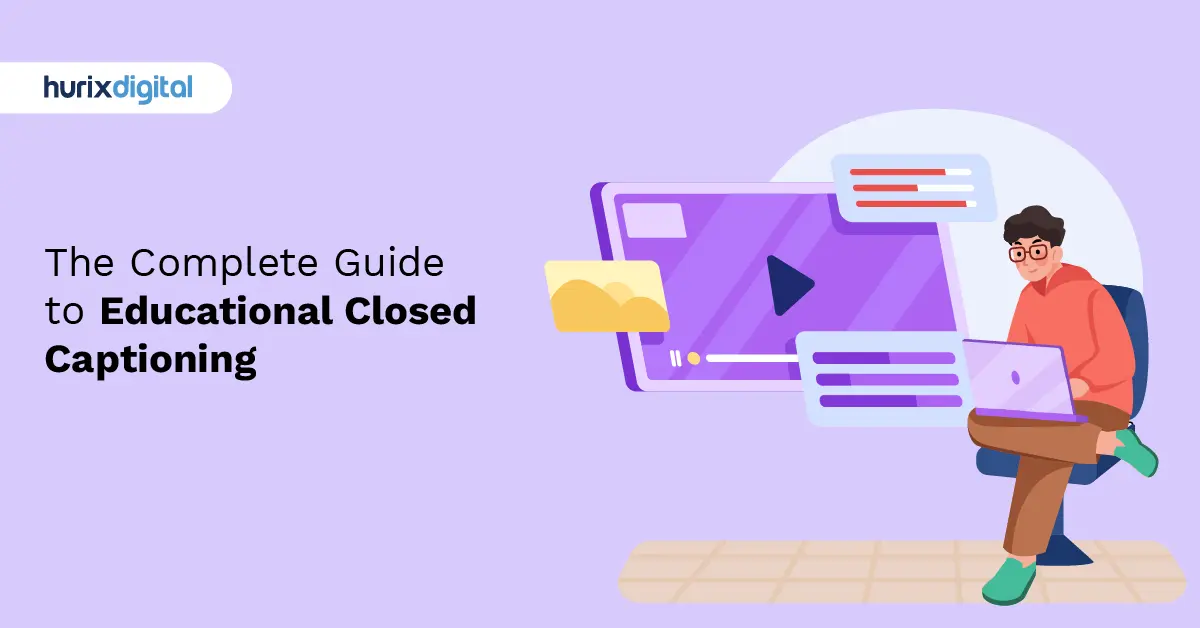
The Complete Guide to Educational Closed Captioning
Summarize with:
Have you ever tried watching a video in a noisy place or late at night with the sound off? If so, you’ve probably relied on those little lines of text at the bottom of the screen. That’s closed captioning, and it’s far more than just a convenience feature. It’s a powerful tool that is reshaping how we access and engage with digital content, especially in education.
Closed captioning provides a text-based version of all audio within a video, including spoken dialogue, speaker identification, and non-speech sounds like laughter or a door slamming. Unlike subtitles, which only translate dialogue for foreign-language content, closed captions are created for viewers who cannot hear the audio. However, their benefits extend to a much wider audience.
In this guide, we’ll explore everything you need to know about closed captioning. We will cover its importance for accessibility, its surprising benefits for all learners, and how to implement it effectively in your educational content. We’ll also debunk some common myths and look at the technology making captioning easier and more accurate than ever. Let’s get started.
Table of Contents:
- What Exactly is Closed Captioning?
- Why Closed Captioning is a Must-Have for Accessibility
- The Surprising Benefits of Closed Captioning for ALL Learners
- Debunking Common Myths About Live Captions
- Implementing High-Quality Closed Captioning: Best Practices
- Closed Captioning and SEO: An Unexpected Alliance
- The Future of Captioning in Education
- Taking the Next Step Towards Accessible Content
What Exactly is Closed Captioning?
At its core, closed captioning (CC) is a process of displaying text on a screen to provide a transcription of the audio. The “closed” part of the name means that the captions are not visible by default; the viewer has to choose to turn them on. This is different from “open captions,” which are permanently burned into the video and cannot be turned off.
Captions deliver more than just spoken words. A complete caption file includes:
- Dialogue: A word-for-word transcript of what is being said.
- Speaker Identification: Labels to show who is speaking, which is crucial in videos with multiple people or when the speaker isn’t on screen.
- Sound Effects and Non-Speech Elements: Descriptions of important sounds like [phone ringing], [suspenseful music], or [audience applause] that contribute to the context and viewing experience.
This comprehensive approach ensures that viewers who are deaf or hard of hearing receive the same information as hearing viewers.
The Evolution of Captioning Technology
Captioning has come a long way. It started in the 1970s as a service for deaf and hard-of-hearing television audiences. Early captions were often clunky and prone to errors. Today, advancements in technology have transformed the landscape.
We’ve moved from manual transcription to sophisticated automated speech recognition (ASR) systems. These AI-powered tools can generate captions in real-time with increasing accuracy. This technology, often referred to as live auto-captions, makes it possible to caption live events, webinars, and online classes as they happen. While ASR is a game-changer, it’s not perfect. Human review is still essential for ensuring accuracy, especially for content with technical jargon, multiple speakers, or poor audio quality.
Why Closed Captioning is a Must-Have for Accessibility
The primary driver behind closed captioning is accessibility. For millions of people around the world, captions are not a preference but a necessity.
Supporting Learners Who Are Deaf or Hard of Hearing
According to the World Health Organization (WHO), over 5% of the world’s population has disabling hearing loss. For these individuals, video content without captions is completely inaccessible. In an educational setting, this means students with hearing impairments are excluded from lectures, instructional videos, and other essential learning resources.
Providing accurate, high-quality captions ensures these students have equal access to education. It’s a fundamental requirement for creating an inclusive learning environment and is often mandated by law. In the United States, laws like the Americans with Disabilities Act (ADA) and Section 508 of the Rehabilitation Act require educational institutions and government agencies to make their digital content accessible.
Benefits Beyond Hearing Loss
Accessibility isn’t just about catering to one specific group. Captions also support learners with various other disabilities:
- Auditory Processing Disorders: Some individuals can hear sounds but have difficulty processing and understanding spoken language. Captions provide a visual reinforcement that can significantly improve comprehension.
- Attention Deficit Hyperactivity Disorder (ADHD): For students who struggle with focus, captions can help maintain engagement by providing a second mode of input. Following the text on screen can minimize distractions.
- Autism Spectrum Disorder: Many individuals on the autism spectrum find it easier to process written text than spoken words. Captions can reduce the cognitive load of interpreting social and emotional cues from speech.
By incorporating captions, you create a more flexible and supportive learning experience that caters to a wide range of needs. It’s a core principle of Universal Design for Learning (UDL), a framework for creating educational environments that are accessible to everyone.
The Surprising Benefits of Closed Captioning for ALL Learners
While captions are essential for accessibility, their advantages reach far beyond. Research consistently shows that using closed captions can improve learning outcomes for all students, regardless of their hearing ability. Let’s look at some of these universal benefits.
Improved Comprehension and Retention
Have you ever read a book and then watched the movie adaptation? The combination of seeing the story play out and reading the dialogue often cements the details in your mind. The same principle applies to captions. When students can read the text while listening to the audio, it reinforces the information through two different sensory channels. This dual-coding approach can lead to better focus, comprehension, and long-term retention of the material.
This is especially helpful for complex or technical subjects. When a video discusses intricate scientific concepts or uses specialized vocabulary, having the terms spelled out on the screen can make a huge difference in understanding.
Supporting English Language Learners (ELL)
For students learning English as a second language, captions are an invaluable tool. They can help bridge the gap between hearing a new word and understanding its spelling, meaning, and context. By seeing the words on screen, ELL students can:
- Learn new vocabulary and spelling.
- Better understand pronunciation and sentence structure.
- Keep up with the pace of native speakers.
- Rewind and review sections without losing the context provided by the text.
This makes video content a much more effective language-learning resource.
Flexibility in Viewing Environments
The modern learner is on the go. Students often watch educational videos in places that aren’t perfectly quiet—a bustling coffee shop, a shared library space, or on public transportation. In these “sound-sensitive” environments, captions allow them to watch and learn without needing headphones or disturbing others.
Conversely, captions are also useful in quiet settings where audio is not an option, such as late-night study sessions when a roommate is asleep. Providing captions gives learners the flexibility to engage with content on their own terms, wherever they may be.
Enhanced Search and Navigation
When you add a caption file to a video, you’re also creating a searchable transcript. Many modern video players allow users to search the transcript for specific keywords and jump directly to that point in the video. This turns a passive viewing experience into an active learning tool. A student can quickly find the exact moment a professor defined a key term or explained a difficult formula, saving time and making studying much more efficient.
Debunking Common Myths About Live Captions
As live captioning technology becomes more common in webinars, virtual classrooms, and live events, some misconceptions have emerged. It’s time to set the record straight on a few of these myths.
Myth 1: Live Captions Are 100% Accurate
Reality: While Automated Speech Recognition (ASR) has made incredible strides, it is not flawless. The accuracy of live captions can be affected by several factors:
- Audio Quality: Clear audio is the most critical factor. Background noise, poor microphone quality, or soft-spoken presenters can all lead to errors.
- Speaker’s Accent and Pace: ASR systems are often trained on standard accents. Strong regional accents or very fast speech can reduce accuracy.
- Technical Terminology: Specialized jargon, acronyms, or proper nouns that are not in the system’s dictionary are often misinterpreted.
For these reasons, while ASR is a fantastic tool for live situations, it’s not a complete substitute for human-reviewed captions for pre-recorded content. The industry standard for accessibility, often referred to as WCAG (Web Content Accessibility Guidelines), calls for an accuracy rate of 99% or higher. ASR alone typically falls short of this, usually landing somewhere between 80-95% accuracy.
Myth 2: Live Captions Are a Distraction
Reality: This is a common concern, but research suggests the opposite. For many viewers, captions can actually improve focus. A study by the Oregon State University Ecampus Research Unit found that the majority of students find captions helpful for maintaining concentration and learning.
Of course, personal preference plays a role. That’s why closed captions, which can be turned on or off, are the ideal solution. Viewers who find them distracting can simply hide them, while those who benefit can use them. Offering the choice empowers the learner.
Myth 3: Only People with Disabilities Use Captions
Reality: This is perhaps the biggest misconception of all. Data shows that a vast majority of people who use captions do not have a hearing impairment. For example, a UK study found that 80% of viewers who use captions are not deaf or hard of hearing. A separate study in the US found that 92% of students find captions helpful for their learning.
People use captions for all the reasons we’ve discussed: to watch in noisy places, to help with focus, to learn a new language, or to better understand complex topics. Thinking of captions as a niche feature for a small group of users is outdated. They are a mainstream tool that enhances the experience for everyone.
Implementing High-Quality Closed Captioning: Best Practices
Creating effective closed captions goes beyond simply generating a transcript. To ensure your captions are truly helpful and accessible, follow these best practices.
1. Strive for 99% Accuracy
As mentioned, 99% accuracy is the gold standard. This means that for every 100 words, there is no more than one error. This level of precision is crucial for comprehension, especially in an educational context where every word matters.
How do you achieve this?
- For pre-recorded video: The best method is to use a professional transcription and captioning service. These services, like those offered by Hurix Digital, use a combination of ASR and human editors to produce highly accurate files. If you’re on a budget, you can start with an ASR-generated transcript and then edit it yourself.
- For live video: Use the best ASR technology available. Platforms like Zoom, Microsoft Teams, and Google Meet have built-in live captioning features. For high-stakes events, consider hiring a professional CART (Communication Access Realtime Translation) provider. CART writers are human stenographers who transcribe live audio with extremely high accuracy.
2. Ensure Proper Synchronization
The timing of your captions is just as important as their accuracy. The text should appear on the screen in sync with the spoken audio, allowing the viewer to read along naturally. Caption files that lag or run ahead of the audio can be confusing and frustrating.
3. Format for Readability
How your captions look on the screen matters. Good formatting makes them easy to read and follow.
- Line Breaks: Don’t put too much text on the screen at once. A good rule of thumb is to limit captions to one or two lines per screen, with a maximum of around 32 characters per line.
- Font Choice: Use a simple, sans-serif font like Arial, Helvetica, or Verdana. Avoid decorative fonts that are hard to read.
- Contrast: Ensure the text color has a high contrast with the background. The most common and effective combination is white text on a semi-transparent black background.
- Positioning: Most of the time, captions should be centered at the bottom of the screen. However, you should move them to the top if they are covering important visual information, like a nameplate or a chart.
Closed Captioning and SEO: An Unexpected Alliance
Here’s a benefit of closed captioning you might not have considered: it can boost your video’s search engine optimization (SEO). Search engines like Google can’t “watch” a video to understand its content. They rely on text-based data associated with the video, such as the title, description, and tags.
When you add a caption file, you are providing a full, word-for-word transcript of your video. This gives search engines a huge amount of rich, descriptive text to crawl and index. A video about “the principles of microlearning” with a full transcript is much more likely to rank for that search term than a video without one. By making your videos more accessible to search engines, you make them more discoverable for your audience.
The Future of Captioning in Education
The technology behind captioning is constantly advancing. What can we expect to see in the coming years?
- AI-Powered Translation: We are already seeing AI tools that can translate captions into multiple languages in real-time. This has the potential to break down language barriers in global classrooms and make educational content universally accessible.
- Improved ASR Accuracy: As AI models are trained on more diverse datasets, their ability to understand different accents, dialects, and technical terminologies will continue to improve.
- Personalized Captions: Future video players might allow users to customize their captioning experience. Imagine being able to adjust the reading speed, choose a preferred font, or even select a mode that automatically defines key terms as they appear on screen.
- Integration with AR/VR: As augmented and virtual reality become more common in education, captioning will adapt. Imagine AR glasses that display live captions in your field of vision during a lecture or a virtual reality simulation with fully integrated, interactive captions.
Taking the Next Step Towards Accessible Content
Closed captioning has evolved from a niche accessibility feature into a mainstream tool that benefits everyone. It enhances comprehension, supports diverse learners, provides flexibility, and even improves your content’s discoverability. In the modern educational landscape, it’s no longer an optional add-on; it’s a fundamental component of high-quality, inclusive digital content.
Creating accessible and effective learning experiences is at the heart of what we do at Hurix Digital. Whether you are looking to make your existing video library accessible or build new, engaging eLearning content from the ground up, we can help. Our expertise in content transformation and custom content development ensures that your materials are not only compliant but also highly effective for all learners.
Ready to make your educational content more powerful and inclusive? Contact us today to learn more about our captioning and accessibility services.
Summarize with:

Vice President – Content Transformation at HurixDigital, based in Chennai. With nearly 20 years in digital content, he leads large-scale transformation and accessibility initiatives. A frequent presenter (e.g., London Book Fair 2025), Gokulnath drives AI-powered publishing solutions and inclusive content strategies for global clients