 A Space for Thoughtful
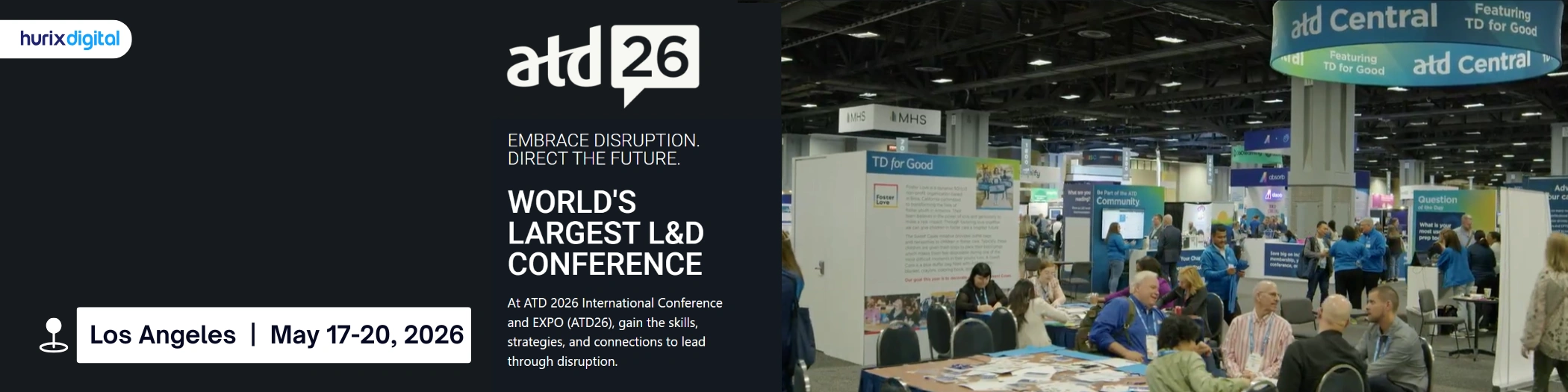
Event Preview | ATD International Conference 2026
Los Angeles is about to host the most important gathering in learning and development this year.
The L&D world is mid-shift. Not the slow, gradual kind — the kind where you look up six months later and the rules have changed. ATD26 is where 10,000+ professionals come to make sense of that shift together, and this year the agenda reflects exactly what’s keeping learning leaders up at night.
35+ sessions dedicated entirely to AI. Keynotes from Zack Kass, who helped take OpenAI’s technology to market, and Liz Wiseman, whose research on how people perform under pressure is frankly overdue for a bigger audience. 300+ exhibitors on the floor. 350+ sessions to choose from.
We’re going in with specific questions about where workforce learning is actually heading, not where the brochures say it is. And we’ll bring the real takeaways back here.
ATD 2026: What Actually Stood Out From Four Days in Los Angeles
If you’ve never been to an ATD conference, picture this: thousands of people who genuinely care about how other people learn, all crammed into one convention center, arguing passionately about things like skill taxonomies and content governance. It’s a lot. In the best way.
This year, Los Angeles hosted over 10,000 attendees across four days, and the energy was different from past years. Not just busier — more urgent. The keynotes from Zack Kass and Liz Wiseman drew packed rooms, and the conversations spilling out into the hallways afterward were just as rich as anything happening on stage. People weren’t asking “should we be doing something differently?” That debate is over. Now everyone’s asking “how do we actually pull this off?”
Here’s what kept coming up, again and again.
Learning can't keep living in its own little corner
For a long time, L&D teams have operated somewhat separately from the rest of the business. You’d have your training department over here, your operations team over there, and a vague hope that the two would somehow connect. That model is falling apart — and honestly, good riddance.
What replaced it in nearly every conversation I heard was this idea that learning needs to be woven directly into how work gets done. Not a separate module employees grudgingly complete. Not a quarterly workshop. Something that shows up at the exact moment someone needs it and actually moves the needle on performance. The metric shift was interesting too — completion rates barely came up. Leaders are now asking harder questions: did this close a real skill gap? Did it affect retention? Did it make the team measurably better?
"Reactive training" is becoming a dirty phrase
There was a noticeable shift in how people talked about workforce development this year. A few years ago, a lot of training initiatives were basically firefighting — something breaks, you build a course. That thinking is getting replaced by something more proactive.
The organizations drawing the most attention on the expo floor weren’t patching holes. They were building ahead of the curve — creating frameworks designed to grow with the business rather than scramble to catch up with it. The fragmented micro-learning pile (you know, the one where no one can find anything and nothing connects to anything else) kept getting called out as a real liability. People want coherent systems that actually hold institutional knowledge together over time.
The vendor landscape has grown up
The expo floor this year felt more sophisticated than I expected. Generic off-the-shelf content packages were almost conspicuously absent from the conversations worth having. What buyers are actually asking for now is specificity — training built for their industry, their workflows, their compliance requirements.
Vendors who could demonstrate deep expertise in a particular sector were getting a lot of attention. Healthcare, engineering, financial services — each has its own operational reality, and the days of repurposing the same content with a new logo are numbered. The procurement conversation has shifted from “what content do you have?” to “can you solve this specific problem we have?”
Digital transformation is still hard, and people are finally being honest about it
Several sessions tackled something that often gets glossed over in conference presentations: the messy, unglamorous reality of modernizing legacy systems. It’s not about buying new software. It’s about figuring out where your data lives, why it’s scattered across seventeen different places, and how you get everyone to agree on a better way forward.
The organizations making real progress seem to have figured out that content management isn’t just an IT problem — it’s a talent problem. If your training assets are buried in outdated repositories that nobody can navigate, your AI tools don’t have anything good to work with. Building a cleaner content infrastructure wasn’t a flashy topic, but it kept showing up as the unglamorous prerequisite to everything else people wanted to do.
The smartest learning systems are starting to anticipate, not just respond
This was probably the thread I found most interesting across the whole event. A handful of organizations showed examples of learning ecosystems that didn’t just serve content on demand — they surfaced it before someone knew they needed it. By connecting learning infrastructure to operational data and performance analytics, these systems could identify where skill gaps were forming and intervene before those gaps became real problems.
Connecting learners to internal subject-matter experts, surfacing the right technical documentation automatically, recommending next steps based on role and context — it sounds like a tall order, but the examples shown weren’t theoretical. Some of this is already working.
So what now?
Walking out of Los Angeles, the clearest takeaway was this: the organizations that are going to win aren’t necessarily the ones with the biggest budgets or the flashiest tools. They’re the ones building systems that actually hold together — where the learning strategy, the content infrastructure, and the technology all point in the same direction.
That’s harder than it sounds. But ATD 2026 made it clear that more companies than ever are figuring out how to do it.
If any of this resonates with challenges you’re working through, we’d love to talk. We help teams build learning ecosystems that are built to last — not just to impress at a conference. Reach out and let’s figure out what the right next step looks like for your organization.